
Pulp Fiction, 1924 · page 107 of 196
Adventure Magazine Cover — page 107: what you’re looking at
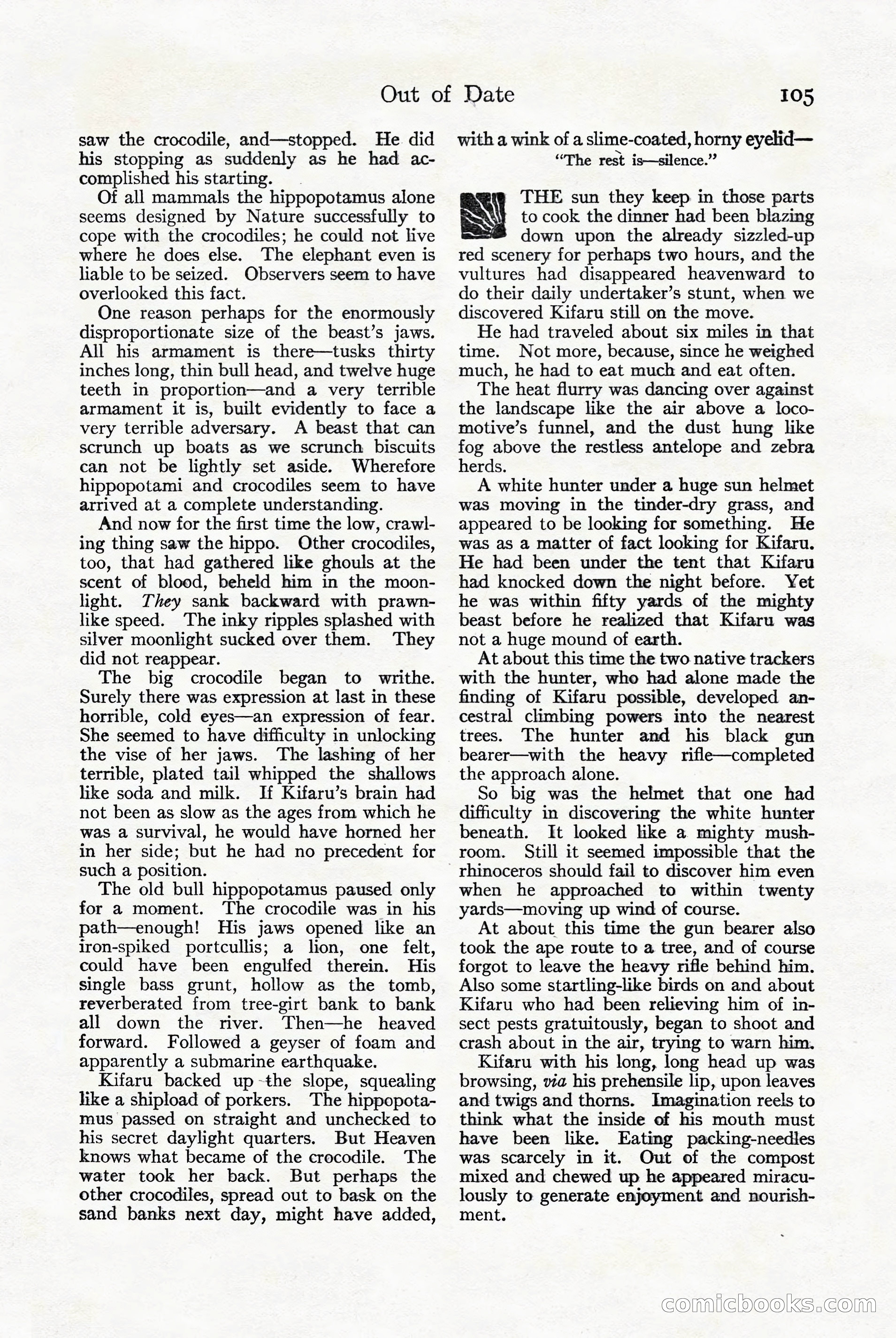
A restored page from Pulp Fiction, 1924. Page through the whole issue in the reader above.
📄 Transcribed text from this page (OCR, searchable)
Machine-transcribed from the original scan — historical spelling and the odd misread are preserved.
Out of Date saw the crocodile, and—stopped. He did his stopping as suddenly as he had ac- complished his starting. Of all mammals the hippopotamus alone seems designed by Nature successfully to cope with the crocodiles; he could not hve where he does else. The elephant even is liable to be seized. Observers seem to have overlooked this fact. One reason perhaps for the enormously disproportionate size of the beast’s jaws. All his armament is there—tusks thirty inches long, thin bull head, and twelve huge teeth in proportion—and a very terrible armament it is, built evidently to face a very terrible adversary. A beast that can scrunch up boats as we scrunch biscuits can not be lightly set aside. Wherefore hippopotami and crocodiles seem to have arrived at a complete understanding. And now for the first time the low, crawl- ing thing saw the hippo. Other crocodiles, too, that had gathered like ghouls at the scent of blood, beheld him in the moon- light. They sank backward with prawn- like speed. The inky ripples splashed with silver moonlight sucked over them. They did not reappear. The big crocodile began to writhe. Surely there was expression at last in these horrible, cold eyes—an expression of fear. She seemed to have difficulty in unlocking the vise of her jaws. The lashing of her terrible, plated tail whipped the shallows like soda and milk. If Kifaru’s brain had not been as slow as the ages from which he was a survival, he would have horned her in her side; but he had no precedent for such a position. The old bull hippopotamus paused only for a moment. The crocodile was in his path—enough! His jaws opened like an iron-spiked portcullis; a lion, one felt, could have been engulfed therein. His single bass grunt, hollow as the tomb, reverberated from tree-girt bank to bank all down the river. Then—he heaved forward. Followed a geyser of foam and apparently a submarine earthquake. Kifaru backed up-the slope, squealing like a shipload of porkers. The hippopota- mus passed on straight and unchecked to his secret daylight quarters. But Heaven knows what became of the crocodile. The water took her back. But perhaps the other crocodiles, spread out to bask on the sand banks next day, might have added, 105 with a wink of a slime-coated, horny eyelid— “The rest is—silence.” THE sun they keep in those parts NN to cook the dinner had been blazing down upon the already sizzled-up red scenery for perhaps two hours, and the vultures had disappeared heavenward to do their daily undertaker’s stunt, when we discovered Kifaru still on the move. He had traveled about six miles in that time. Not more, because, since he weighed much, he had to eat much and eat often. The heat flurry was dancing over against the landscape like the air above a loco- motive’s funnel, and the dust hung like fog above the restless antelope and zebra herds. A white hunter under a huge sun helmet was moving in the tinder-dry grass, and appeared to be looking for something. He was as a matter of fact looking for Kifaru. He had been under the tent that Kifaru had knocked down the night before. Yet he was within fifty yards of the mighty beast before he realized that Kifaru was not a huge mound of earth. At about this time the two native trackers with the hunter, who had alone made the finding of Kifaru possible, developed an- cestral climbing powers into the nearest trees. The hunter and his black gun bearer—with the heavy rifle—completed the approach alone. So big was the helmet that one had difficulty in discovering the white hunter beneath. It looked lke a mighty mush- room. Still it seemed impossible that the rhinoceros should fail to discover him even when he approached to within twenty yards—moving up wind of course. At about this time the gun bearer also took the ape route to a tree, and of course forgot to leave the heavy rifle behind him. Also some startling-like birds on and about Kifaru who had been relieving him of in- sect pests gratuitously, began to shoot and crash about in the air, trying to warn him. Kifaru with his long, long head up was browsing, va his prehensile lip, upon leaves and twigs and thorns. Imagination reels to think what the inside of his mouth must have been like. Eating packing-needles was scarcely in it. Out of the compost mixed and chewed up he appeared miracu- lously to generate enjoyment and nourish- ment. CoOmiclool (C@