
Pulp Fiction, 1924 · page 151 of 196
Adventure Magazine Cover — page 151: what you’re looking at
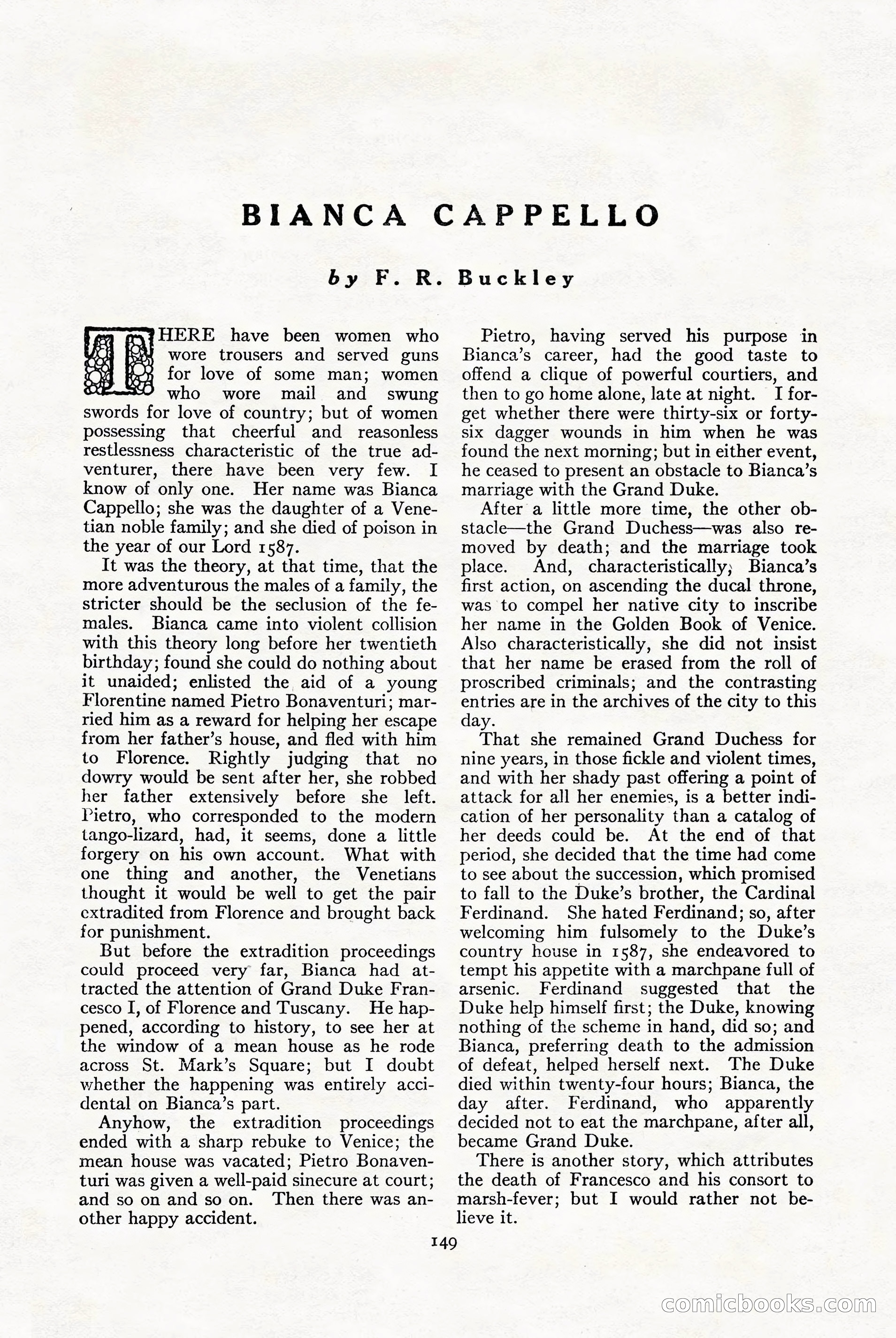
A restored page from Pulp Fiction, 1924. Page through the whole issue in the reader above.
📄 Transcribed text from this page (OCR, searchable)
Machine-transcribed from the original scan — historical spelling and the odd misread are preserved.
BIANCA CAPPELLO by F.R. ™7 HERE have been women who S84 wore trousers and served guns Bo for love of some man; women 30 who wore mail and swung swords for love of country; but of women possessing that cheerful and _ reasonless restlessness characteristic of the true ad- venturer, there have been very few. I know of only one. Her name was Bianca Cappello; she was the daughter of a Vene- tian noble family; and she died of poison in the year of our Lord 1587. It was the theory, at that time, that the more adventurous the males of a family, the stricter should be the seclusion of the fe- males. Bianca came into violent collision with this theory long before her twentieth birthday; found she could do nothing about it unaided; enlisted the aid of a young Florentine named Pietro Bonaventuri; mar- ried him as a reward for helping her escape from her father’s house, and fled with him to Florence. Rightly judging that no dowry would be sent after her, she robbed her father extensively before she left. Pietro, who corresponded to the modern tango-lizard, had, it seems, done a little forgery on his own account. What with one thing and another, the Venetians thought it would be well to get the pair extradited from Florence and brought back for punishment. But before the extradition proceedings could proceed very far, Bianca had at- tracted the attention of Grand Duke Fran- cesco I, of Florence and Tuscany. He hap- pened, according to history, to see her at the window of a mean house as he rode across St. Mark’s Square; but I doubt whether the happening was entirely acci- dental on Bianca’s part. Anyhow, the extradition proceedings ended with a sharp rebuke to Venice; the mean house was vacated; Pietro Bonaven- turi was given a well-paid sinecure at court; and so on and so on. ‘Then there was an- other happy accident. Buckley Pietro, having served his purpose in Bianca’s career, had the good taste to offend a clique of powerful courtiers, and then to go home alone, late at night. I for- get whether there were thirty-six or forty- six dagger wounds in him when he was found the next morning; but in either event, he ceased to present an obstacle to Bianca’s marriage with the Grand Duke. After a little more time, the other ob- stacle—the Grand Duchess—was also re- moved by death; and the marriage took place. And, characteristically; Bianca’s first action, on ascending the ducal throne, was to compel her native city to inscribe her name in the Golden Book of Venice. Also characteristically, she did not insist that her name be erased from the roll of proscribed criminals; and the contrasting entries are in the archives of the city to this day. That she remained Grand Duchess for nine years, in those fickle and violent times, and with her shady past offering a point of attack for all her enemies, is a better indi- cation of her personality than a catalog of her deeds could be. At the end of that period, she decided that the time had come to see about the succession, which promised to fall to the Duke’s brother, the Cardinal Ferdinand. She hated F erdinand: so, after welcoming him fulsomely to the Duke’s country house in 1587, she endeavored to tempt his appetite with a marchpane full of arsenic. Ferdinand suggested that the Duke help himself first; the Duke, knowing nothing of the scheme in hand, did so ; and Bianca, preferring death to the admission of defeat, helped herself next. The Duke died within twenty-four hours; Bianca, the day after. Ferdinand, who apparently decided not to eat the marchpane, after all, became Grand Duke. There is another story, which attributes the death of Francesco and his consort to marsh-fever; but I would rather not be- lieve it. 149 Co NOOK C@ inn