
Pulp Fiction, 1924 · page 179 of 196
Adventure Magazine Cover — page 179: what you’re looking at
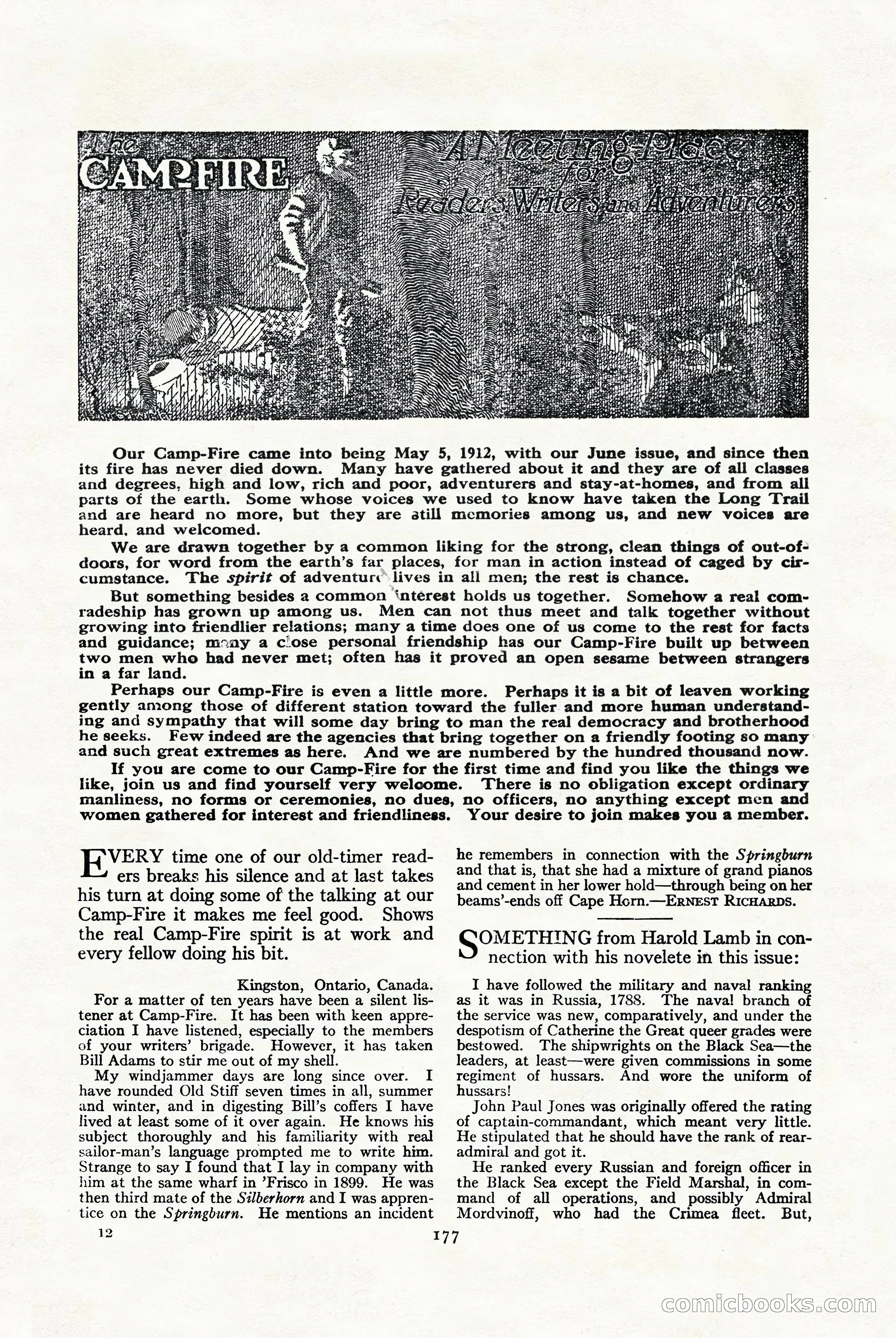
A restored page from Pulp Fiction, 1924. Page through the whole issue in the reader above.
📄 Transcribed text from this page (OCR, searchable)
Machine-transcribed from the original scan — historical spelling and the odd misread are preserved.
Our Camp-Fire came into being May 5, 1912, with our June issue, and since then its fire has never died down. Many have gathered about it and they are of all classes and degrees, high and low, rich and poor, adventurers and stay-at-homes, and from all parts of the earth. Some whose voices we used to know have taken the Long Trail and are heard no more, but they are atill memories among us, and new voices are heard, and welcomed. We are drawn together by a common liking for the strong, clean things of out-of- doors, for word from the earth’s far places, for man in action instead of caged by cir- cumstance. The spirit of adventure lives in ali men; the rest is chance. But something besides 2 common interest holds us together. Somehow a real com- radeship has grown up among us. Men can not thus meet and talk together without growing into friendlier relations; many a time does one of us come to the rest for facts and guidance; mony a close personal friendship has our Camp-Fire built up between two men who had never met; often has it proved an open sesame between strangers in a far land. Perhaps our Camp-Fire is even a little more. Perhaps it is a bit of leaven working gently among those of different station toward the fuller and more human understand- ing and sympathy that will some day bring to man the real democracy and brotherhood he seeks. and such great extremes as here. Few indeed are the agencies that bring together on a friendly footing so many And we are numbered by the hundred thousand now. If you are come to our Camp-Fire for the first time and find you like the things we like, join us and find yourself very welcome. There is no obligation except ordinary manliness, no forms or ceremonies, no dues, no officers, no anything except men and women gathered for interest and friendliness. VERY time one of our old-timer read- ers breaks his silence and at last takes his turn at doing some of the talking at our Camp-Fire it makes me feel good. Shows the real Camp-Fire spirit is at work and every fellow doing his bit. Kingston, Ontario, Canada. For a matter of ten years have been a silent lis- tener at Camp-Fire. It has been with keen appre- ciation I have listened, especially to the members of your writers’ brigade. However, it has taken Bill Adams to stir me out of my shell. My windjammer days are long since over. I have rounded Old Stiff seven times in all, summer and winter, and in digesting Bill’s coffers I have lived at least some of it over again. He knows his subject thoroughly and his familiarity with real sailor-man’s language prompted me to write him. Strange to say I found that I lay in company with him at the same wharf in ’Frisco in 1899. He was then third mate of the Szlberhorn and I was appren- tice on the Springburn. He mentions an incident Your desire to join makes you a member. he remembers in connection with the Springburn and that is, that she had a mixture of grand pianos and cement in her lower hold—through being on her beams’-ends off Cape Horn.—ERNEST RICHARDS. OMETHING from Harold Lamb in con- nection with his novelete in this issue: I have followed the military and naval ranking as it was in Russia, 1788. The naval! branch of the service was new, comparatively, and under the despotism of Catherine the Great queer grades were bestowed. The shipwrights on the Black Sea—the leaders, at least—were given commissions in some regiment of hussars. And wore the uniform of hussars! John Paul Jones was originally offered the rating of captain-commandant, which meant very little. He stipulated that he should have the rank of rear- admiral and got it. He ranked every Russian and foreign officer in the Black Sea except the Field Marshal, in com- mand of all operations, and possibly Admiral Mordvinoff, who had the Crimea fleet. But, 12 177 COnliclbooo (C@