
Pulp Fiction, 1924 · page 182 of 196
Adventure Magazine Cover — page 182: what you’re looking at
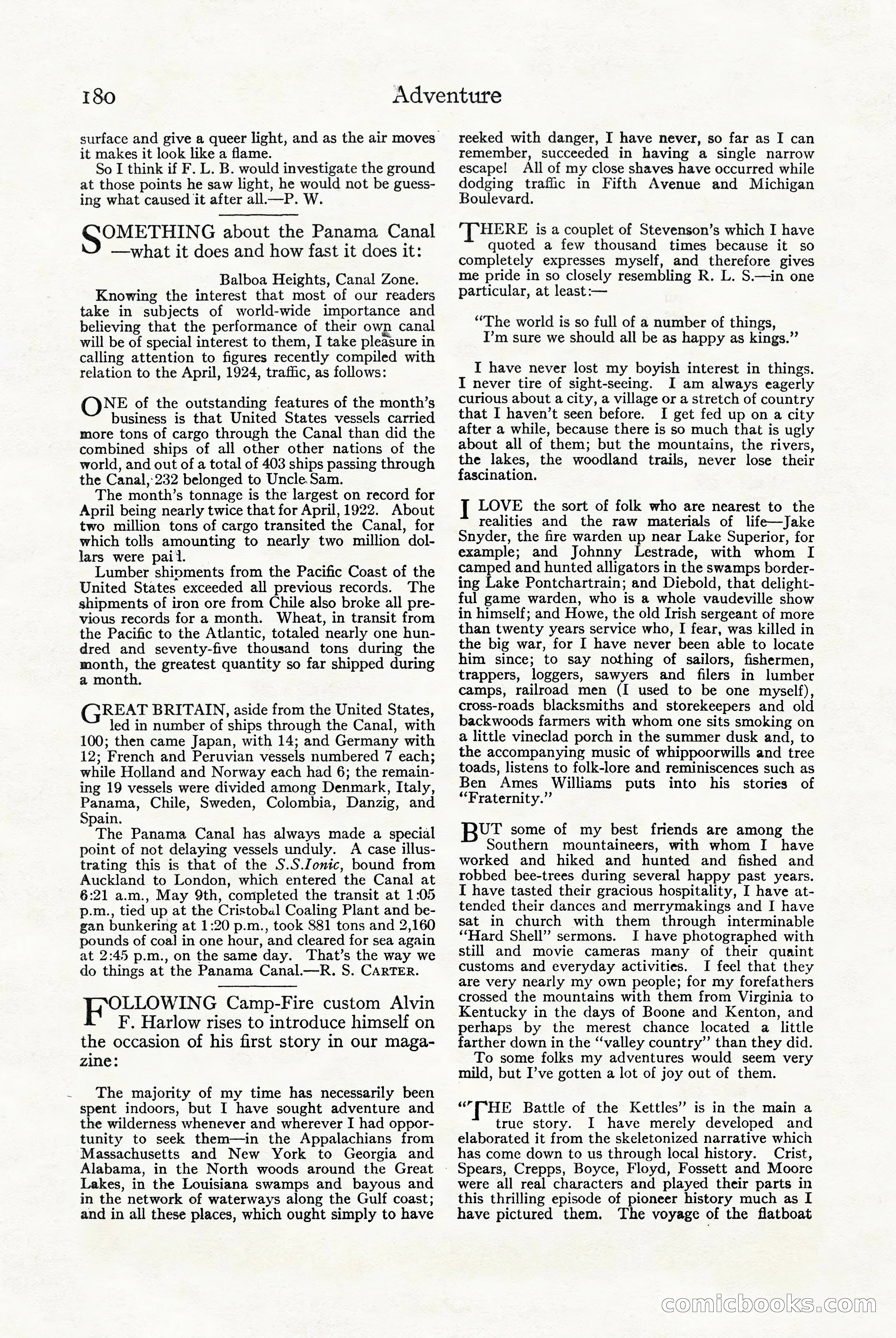
A restored page from Pulp Fiction, 1924. Page through the whole issue in the reader above.
📄 Transcribed text from this page (OCR, searchable)
Machine-transcribed from the original scan — historical spelling and the odd misread are preserved.
! 180 surface and give a queer light, and as the air moves it makes it look like a flame. So I think if F. L. B. would investigate the ground at those points he saw light, he would not be guess- ing what caused it after all—P. W. OMETHING about the Panama Canal —what it does and how fast it does it: Balboa Heights, Canal Zone. Knowing the interest that most of our readers take in subjects of world-wide importance and believing that the performance of their own canal will be of special interest to them, I take pleasure in calling attention to figures recently compiled with relation to the April, 1924, traffic, as follows: NE of the outstanding features of the month’s business is that United States vessels carried more tons of cargo through the Canal than did the combined ships of all other other nations of the world, and out of a total of 403 ships passing through the Canal,-232 belonged to Uncle.Sam. The month’s tonnage is the largest on record for April being nearly twice that for April, 1922. About two million tons of cargo transited the Canal, for which tolls amounting to nearly two million dol- lars were pail. Lumber shipments from the Pacific Coast of the United States exceeded all previous records. The shipments of iron ore from Chile also broke all pre- vious records for a month. Wheat, in transit from the Pacific to the Atlantic, totaled ‘nearly one hun- dred and seventy-five thousand tons during the month, the greatest quantity so far shipped during a month. (GREAT BRITAIN, aside from the United States, led in number of ships through the Canal, with 100; then came Japan, with 14; and Germany with 12; French and Peruvian vessels numbered 7 each; while Holland and Norway each had 6; the remain- ing 19 vessels were divided among Denmark, Italy, Panama, Chile, Sweden, Colombia, Danzig, and Spain. The Panama Canal has always made a special point of not delaying vessels unduly. A case illus- trating this is that of the S.S.Jonic, bound from Auckland to London, which entered the Canal at 6:21 a.m., May 9th, completed the transit at 1:05 p.m., tied up at the Cristobal Coaling Plant and be- gan bunkering at 1:20 p.m., took 881 tons and 2,160 pounds of coal] in one hour, and cleared for sea again at 2:45 p.m., on the same day. That’s the way we do things at the Panama Canal.—R. S. CARTER. Eee NG Camp-Fire custom Alvin F.. Harlow rises to introduce himself on the occasion of his first story in our maga- zine: The majority of my time has necessarily been spent indoors, but I have sought adventure and the wilderness whenever and wherever I had oppor- tunity to seek them—in the Appalachians from Massachusetts and New York to Georgia and Alabama, in the North woods around the Great Lakes, in the Louisiana swamps and bayous and in the network of waterways along the Gulf coast; and in all these places, which ought simply to have Adventure reeked with danger, I have never, so far as I can remember, succeeded in having a single narrow escape! All of my close shaves have occurred while dodging traffic in Fifth Avenue and Michigan Boulevard. HERE is a couplet of Stevenson’s which I have quoted a few thousand times because it so completely expresses myself, and therefore gives me pride in so closely resembling R. L. S.—in one particular, at least :-— “The world is so full of a number of things, I’m sure we should all be as happy as kings.” I have never lost my boyish interest in things. I never tire of sight-seeing. I am always eagerly curious about a city, a village or a stretch of country that I haven’t seen before. I get fed up on a city after a while, because there is so much that is ugly about all of them; but the mountains, the rivers, the lakes, the woodland trails, never lose their fascination. LOVE the sort of folk who are nearest to the realities and the raw materials of life—Jake Snyder, the fire warden up near Lake Superior, for example; and Johnny Lestrade, with whom I camped and hunted alligators in the swamps border- ing Lake Pontchartrain; and Diebold, that delight- ful game warden, who is a whole vaudeville show in himself; and Howe, the old Irish sergeant of more than twenty years service who, I fear, was killed in the big war, for I have never been able to locate him since; to say nothing of sailors, fishermen, trappers, loggers, sawyers and filers in lumber camps, railroad men (I used to be one myself), cross-roads blacksmiths and storekeepers and old backwoods farmers with whom one sits smoking on a little vineclad porch in the summer dusk and, to the accompanying music of whippoorwills and tree toads, listens to folk-lore and reminiscences such as Ben Ames Williams puts into his stories of “Fraternity.” UT some of my best friends are among the Southern mountaineers, with whom I have worked and hiked and hunted and fished and robbed bee-trees during several happy past years. [ have tasted their gracious hospitality, I have at- tended their dances and merrymakings and I have sat in church with them through interminable ‘Hard Shell” sermons. I have photographed with still and movie cameras many of their quaint customs and everyday activities. I feel that they are very nearly my own people; for my forefathers crossed the mountains with them from Virginia to Kentucky in the days of Boone and Kenton, and perhaps by the merest chance located a little farther down in the “‘valley country” than they did. To some folks my adventures would seem very mild, but I’ve gotten a lot of joy out of them. “PHe Battle of the Kettles” is in the main a true story. I have merely developed and elaborated it from the skeletonized narrative which has come down to us through local history. Crist, - Spears, Crepps, Boyce, Floyd, Fossett and Moore were all real characters and played their parts in this thrilling episode of pioneer history much as I have pictured them. The voyage of the flatboat TOO C@