
Pulp Fiction, 1924 · page 190 of 196
Adventure Magazine Cover — page 190: what you’re looking at
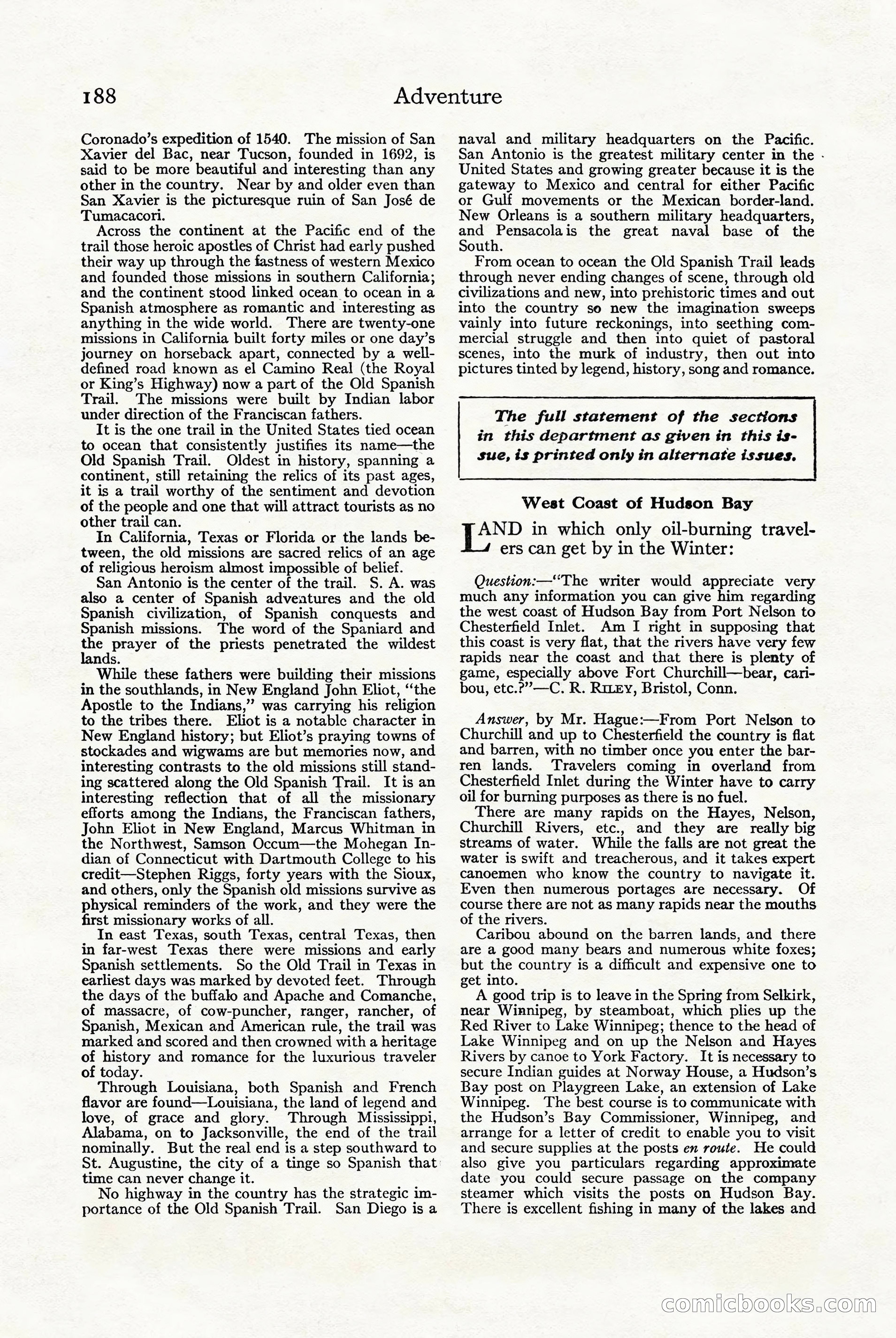
A restored page from Pulp Fiction, 1924. Page through the whole issue in the reader above.
📄 Transcribed text from this page (OCR, searchable)
Machine-transcribed from the original scan — historical spelling and the odd misread are preserved.
188 Coronado’s expedition of 1540. The mission of San Xavier del Bac, near Tucson, founded in 1692, is said to be more beautiful and interesting than any other in the country. Near by and older even than San Xavier is the picturesque ruin of San José de Tumacacori. Across the continent at the Pacific end of the trail those heroic apostles of Christ had early pushed their way up through the fastness of western Mexico and founded those missions in southern California; and the continent stood linked ocean to ocean in a Spanish atmosphere as romantic and interesting as anything in the wide world. There are twenty-one missions in California built forty miles or one day’s journey on horseback apart, connected by a well- defined road known as el Camino Real (the Royal or King’s Highway) now a part of the Old Spanish Trail. The missions were built by Indian labor under direction of the Franciscan fathers. It is the one trail in the United States tied ocean to ocean that consistently justifies its name—the Old Spanish Trail. Oldest in history, spanning a continent, still retaining the relics of its past ages, it is a trail worthy of the sentiment and devotion of the people and one that will attract tourists as no other trail can. : In California, Texas or Florida or the lands be- tween, the old missions are sacred relics of an age of religious heroism almost impossible of belief. San Antonio is the center of the trail. S. A. was also a center of Spanish adventures and the old Spanish civilization, of Spanish conquests and Spanish missions. The word of the Spaniard and adel of the priests penetrated the wildest S. While these fathers were building their missions in the southlands, in New England John Eliot, ‘‘the Apostle to the Indians,”’ was carrying his religion to the tribes there. Eliot is a notable character in New England history; but Eliot’s praying towns of stockades and wigwams are but memories now, and interesting contrasts to the old missions still stand- ing scattered along the Old Spanish Trail. It is an interesting reflection that of all the missionary efforts among the Indians, the Franciscan fathers, John Eliot in New England, Marcus Whitman in the Northwest, Samson Occum—the Mohegan In- dian of Connecticut with Dartmouth College to his credit—Stephen Riggs, forty years with the Sioux, and others, only the Spanish old missions survive as physical reminders of the work, and they were the first missionary works of all. In east Texas, south Texas, central Texas, then in far-west Texas there were missions and early Spanish settlements. So the Old Trail in Texas in earliest days was marked by devoted feet. Through the days of the buffalo and Apache and Comanche, of massacre, of cow-puncher, ranger, rancher, of Spanish, Mexican and American rule, the trail was marked and scored and then crowned with a heritage of history and romance for the luxurious traveler of today. Through Louisiana, both Spanish and French flavor are found—Louisiana, the land of legend and love, of grace and glory. Through Mississippi, Alabama, on to Jacksonville, the end of the trail nominally. But the real end is a step southward to St. Augustine, the city of a tinge so Spanish that: time can never change it. No highway in the country has the strategic im- portance of the Old Spanish Trail. San Diego is a Adventure naval and military headquarters on the Pacific. San Antonio is the greatest military center in the - United States and growing greater because it is the gateway to Mexico and central for either Pacific or Gulf movements or the Mexican border-land. New Orleans is a southern military headquarters, and Pensacolais the great naval base of the South. From ocean to ocean the Old Spanish Trail leads through never ending changes of scene, through old civilizations and new, into prehistoric times and out into the country so new the imagination sweeps vainly into future reckonings, into seething com- mercial struggle and then into quiet of pastoral scenes, into the murk of industry, then out into pictures tinted by legend, history, song and romance. The full statemnent of the sections in this department as givenin this is- sue, is printed only in alternate issues. West Coast of Hudson Bay oe in which only oil-burning travel- ers can get by in the Winter: Question:—The writer would appreciate very much any information you can give him regarding the west coast of Hudson Bay from Port Nelson to Chesterfield Inlet. Am I right in supposing that this coast is very flat, that the rivers have very few rapids near the coast and that there is plenty of game, especially above Fort Churchill—bear, cari- bou, etc.?”—C. R. RiEy, Bristol, Conn. Answer, by Mr. Hague:—From Port Nelson to Churchill and up to Chesterfield the country is flat and barren, with no timber once you enter the bar- ren lands. Travelers coming in overland from Chesterfield Inlet during the Winter have to carry oil for burning purposes as there is no fuel. There are many rapids on the Hayes, Nelson, Churchill Rivers, etc., and they are really big streams of water. While the falls are not great the water is swift and treacherous, and it takes expert canoemen who know the country to navigate it. Even then numerous portages are necessary. Of course there are not as many rapids near the mouths of the rivers. Caribou abound on the barren lands, and there are a good many bears and numerous white foxes; but the country is a difficult and expensive one to get into. A good trip is to leave in the Spring from Selkirk, near Winnipeg, by steamboat, which plies up the Red River to Lake Winnipeg; thence to the head of Lake Winnipeg and on up the Nelson and Hayes Rivers by canoe to York Factory. It is necessary to secure Indian guides at Norway House, a Hudson’s Bay post on Playgreen Lake, an extension of Lake Winnipeg. The best course is to communicate with the Hudson’s Bay Commissioner, Winnipeg, and arrange for a letter of credit to enable you to visit and secure supplies at the posts ex route. He could also give you particulars regarding approximate date you could secure passage on the company steamer which visits the posts on Hudson Bay. There is excellent fishing in many of the lakes and DOO C@