
Pulp Fiction, 1924 · page 67 of 196
Adventure Magazine Cover — page 67: what you’re looking at
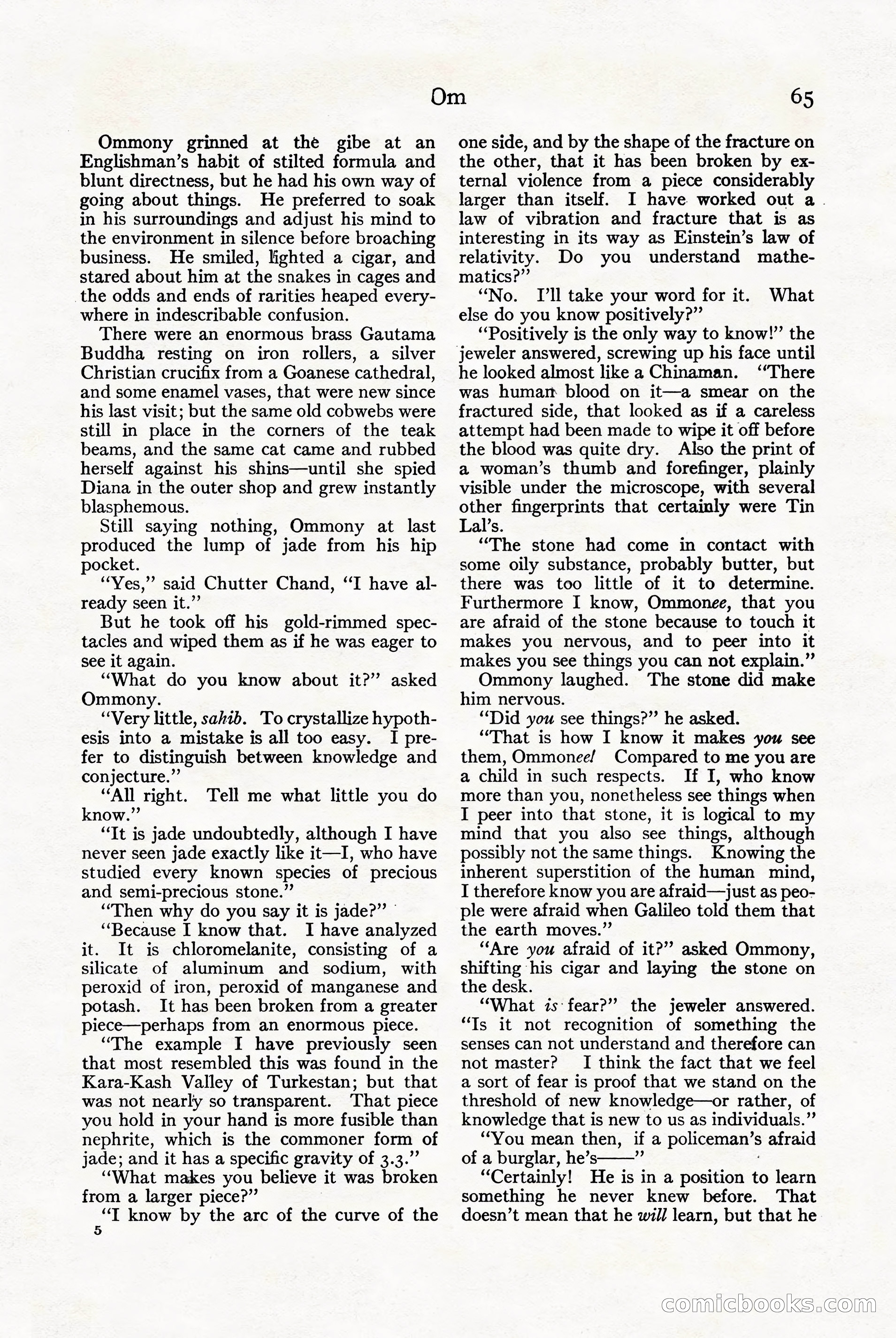
A restored page from Pulp Fiction, 1924. Page through the whole issue in the reader above.
📄 Transcribed text from this page (OCR, searchable)
Machine-transcribed from the original scan — historical spelling and the odd misread are preserved.
Om Ommony grinned at the gibe at an Englishman’s habit of stilted formula and blunt directness, but he had his own way of going about things. He preferred to soak in his surroundings and adjust his mind to the environment in silence before broaching business. He smiled, lighted a cigar, and stared about him at the snakes in cages and the odds and ends of rarities heaped every- where in indescribable confusion. There were an enormous brass Gautama Buddha resting on iron rollers, a silver Christian crucifix from a Goanese cathedral, and some enamel vases, that were new since his last visit; but the same old cobwebs were still in place in the corners of the teak beams, and the same cat came and rubbed herself against his shins—until she spied Diana in the outer shop and grew instantly blasphemous. Still saying nothing, Ommony at last produced the lump of jade from his hip pocket. “Yes,” said Chutter Chand, “I have al- ready seen it.”’ But he took off his gold-rimmed spec- tacles and wiped them as if he was eager to see it again. “What do you know about it?” asked Ommony. “Very little, sahib. To crystallize hypoth- esis into a mistake is all too easy. I pre- fer to distinguish between knowledge and conjecture.”’ “All right. know.” “It is jade undoubtedly, although I have never seen jade exactly like it—I, who have studied every known species of precious and semi-precious stone.”’ “‘Then why do you say it is jade?” ° “Because I know that. I have analyzed it. It is chloromelanite, consisting of a silicate of aluminum and sodium, with peroxid of iron, peroxid of manganese and potash. It has been broken from a greater piece—perhaps from an enormous piece. “The example I have previously seen that most resembled this was found in the Kara-Kash Valley of Turkestan; but that was not nearly so transparent. That piece you hold in your hand is more fusible than nephrite, which is the commoner form of jade; and it has a specific gravity of 3.3.” ‘‘What makes you believe it was broken from a larger piece?”’ | ee know by the arc of the curve of the Tell me what little you do 05 one side, and by the shape of the fracture on the other, that it has been broken by ex- ternal violence from a piece considerably larger than itself. I have worked out a. law of vibration and fracture that is as interesting in its way as Einstein’s law of relativity. Do you understand mathe- matics?” “No. Ill take your word for it. else do you know positively?” “Positively is the only way to know!”’ the What jeweler answered, screwing up his face until he looked almost like a Chinaman. ‘There was humarm blood on it—a smear on the fractured side, that looked as if a careless attempt had been made to wipe it off before the blood was quite dry. Also the print of a woman’s thumb and forefinger, plainly visible under the microscope, with several other fingerprints that certainly were Tin Lal’s. “The stone had come in contact with some oily substance, probably butter, but there was too little of it to determine. Furthermore I know, Ommonee, that you are afraid of the stone because to touch it makes you nervous, and to peer into it makes you see things you can not explain.” Ommony laughed. The stone did make him nervous. “Did you see things?” he asked. “That is how I know it makes you see them, Ommonee/ Compared to me you are a child in such respects. If I, who know more than you, nonetheless see things when I peer into that stone, it is logical to my mind that you also see things, although possibly not the same things. Knowing the inherent superstition of the human mind, I therefore know you are afraid—just as peo- ple were afraid when Galileo told them that the earth moves.” “‘Are you afraid of it?” asked Ommony, shifting his cigar and laying the stone on the desk. “‘What is fearr” the jeweler answered. “Is it not recognition of something the senses can not understand and therefore can not master? I think the fact that we feel a sort of fear is proof that we stand on the threshold of new knowledge—or rather, of knowledge that is new to us as individuals.” ‘““You mean then, if a policeman’s afraid of a burglar, he’s a “Certainly! He is in a position to learn something he never knew before. That doesn’t mean that he will learn, but that he MICLOOOK C©@ in