
Pulp Fiction, 1924 · page 69 of 196
Adventure Magazine Cover — page 69: what you’re looking at
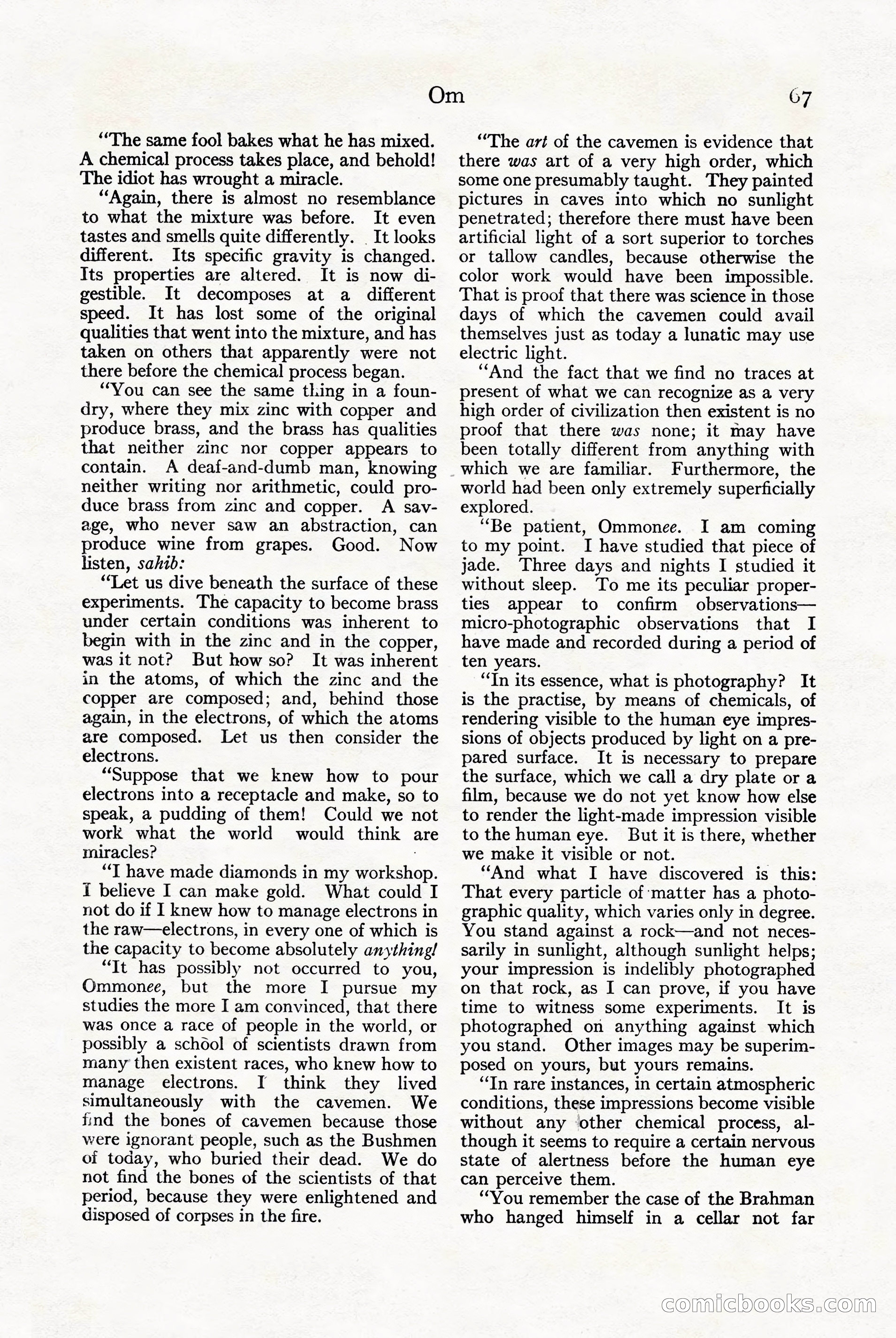
A restored page from Pulp Fiction, 1924. Page through the whole issue in the reader above.
📄 Transcribed text from this page (OCR, searchable)
Machine-transcribed from the original scan — historical spelling and the odd misread are preserved.
Om “‘The same fool bakes what he has mixed. A chemical process takes place, and behold! The idiot has wrought a miracle. “Again, there is almost no resemblance to what the mixture was before. It even tastes and smells quite differently. _ It looks different. Its specific gravity is changed. Its properties are altered. It is now di- gestible. It decomposes at a_ different speed. It has lost some of the original qualities that went into the mixture, and has taken on others that apparently were not there before the chemical process began. “You can see the same thing in a foun- dry, where they mix zinc with copper and produce brass, and the brass has qualities that neither zinc nor copper appears to contain. A deaf-and-dumb man, knowing neither writing nor arithmetic, could pro- duce brass from zinc and copper. A sav- age, who never saw an abstraction, can produce wine from grapes. Good. Now listen, sahib: “Let us dive beneath the surface of these experiments. The capacity to become brass under certain conditions was inherent to begin with in the zinc and in the copper, was it not? But how so? It was inherent in the atoms, of which the zinc and the copper are composed; and, behind those again, in the electrons, of which the atoms are composed. Let us then consider the electrons. “Suppose that we knew how to pour electrons into a receptacle and make, so to speak, a pudding of them! Could we not work what the world would think are miracles? : “IT have made diamonds in my workshop. I believe I can make gold. What could I not do if I knew how to manage electrons in the raw—electrons, in every one of which is the capacity to become absolutely anything! “It has possibly not occurred to you, Ommonee, but the more I pursue my studies the more I am convinced, that there was once a race of people in the world, or possibly a school of scientists drawn from many then existent races, who knew how to manage electrons. I think they lived simultaneously with the cavemen. We iind the bones of cavemen because those were ignorant people, such as the Bushmen of today, who buried their dead. We do not find the bones of the scientists of that period, because they were enlightened and disposed of corpses in the fire. 67 “The art of the cavemen is evidence that there was art of a very high order, which some one presumably taught. They painted pictures in caves into which no sunlight penetrated; therefore there must have been artificial light of a sort superior to torches or tallow candles, because otherwise the color work would have been impossible. That is proof that there was science in those days of which the cavemen could avail themselves just as today a lunatic may use electric light. “And the fact that we find no traces at present of what we can recognize as a very high order of civilization then existent is no proof that there was none; it may have been totally different from anything with which we are familiar. Furthermore, the world had been only extremely superficially explored. “Be patient, Ommonee. I am coming to my point. I have studied that piece of jade. Three days and nights I studied it without sleep. To me its peculiar proper- ties appear to confirm observations— micro-photographic observations that I have made and recorded during a period of ten years. “In its essence, what is photography? It is the practise, by means of chemicals, of rendering visible to the human eye impres- sions of objects produced by light on a pre- pared surface. It is necessary to prepare the surface, which we call a dry plate or a film, because we do not yet know how else to render the light-made impression visible to the human eye. But it is there, whether we make it visible or not. , “And what I have discovered is this: That every particle of ‘matter has a photo- graphic quality, which varies only in degree. You stand against a rock—and not neces- sarily in sunlight, although sunlight helps; your impression is indelibly photographed on that rock, as I can prove, if you have time to witness some experiments. It is photographed on anything against which you stand. Other images may be superim- posed on yours, but yours remains. “In rare instances, in certain atmospheric conditions, these impressions become visible without any other chemical process, al- though it seems to require a certain nervous state of alertness before the human eye can perceive them. “You remember the case of the Brahman who hanged himself in a cellar not far DOO C© inn