
Pulp Fiction, 1924 · page 72 of 196
Adventure Magazine Cover — page 72: what you’re looking at
A restored page from Pulp Fiction, 1924. Page through the whole issue in the reader above.
📄 Transcribed text from this page (OCR, searchable)
Machine-transcribed from the original scan — historical spelling and the odd misread are preserved.
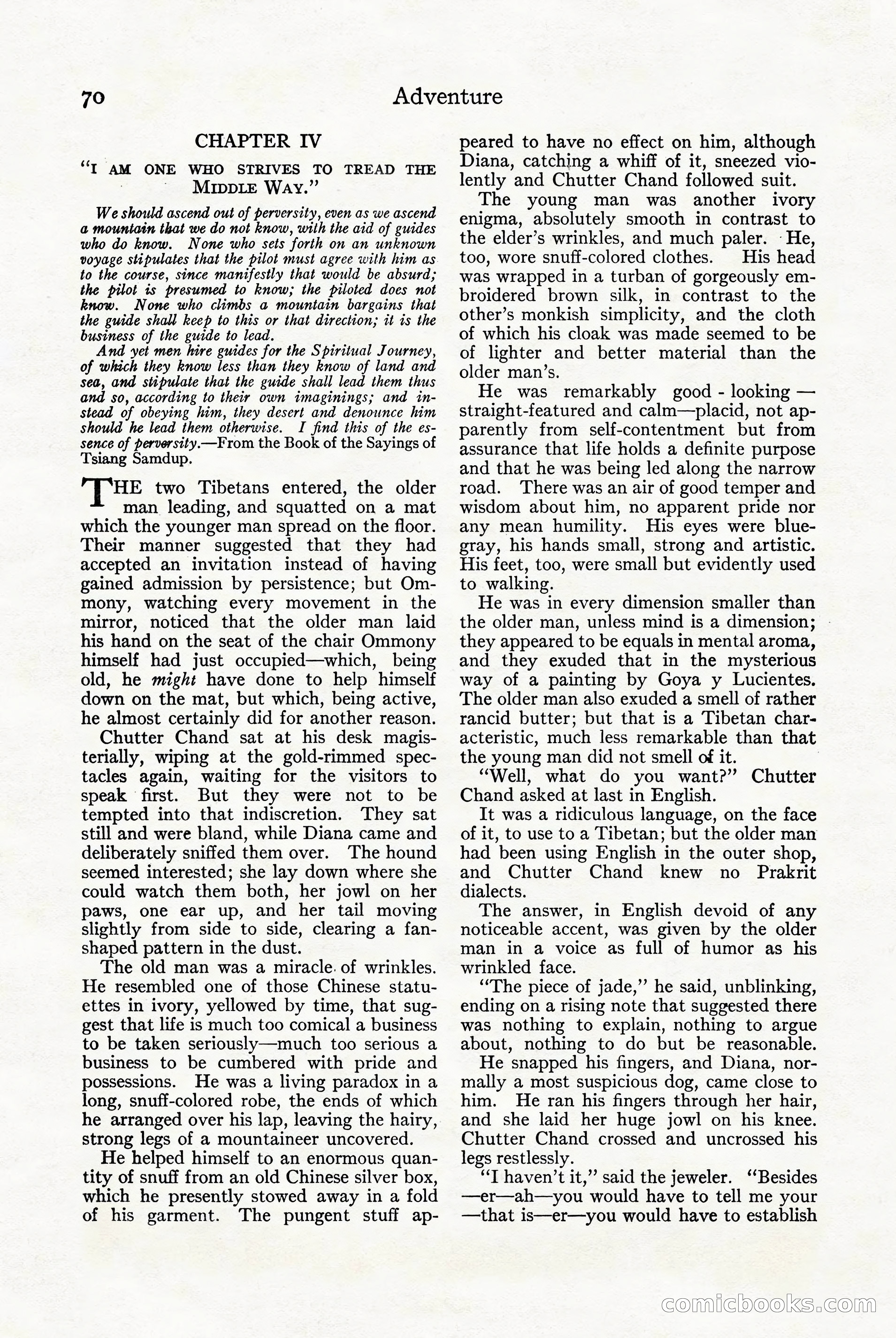
7O CHAPTER IV WHO STRIVES TO TREAD THE MIDDLE Way.” We should ascend out of perversity, even as we ascend a mountain that we do not know, with the aid of guides who do know. None who sets forth on an unknown “T AM ONE voyage stipulates that the pilot must agree with him as. to the course, since manifestly that would be absurd; the pilot is presumed to know, the piloted does not know. None who climbs a mountain bargains that the guide shall keep to this or that direction; it is the business of the guide to lead. And yet men hire guides for the Spiritual Journey, of which they know less than they know of land and sea, and stipulate that the guide shall lead them thus and so, according to their own imaginings; and in- stead of obeying him, they desert and denounce him should he lead them otherwise. I find this of the es- sence of perversity.—F rom the Book of the Sayings of Tsiang Samdup. HE two Tibetans entered, the older man leading, and squatted on a mat which the younger man spread on the floor. Their manner suggested that they had accepted an invitation instead of having gained admission by persistence; but Om- mony, watching every movement in the mirror, noticed that the older man laid his hand on the seat of the chair Ommony himself had just occupied—which, being old, he might have done to help himself down on the mat, but which, being active, he almost certainly did for another reason. Chutter Chand sat at his desk magis- terially, wiping at the gold-rimmed spec- tacles again, waiting for the visitors to speak first. But they were not to be tempted into that indiscretion. They sat still and were bland, while Diana came and deliberately sniffed them over. The hound seemed interested; she lay down where she could watch them both, her jowl on her paws, one ear up, and her tail moving slightly from side to side, clearing a fan- shaped pattern in the dust. The old man was a miracle. of wrinkles. He resembled one of those Chinese statu- ettes in ivory, yellowed by time, that sug- gest that life is much too comical a business to be taken seriously—much too serious a business to be cumbered with pride and possessions. He was a living paradox in a long, snuff-colored robe, the ends of which he arranged over his lap, leaving the hairy, strong legs of a mountaineer uncovered. He helped himself to an enormous quan- tity of snuff from an old Chinese silver box, which he presently stowed away in a fold of his garment. The pungent stuff ap- Adventure peared to have no effect on him, although Diana, catching a whiff of it, sneezed vio- lently and Chutter Chand followed suit. The young man was another ivory enigma, absolutely smooth in contrast to the elder’s wrinkles, and much paler. - He, too, wore snuff-colored clothes. His head was wrapped in a turban of gorgeously em- broidered brown silk, in contrast to the other’s monkish simplicity, and the cloth of which his cloak was made seemed to be of lighter and better material than the older man’s. He was remarkably good - looking — straight-featured and calm—placid, not ap- parently from self-contentment but from assurance that life holds a definite purpose and that he was being led along the narrow road. ‘There was an air of good temper and wisdom about him, no apparent pride nor any mean humility. His eyes were blue- gray, his hands small, strong and artistic. His feet, too, were small but evidently used to walking. He was in every dimension smaller than the older man, unless mind is a dimension; - they appeared to be equals in mental aroma, and they exuded that in the mysterious way of a painting by Goya y Lucientes. The older man also exuded a smell of rather rancid butter; but that is a Tibetan char- acteristic, much less remarkable than that the young man did not smell of it. “Well, what do you want?” Chutter Chand asked at last in English. It was a ridiculous language, on the face of it, to use to a Tibetan; but the older man had been using English in the outer shop, and Chutter Chand knew no Prakrit dialects. The answer, in English devoid of any noticeable accent, was given by the older man in a voice as full of humor as his wrinkled face. ‘“‘The piece of jade,” he said, unblinking, ending on a rising note that suggested there was nothing to explain, nothing to argue about, nothing to do but be reasonable. He snapped his fingers, and Diana, nor- mally a most suspicious dog, came close to him. He ran his fingers through her hair, and she laid her huge jowl on his knee. Chutter Chand crossed and uncrossed his legs restlessly. “T haven’t it,” said the jeweler. ‘Besides —er—ah—you would have to tell me your —that is—er—you would have to establish DOO C@