
Pulp Fiction, 1924 · page 9 of 196
Adventure Magazine Cover — page 9: what you’re looking at
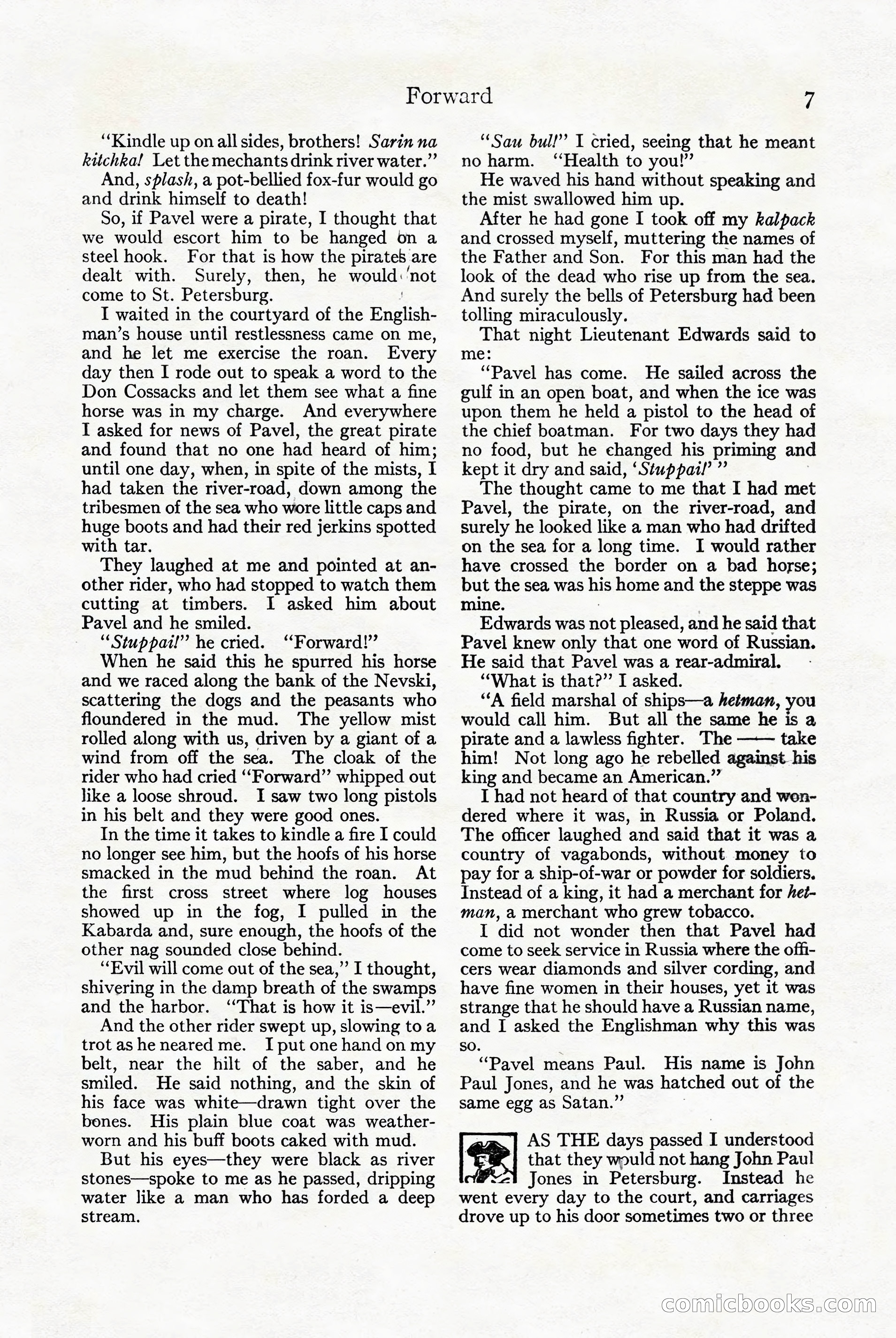
A restored page from Pulp Fiction, 1924. Page through the whole issue in the reader above.
📄 Transcribed text from this page (OCR, searchable)
Machine-transcribed from the original scan — historical spelling and the odd misread are preserved.
Forward 7 “Kindle up on all sides, brothers! Sarin na kitchka! Let the mechants drink river water.”’ And, splash, a pot-bellied fox-fur would go and drink himself to death! So, if Pavel were a pirate, I thought that we would escort him to be hanged on a steel hook. For that is how the pirate’ are dealt with. Surely, then, he would. ‘not come to St. Petersburg. I waited i in the courtyard of the Paclist: man’s house until restlessness came on me, and he let me exercise the roan. Every day then I rode out to speak a word to the Don Cossacks and let them see what a fine horse was in my charge. And everywhere I asked for news of Pavel, the great pirate and found that no one had heard of him; until one day, when, in spite of the mists, I had taken the river-road, down among the tribesmen of the sea who wore little caps and huge boots and had their red jerkins spotted with tar. They laughed at me and pointed at an- other rider, who had stopped to watch them cutting at timbers. I asked him about Pavel and he smiled. “Stuppail’”’ he cried. ‘Forward!’ When he said this he spurred his horse and we raced along the bank of the Nevski, scattering the dogs and the peasants who floundered in the mud. The yellow mist rolled along with us, driven by a giant of a wind from off the sea. The cloak of the rider who had cried “Forward” whipped out like a loose shroud. I saw two long pistols in his belt and they were good ones. In the time it takes to kindle a fire I could no longer see him, but the hoofs of his horse smacked in the mud behind the roan. At the first cross street where log houses showed up in the fog, I pulled in the Kabarda and, sure enough, the hoofs of the other nag sounded close behind. ‘Evil will come out of the sea,’’ I thought, shivering in the damp breath of the swamps and the harbor. ‘That is how it is—evil.”’ And the other rider swept up, slowing to a trotas he neared me. I put one hand on my belt, near the hilt of the saber, and he smiled. He said nothing, and the skin of his face was white—drawn tight over the bones. His plain blue coat was weather- worn and his buff boots caked with mud. But his eyes—they were black as river stones—spoke to me as he passed, dripping water like a man who has forded a deep stream. ‘Sau bull’ I cried, seeing that he meant no harm. “Health to you!” He waved his hand without speaking and the mist swallowed him up. After he had gone I took off my kalpack and crossed myself, muttering the names of the Father and Son. For this man had the look of the dead who rise up from the sea. And surely the bells of Petersburg had been tolling miraculously. That night Lieutenant Edwards said to me: ‘Pavel has come. He sailed across the gulf in an open boat, and when the ice was upon them he held a pistol to the head of the chief boatman. For two days they had no food, but he changed his priming and kept it dry and said, ‘Stuppail’ ” The thought came to me that I had met Pavel, the pirate, on the river-road, and surely he looked like a man who had drifted on the sea for a long time. I would rather have crossed the border on a bad horse; but the sea was ae home and the steppe was mine. Edwards was not pleased, and he said that Pavel knew only that one word of Russian. He said that Pavel was a rear-admiral. ‘“‘What is that?” I asked. “A field marshal of ships—a hetman, you would call him. But all the same he is a pirate and a lawless fighter. The —— take him! Not long ago he rebelled against. his king and became an American.” I had not heard of that country and won- dered where it was, in Russia or Poland. The officer laughed and said that it was a country of vagabonds, without money to pay for a ship-of-war or powder for soldiers. Instead of a king, it had a merchant for het- man, a merchant who grew tobacco. I did not wonder then that Pavel had come to seek service in Russia where the offi- cers wear diamonds and silver cording, and have fine women in their houses, yet it was strange that he should have a Russian name, and I asked the Englishman why this was so. “Pavel means Paul. His name is John Paul Jones, and he was hatched out of the same egg as Satan.” ) AS THE days passed I understood : | that they would not hang John Paul <2} Jones in Petersburg. Instead he went every day to the court, and carriages drove up to his door sometimes two or three DOOK (C© in