
Pulp Fiction, 1924 · page 141 of 204
Adventure Magazine Cover, October 30, 1924 — page 141: what you’re looking at
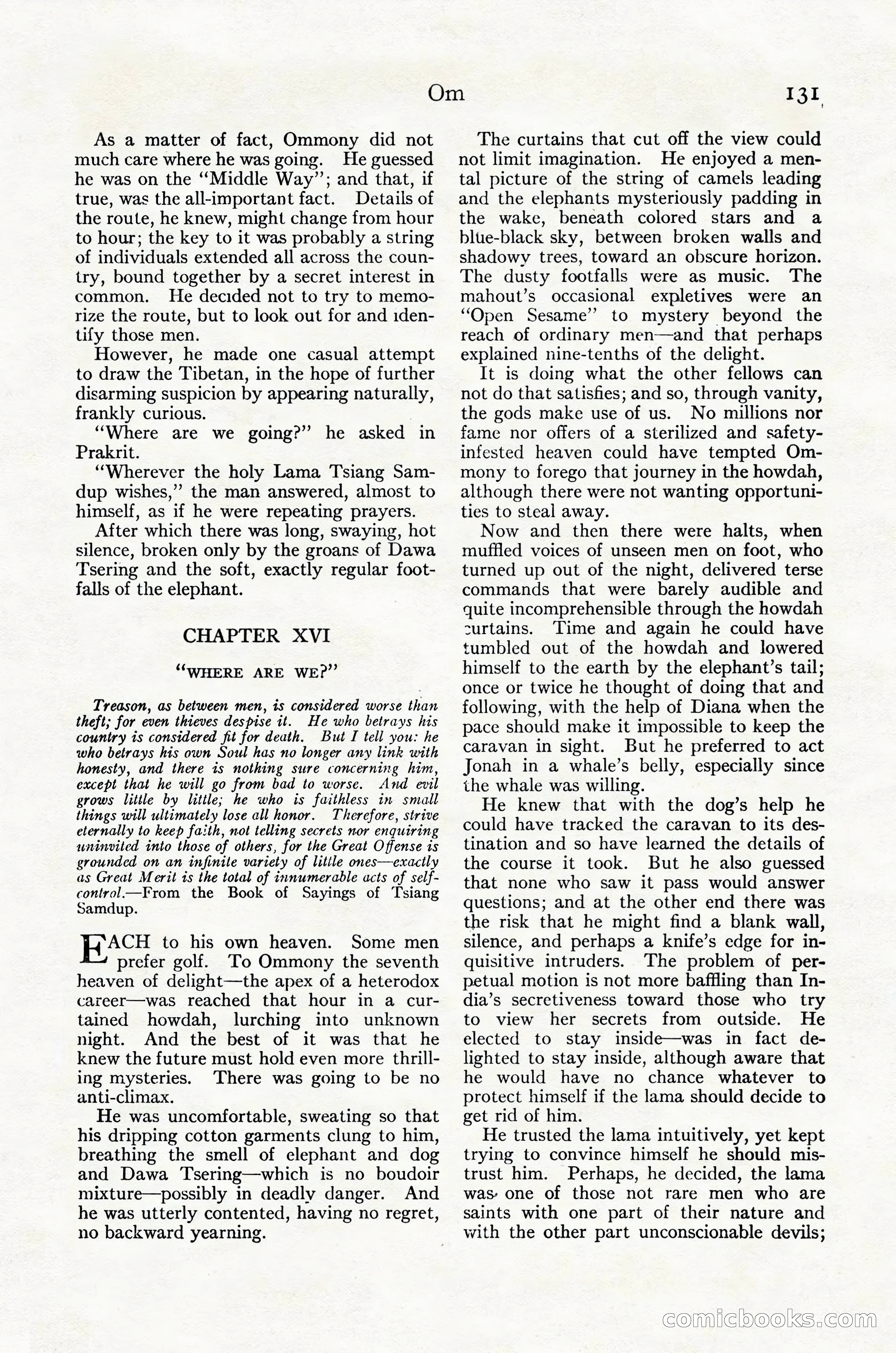
A restored page from Pulp Fiction, 1924. Page through the whole issue in the reader above.
📄 Transcribed text from this page (OCR, searchable)
Machine-transcribed from the original scan — historical spelling and the odd misread are preserved.
Om As a matter of fact, Ommony did not much care where he was going. He guessed he was on the ‘Middle Way’’; and that, if true, was the all-important fact. Details of the route, he knew, might change from hour to hour; the key to it was probably a string of individuals extended all across the coun- try, bound together by a secret interest in common. He decided not to try to memo- rize the route, but to look out for and iden- tify those men. However, he made one casual attempt to draw the Tibetan, in the hope of further disarming suspicion by appearing naturally, frankly curious. “Where are we going?” he asked in Prakrit. “Wherever the holy Lama Tsiang Sam- dup wishes,” the man answered, almost to himself, as if he were repeating prayers. After which there was long, swaying, hot silence, broken only by the groans of Dawa Tsering and the soft, exactly regular foot- falls of the elephant. CHAPTER XVI “WHERE ARE WEP?” Treason, as between men, 1s considered worse than theft; for even thieves despise it. He who betrays his country is considered fit for death. But I tell you: he who betrays his own Soul has no longer any link with honesty, and there is nothing sure concerning him, except that he will go from bad to worse. And evil grows little by little; he who is faithless in small things will ultimately lose all honor. Therefore, strive eternally to keep faith, not telling secrets nor enquiring uninvited into those of others, for the Great Offense is grounded on an infinile variety of little ones—exactly as Great Merit ts the total of innumerable acts of self- control—From the Book of Sayings of Tsiang Samdup. ACH to his own heaven. Some men prefer golf. Too Ommony the seventh heaven of delight—the apex of a heterodox career—was reached that hour in a cur- tained howdah, lurching into unknown night. And the best of it was that he knew the future must hold even more thrill- ing mysteries. ‘There was going to be no anti-climax. He was uncomfortable, sweating so that his dripping cotton garments clung to him, breathing the smell of elephant and dog and Dawa Tsering—which is no boudoir mixture—possibly in deadly danger. And he was utterly contented, having no regret, no backward yearning. The curtains that cut off the view could not limit imagination. He enjoyed a men- tal picture of the string of camels leading and the elephants mysteriously padding in the wake, beneath colored stars and a blue-black sky, between broken walls and shadowy trees, toward an obscure horizon. The dusty footfalls were as music. The mahout’s occasional expletives were an “Open Sesame’ to mystery beyond the reach of ordinary men—and that perhaps explained nine-tenths of the delight. It is doing what the other fellows can not do that satisfies; and so, through vanity, the gods make use of us. No millions nor fame nor offers of a sterilized and safety- infested heaven could have tempted Om- mony to forego that journey in the howdah, although there were not wanting opportuni- ties to steal away. Now and then there were halts, when muffled voices of unseen men on foot, who turned up out of the night, delivered terse commands that were barely audible and quite incomprehensible through the howdah curtains. Time and again he could have tumbled out of the howdah and lowered himself to the earth by the elephant’s tail; once or twice he thought of doing that and following, with the help of Diana when the pace should make it impossible to keep the caravan in sight. But he preferred to act Jonah in a whale’s belly, especially since the whale was willing. He knew that with the dog’s help he could have tracked the caravan to its des- tination and so have learned the details of the course it took. But he also guessed that none who saw it pass would answer questions; and at the other end there was the risk that he might find a blank wall, silence, and perhaps a knife’s edge for in- quisitive intruders. The problem of per- petual motion is not more baffling than In- dia’s secretiveness toward those who try to view her secrets from outside. He elected to stay inside—was in fact de- lighted to stay inside, although aware that he would have no chance whatever to protect himself if the lama should decide to get rid of him. He trusted the lama intuitively, yet kept trying to convince himself he should mis- trust him. Perhaps, he decided, the lama was one of those not rare men who are saints with one part of their nature and with the other part unconscionable devils; I3r CoOmiclbools.¢