
Pulp Fiction, 1924 · page 177 of 204
Adventure Magazine Cover, October 30, 1924 — page 177: what you’re looking at
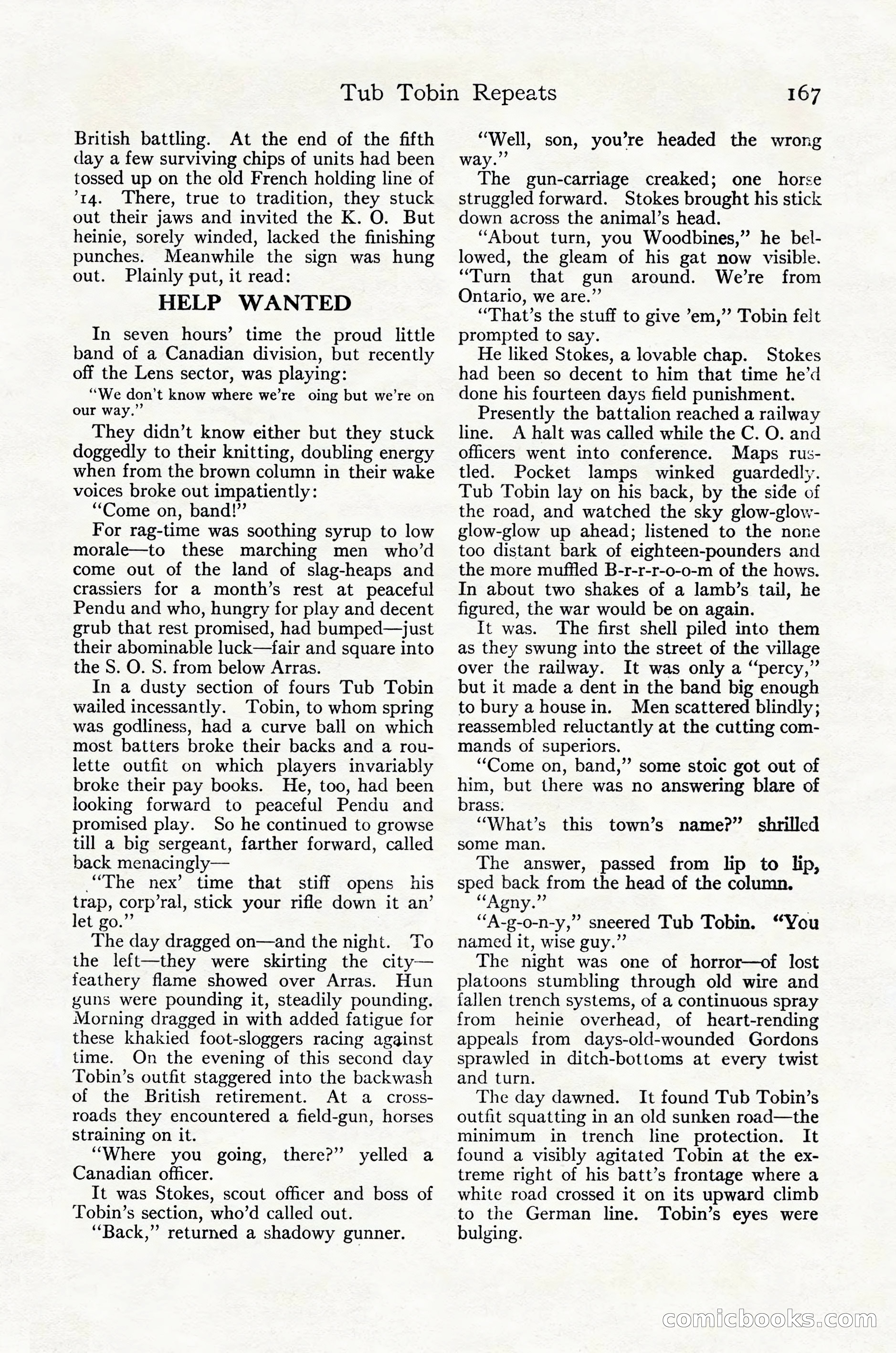
A restored page from Pulp Fiction, 1924. Page through the whole issue in the reader above.
📄 Transcribed text from this page (OCR, searchable)
Machine-transcribed from the original scan — historical spelling and the odd misread are preserved.
Tub Tobin Repeats British battling. At the end of the fifth day a few surviving chips of units had been tossed up on the old French holding line of 14. There, true to tradition, they stuck out their jaws and invited the K. O. But heinie, sorely winded, lacked the finishing punches. Meanwhile the sign was hung out. Plainly put, it read: HELP WANTED In seven hours’ time the proud little band of a Canadian division, but recently off the Lens sector, was playing: “We don’t know where we’re oing but we’re on our way.” They didn’t know either but they stuck doggedly to their knitting, doubling energy when from the brown column in their wake voices broke out impatiently: “Come on, band!” For rag-time was soothing syrup to low morale—to these marching men who’d come out of the land of slag-heaps and crassiers for a month’s rest at peaceful Pendu and who, hungry for play and decent grub that rest promised, had bumped—just their abominable luck—fair and square into the S. O. S. from below Arras. In a dusty section of fours Tub Tobin wailed incessantly. Tobin, to whom spring was godliness, had a curve ball on which most batters broke their backs and a rou- lette outfit on which players invariably broke their pay books. He, too, had been looking forward to peaceful Pendu and promised play. So he continued to growse till a big sergeant, farther forward, called back menacingly— “The nex’ time that stiff opens his trap, corp’ral, stick your rifle down it an’ let go.” ) The day dragged on—and the night. To the left—they were skirting the city— feathery flame showed over Arras. Hun guns were pounding it, steadily pounding. Morning dragged in with added fatigue for these khakied foot-sloggers racing against time. On the evening of this second day Tobin’s outfit staggered into the backwash of the British retirement. At a cross- roads they encountered a field-gun, horses straining on it. “Where you going, there?” yelled a Canadian officer. It was Stokes, scout officer and boss of Tobin’s section, who’d called out. “Back,” returned a shadowy gunner. 167 “Well, son, you’re headed the wrong way.” The gun-carriage creaked; one horse struggled forward. Stokes brought his stick down across the animal’s head. “About turn, you Woodbines,” he bel- lowed, the gleam of his gat now visible. “Turn that gun around. We’re from Ontario, we are.” ‘“That’s the stuff to give ’em,”’ Tobin felt prompted to say. He liked Stokes, a lovable chap. Stokes had been so decent to him that time he’d done his fourteen days field punishment. Presently the battalion reached a railway line. A halt was called while the C. O. and officers went into conference. Maps rus- tled. Pocket lamps winked guardedly. Tub Tobin lay on his back, by the side of the road, and watched the sky glow-glow- glow-glow up ahead; listened to the none too distant bark of eighteen-pounders and the more muffled B-r-r-r-o-o-m of the hows. In about two shakes of a lamb’s tail, he figured, the war would be on again. It was. The first shell piled into them as they swung into the street of the village over the railway. It was only a “percy,” but it made a dent in the band big enough to bury a house in. Men scattered blindly; reassembled reluctantly at the cutting com- mands of superiors. “Come on, band,” some stoic got out of him, but there was no answering blare of brass. “What’s this town’s name?” shrilled some man. The answer, passed from lip to lip, sped back from the head of the column. ‘Any ‘‘A-g-o-n-y,”’ sneered Tub Tobin. “You named it, wise guy.” The night was one of horror—of lost platoons stumbling through old wire and fallen trench systems, of a continuous spray from heinie overhead, of heart-rending appeals from days-old-wounded Gordons sprawled in ditch-bottoms at every twist and turn. The day dawned. It found Tub Tobin’s outfit squatting in an old sunken road—the minimum in trench line protection. It found a visibly agitated Tobin at the ex- treme right of his batt’s frontage where a white road crossed it on its upward climb to the German line. Tobin’s eyes were bulging. micloool © inn