
Pulp Fiction, 1924 · page 186 of 204
Adventure Magazine Cover, October 30, 1924 — page 186: what you’re looking at
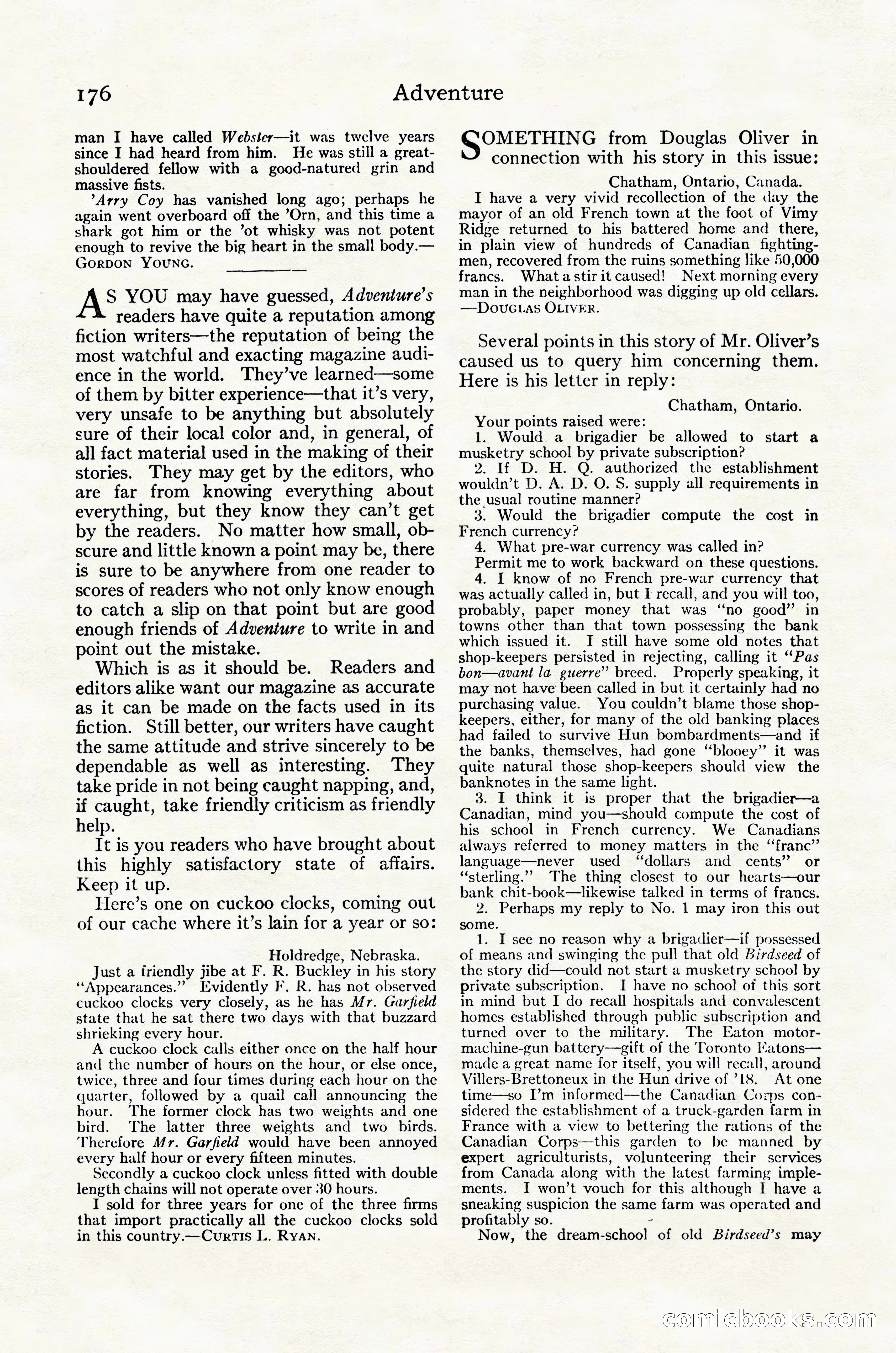
A restored page from Pulp Fiction, 1924. Page through the whole issue in the reader above.
📄 Transcribed text from this page (OCR, searchable)
Machine-transcribed from the original scan — historical spelling and the odd misread are preserved.
176 man I have called Webster—it was twelve years since I had heard from him. He was still a great- shouldered fellow with a good-natured grin and massive fists. ’Arry Coy has vanished long ago; perhaps he again went overboard off the ’Orn, and this time a shark got him or the ’ot whisky was not potent enough to revive the big heart in the small body.— GORDON YOUNG. A® YOU may have guessed, Adventure’s readers have quite a reputation among fiction writers—the reputation of being the most watchful and exacting magazine audi- ence in the world. They’ve learned—some of them by bitter experience—that it’s very, very unsafe to be anything but absolutely cure of their local color and, in general, of all fact material used in the making of their stories. They may get by the editors, who are far from knowing everything about everything, but they know they can’t get by the readers. No matter how small, ob- scure and little known a point may be, there is sure to be anywhere from one reader to scores of readers who not only know enough to catch a slip on that point but are good enough friends of Adventure to write in and point out the mistake. Which is as it should be. Readers and editors alike want our magazine as accurate as it can be made on the facts used in its fiction. Still better, our writers have caught the same attitude and strive sincerely to be dependable as well as interesting. They take pride in not being caught napping, and, if caught, take friendly criticism as friendly help. It is you readers who have brought about this highly satisfactory state of affairs. Keep it up. Here’s one on cuckoo clocks, coming out of our cache where it’s lain for a year or so: Holdredge, Nebraska. Just a friendly jibe at F. R. Buckley in his story “Appearances.” Evidently F. R. has not observed cuckoo clocks very closely, as he has Mr. Garfield state that he sat there two days with that buzzard shrieking every hour. A cuckoo clock calls either once on the half hour and the number of hours on the hour, or else once, twice, three and four times during each hour on the quarter, followed by a quail call announcing the hour. The former clock has two weights and one bird. The latter three weights and two birds. Therefore Mr. Garfield would have been annoyed every half hour or every fifteen minutes. Secondly a cuckoo clock unless fitted with double length chains will not operate over 30 hours. I sold for three years for one of the three firms that import practically all the cuckoo clocks sold in this country.—Curtis L. RYAN. Adventure COME aN G from Douglas Oliver in connection with his story in this issue: Chatham, Ontario, Canada. I have a very vivid recollection of the day the mayor of an old French town at the foot of Vimy Ridge returned to his battered home and there, in plain view of hundreds of Canadian fighting- men, recovered from the ruins something like 50,000 francs. Whatastirit caused! Next morning every man in the neighborhood was digging up old cellars. —Douctas OLIVER. Several points in this story of Mr. Oliver’s caused us to query him concerning them. Here is his letter in reply: Chatham, Ontario. Your points raised were: 1. Would a brigadier be allowed to start a musketry school by private subscription? 2. If D. H. Q. authorized the establishment wouldn’t D. A. D. O. S. supply all requirements in the usual routine manner? 3. Would the brigadier compute the cost in French currency? 4. What pre-war currency was called in? Permit me to work backward on these questions. 4. I know of no French pre-war currency that was actually called in, but I recall, and you will too, probably, paper money that was ‘‘no good” in towns other than that town possessing the bank which issued it. J still have some old notes that shop-keepers persisted in rejecting, calling it “Pas bon—avant la guerre’ breed. Properly speaking, it may not have’ been called in but it certainly had no purchasing value. You couldn’t blame those shop- keepers, either, for many of the old banking places had failed to survive Hun bombardments—and if the banks, themselves, had gone “‘blooey”’ it was quite natural those shop-keepers should view the banknotes in the same light. 3. I think it is proper that the brigadier—a Canadian, mind you—should compute the cost of his school in French currency. We Canadians always referred to money matters in the “franc’’ language—never used “dollars and cents” or “sterling.”’ The thing closest to our hearts—our bank chit-book—likewise talked in terms of francs. 2. Perhaps my reply to No. 1 may iron this out some. 1. I see no reason why a brigadier—if possessed of means and swinging the pull that old Birdseed of the story did—could not start a musketry school by private subscription. I have no school of this sort in mind but I do recall hospitals and convalescent homes established through public subscription and turned over to the military. The Eaton motor- machine-gun battery—gift of the Toronto Katons— made a great name for itself, you will recall, around Villers-Brettoneux in the Hun drive of 718. At one time—so I’m informed—the Canadian Corps con- sidered the establishment of a truck-garden farm in France with a view to bettering the rations of the Canadian Corps—this garden to be manned by expert agriculturists, volunteering their services from Canada along with the latest farming imple- ments. I won’t vouch for this although I have a sneaking suspicion the same farm was operated and profitably so. - Now, the dream-school of old Birdseed’s may CoOmiclbooks