
Pulp Fiction, 1924 · page 188 of 204
Adventure Magazine Cover, October 30, 1924 — page 188: what you’re looking at
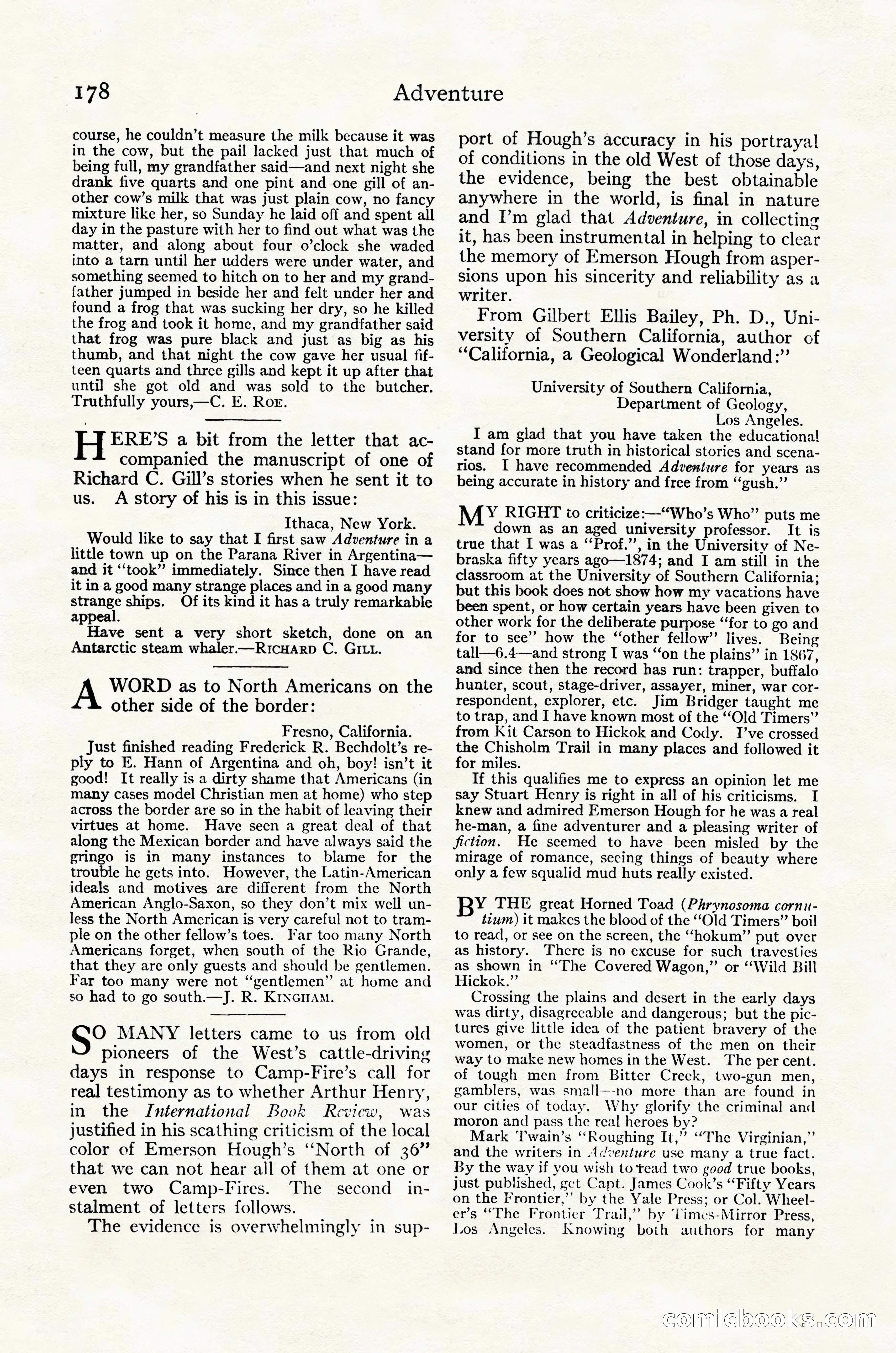
A restored page from Pulp Fiction, 1924. Page through the whole issue in the reader above.
📄 Transcribed text from this page (OCR, searchable)
Machine-transcribed from the original scan — historical spelling and the odd misread are preserved.
178 course, he couldn’t measure the milk because it was in the cow, but the pail lacked just that much of being full, my grandfather said—and next night she drank five quarts and one pint and one gill of an- other cow’s milk that was just plain cow, no fancy mixture like her, so Sunday he laid off and spent all day in the pasture with her to find out what was the matter, and along about four o’clock she waded into a tarn until her udders were under water, and something seemed to hitch on to her and my grand- father jumped in beside her and felt under her and found a frog that was sucking her dry, so he killed the frog and took it home, and my grandfather said that frog was pure black and just as big as his thumb, and that night the cow gave her usual fif- teen quarts and three gills and kept it up after that until she got old and was sold to the butcher. Truthfully yours,—C. E. Ror. ERE’S a bit from the letter that ac- companied the manuscript of one of Richard C. Gill’s stories when he sent it to us. A story of his is in this issue: Ithaca, New York. Would like to say that I first saw Adventure in a little town up on the Parana River in Argentina— and it ‘‘took” immediately. Since then I have read it ina good many strange places and in a good many strange ships. Of its kind it has a truly remarkable appeal. Have sent a very short sketch, done on an Antarctic steam whaler—RticHarpD C. GILL. WORD as to North Americans on the other side of the border: Fresno, California. Just finished reading Frederick R. Bechdolt’s re- ply to E. Hann of Argentina and oh, boy! isn’t it good! It really is a dirty shame that Americans (in many cases model Christian men at home) who step across the border are so in the habit of leaving their virtues at home. Have seen a great deal of that along the Mexican border and have always said the gringo is in many instances to blame for the trouble he gets into. However, the Latin-American ideals and motives are different from the North American Anglo-Saxon, so they don’t mix well un- less the North American is very careful not to tram- ple on the other fellow’s toes. Far too many North Americans forget, when south of the Rio Grande, that they are only guests and should be gentlemen. Far too many were not “gentlemen” at home and so had to go south.—J. R. KincHam. O MANY letters came to us from old pioneers of the West’s cattle-driving days in response to Camp-Fire’s call for real testimony as to whether Arthur Henry, in the International Book Review, was justified in his scathing criticism of the local color of Emerson Hough’s ‘‘North of 36” that we can not hear all of them at one or even two Camp-lires. The second in- stalment of letters follows. The evidence is overwhelmingly in sup- Adventure port of Hough’s accuracy in his portrayal of conditions in the old West of those days, the evidence, being the best obtainable anywhere in the world, is final in nature and I’m glad that Adventure, in collecting it, has been instrumental in helping to clear the memory of Emerson Hough from asper- sions upon his sincerity and reliability as a writer. From Gilbert Ellis Bailey, Ph. D., Uni- versity of Southern California, author of “California, a Geological Wonderland:”’ University of Southern California, Department of Geology, Los Angeles. I am glad that you have taken the educational stand for more truth in historical stories and scena- rios. I have recommended Adventure for years as being accurate in history and free from “gush.” A Y RIGHT io criticize-—“Who’s Who” puts me down as an aged university professor. It is true that I was a “Prof.’’, in the University of Ne- braska fifty years ago—1874; and I am still in the classroom at the University of Southern California; but this book does not show how my vacations have been spent, or how certain years have been given to other work for the deliberate purpose ‘‘for to go and for to see” how the “other fellow” lives. Being tall—6.4—and strong I was “‘on the plains” in 1867, and since then the record has run: trapper, buffalo hunter, scout, stage-driver, assayer, miner, war cor- respondent, explorer, etc. Jim Bridger taught me to trap, and I have known most of the ‘Old Timers” from Kit Carson to Hickok and Cody. I’ve crossed the Chisholm Trail in many places and followed it for miles. If this qualifies me to express an opinion let me say Stuart Henry is right in all of his criticisms. I knew and admired Emerson Hough for he was a real he-man, a fine adventurer and a pleasing writer of fiction. He seemed to have been misled by the mirage of romance, secing things of beauty where only a few squalid mud huts really existed. Y THE great Horned Toad (Phrynosoma cornu- tzum) it makes the blood of the “Old Timers”’ boil to read, or see on the screen, the “hokum” put over as history. There is no excuse for such travesties as shown in “The Covered Wagon,” or “Wild Bill Hickok.” Crossing the plains and desert in the early days was dirty, disagreeable and dangerous; but the pic- tures give little idea of the patient bravery of the women, or the steadfastness of the men on their way to make new homes in the West. The per cent. of tough men from Bitter Creek, two-gun men, gamblers, was small—-no more than are found in our cities of today. Why glorify the criminal and moron and pass the real heroes by? Mark Twain’s “Roughing It,” ‘‘The Virginian,” and the writers in .1¢venture use many a true fact. By the way if you wish to‘'tead two good true books, just published, get Capt. James Cook’s “Fifty Years on the Frontier,’’ by the Yale Press; or Col. Wheel- er’s “The Fronticr Trail,’’ by Times-Mirror Press, Los Angeles. Knowing both authors for many DOO C© inn