
Pulp Fiction, 1924 · page 197 of 204
Adventure Magazine Cover, October 30, 1924 — page 197: what you’re looking at
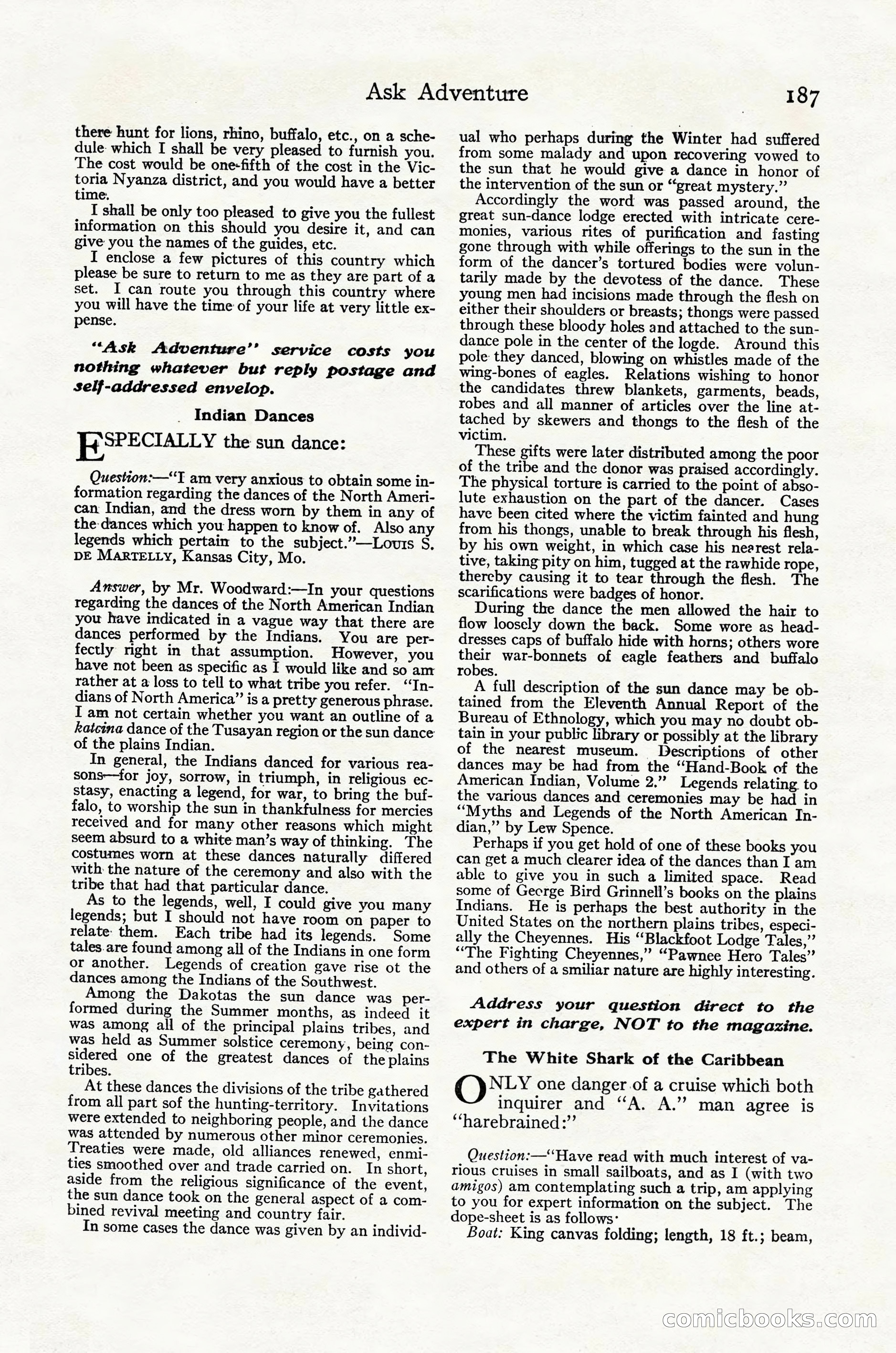
A restored page from Pulp Fiction, 1924. Page through the whole issue in the reader above.
📄 Transcribed text from this page (OCR, searchable)
Machine-transcribed from the original scan — historical spelling and the odd misread are preserved.
Ask Adventure there hunt for lions, rhino, buffalo, etc., on a sche- dule: which I shall be very pleased to furnish you. The cost would be one-fifth of the cost in the Vic- toria Nyanza district, and you would have a better time. I shall be only too pleased to give you the fullest information on this should you desire it, and can give you the names of the guides, etc. I enclose a few pictures of this country which please be sure to return to me as they are part of a set. I can route you through this country where you will have the time of your life at very little ex- pense. ‘“‘Ask Adventure’’ service costs you nothing whatever but reply postage and self-addressed envelop. Indian Dances PSPECIALLY the sun dance: Question: —“T am very anxious to obtain some in- formation regarding the dances of the North Ameri- can Indian, and the dress worn by them in any of the dances which you happen to know of. Also any legends which pertain to the subject.”—Lovis S. DE MARTELLY, Kansas City, Mo. Answer, by Mr. Woodward:—In your questions regarding the dances of the North American Indian you have indicated in a vague way that there are dances performed by the Indians. You are per- fectly right in that assumption. However, you have not been as specific as I would like and so am rather at a loss to tell to what tribe you refer. “In- dians of North America” is a pretty generous phrase. I am not certain whether you want an outline of a katcina dance of the Tusayan region or the sun dance of the plains Indian. In general, the Indians danced for various rea- sons—for joy, sorrow, in triumph, in religious ec- stasy, enacting a legend, for war, to bring the buf- falo, to worship the sun in thankfulness for mercies received and for many other reasons which might seem absurd to a white man’s way of thinking. The costumes worn at these dances naturally differed with the nature of the ceremony and also with the tribe that had that particular dance. As to the legends, well, I could give you many legends; but I should not have room on paper to relate them. Each tribe had its legends. Some tales. are found among all of the Indians in one form or another. Legends of creation gave rise ot the dances among the Indians of the Southwest. Among the Dakotas the sun dance was per- formed during the Summer months, as indeed it was among all of the principal plains tribes, and was held as Summer solstice ceremony, being con- sidered one of the greatest dances of the plains tribes. At these dances the divisions of the tribe gathered from all part sof the hunting-territory. Invitations were extended to neighboring people, and the dance was attended by numerous other minor ceremonies. Treaties were made, old alliances renewed, enmi- ties smoothed over and trade carried on. In short, aside from the religious significance of the event, the sun dance took on the general aspect of a com- bined revival meeting and country fair. In some cases the dance was given by an individ- 187 ual who perhaps during the Winter had suffered from some malady and upon recovering vowed to the sun that he would give a dance in honor of the intervention of the sun or “great mystery.” Accordingly the word was passed around, the great sun-dance lodge erected with intricate cere- monies, various rites of purification and fasting gone through with while offerings to the sun in the form of the dancer’s tortured bodies were volun- tarily made by the devotess of the dance. These young men had incisions made through the flesh on either their shoulders or breasts; thongs were passed through these bloody holes and attached to the sun- dance pole in the center of the logde. Around this pole: they danced, blowing on whistles made of the wing-bones of eagles. Relations wishing to honor the candidates threw blankets, garments, beads, robes and all manner of articles over the line at- tached by skewers and thongs to the flesh of the victim. These gifts were later distributed among the poor of the tribe and the donor was praised accordingly. The physical torture is carried to the point of abso- lute exhaustion on the part of the dancer. Cases have been cited where the victim fainted and hung from his thongs, unable to break through his flesh, by his own weight, in which case his neerest rela- tive, taking pity on him, tugged at the rawhide rope, thereby causing it to tear through the flesh. The scarifications were badges of honor. During the dance the men allowed the hair to flow loosely down the back. Some wore as head- dresses caps of buffalo hide with horns; others wore their war-bonnets of eagle feathers and buffalo robes. A full description of the sun dance may be ob- tained from the Eleventh Annual Report of the Bureau of Ethnology, which you may no doubt ob- tain in your public library or possibly at the library of the nearest museum. Descriptions of other dances may be had from the ‘“Hand-Book of the American Indian, Volume 2.” Legends relating. to the various dances and ceremonies may be had in “Myths and Legends of the North American In- dian,” by Lew Spence. Perhaps if you get hold of one of these books you can get a much clearer idea of the dances than I am able to give you in such a limited space. Read some of Gecrge Bird Grinnell’s books on the plains Indians. He is perhaps the best authority in the United States on the northern plains tribes, especi- ally the Cheyennes. His “Blackfoot Lodge Tales,” “The Fighting Cheyennes,” “Pawnee Hero Tales” and others of a smiliar nature are highly interesting. Address your question direct to the expert in charge, NOT to the magazine. The White Shark of the Caribbean ON LY one danger of a cruise which both inquirer and “A. A.” man agree is “‘harebrained:”’ Question: —‘Have read with much interest of va- rious cruises in small sailboats, and as I (with two amigos) am contemplating such a trip, am applying to you for expert information on the subject. The dope-sheet is as follows: Boat: King canvas folding; length, 18 ft.; beam, COmiclbooks