
Pulp Fiction, 1924 · page 86 of 204
Adventure Magazine Cover, October 30, 1924 — page 86: what you’re looking at
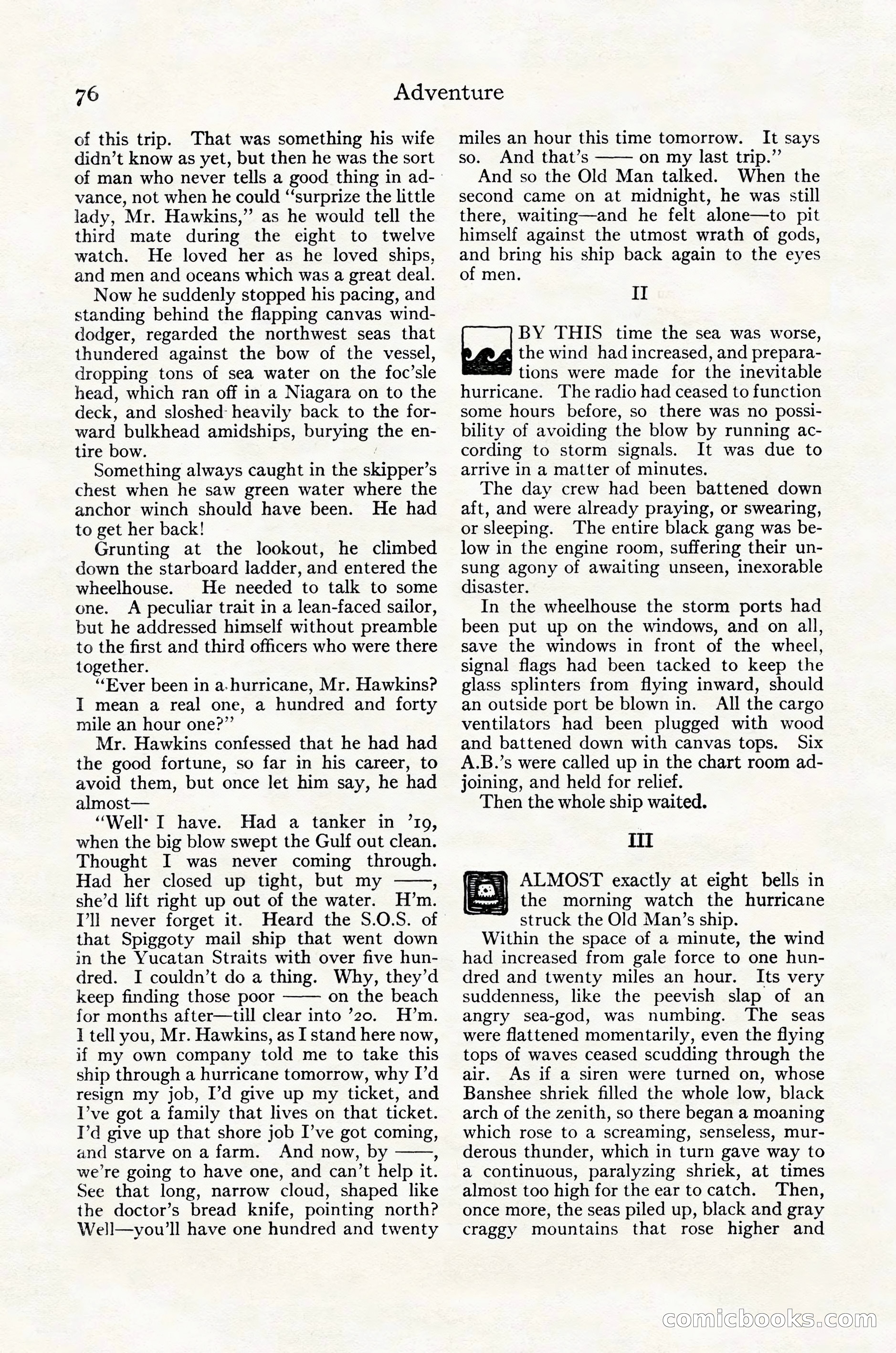
A restored page from Pulp Fiction, 1924. Page through the whole issue in the reader above.
📄 Transcribed text from this page (OCR, searchable)
Machine-transcribed from the original scan — historical spelling and the odd misread are preserved.
76 Adventure of this trip. That was something his wife didn’t know as yet, but then he was the sort of man who never tells a good thing in ad-— vance, not when he could “‘surprize the little lady, Mr. Hawkins,” as he would tell the third mate during the eight to twelve watch. He loved her as he loved ships, and men and oceans which was a great deal. Now he suddenly stopped his pacing, and standing behind the flapping canvas wind- dodger, regarded the northwest seas that thundered against the bow of the vessel, dropping tons of sea water on the foc’sle head, which ran off in a Niagara on to the deck, and sloshed: heavily back to the for- ward bulkhead amidships, burying the en- tire bow. Something always caught in the skipper’ S chest when he saw green water where the anchor winch should have been. He had to get her back! Grunting at the lookout, he climbed down the starboard ladder, and entered the wheelhouse. He needed to talk to some one. A peculiar trait in a lean-faced sailor, but he addressed himself without preamble to the first and third officers who were there together. “Ever been in a.-hurricane, Mr. Hawkins? I mean a real one, a hundred and forty mile an hour one?”’ Mr. Hawkins confessed that he had had the good fortune, so far in his career, to avoid them, but once let him say, he had almost— “Well? I have. Had a tanker in ’1o, when the big blow swept the Gulf out clean. Thought I was never coming through. Had her closed up tight, but my ——, she’d lift right up out of the water. H’m. I’ll never forget it. Heard the $.O.S. of that Spiggoty mail ship that went down in the Yucatan Straits with over five hun- dred. I couldn’t do a thing. Why, they’d keep finding those poor on the beach for months after—till clear into ’20. H’m 1 tell you, Mr. Hawkins, as I stand here now, if my own company told me to take this ship through a hurricane tomorrow, why I’d resign my job, I’d give up my ticket, and I've got a family that lives on that ticket. I’d give up that shore job I’ve got coming, and starve on a farm. And now, by we're going to have one, and can’t help it. See that long, narrow cloud, shaped like the doctor’s bread knife, pointing north? Well—you’ll have one hundred and twenty miles an hour this time tomorrow. It says so. And that’s on my last tnp.”’ And so the Old Man talked. When the second came on at midnight, he was still there, waiting—and he felt alone—to pit himself against the utmost wrath of gods, and bring his ship back again to the eyes of men. IT BY THIS time the sea was worse, eg the wind had increased, and prepara- tions were made for the inevitable hurricane. The radio had ceased to function some hours before, so there was no possi- bility of avoiding the blow by running ac- cording to storm signals. It was due to arrive in a matter of minutes. The day crew had been battened down aft, and were already praying, or swearing, or sleeping. The entire black gang was be- low in the engine room, suffering their un- sung agony of awaiting unseen, inexorable disaster. In the wheelhouse the storm ports had been put up on the windows, and on all, save the windows in front of the wheel, signal flags had been tacked to keep the glass splinters from flying inward, should an outside port be blown in. All the cargo ventilators had been plugged with wood and battened down with canvas tops. Six A.B.’s were called up in the chart room ad- joining, and held for relief. Then the whole ship waited. iit ALMOST exactly at eight bells in 4 the morning watch the hurricane struck the Old Man’s ship. Within the space of a minute, the wind had increased from gale force to one hun- dred and twenty miles an hour. Its very suddenness, like the peevish slap of an angry sea-god, was numbing. The seas were flattened momentarily, even the flying tops of waves ceased scudding through the air. As if a siren were turned on, whose Banshee shriek filled the whole low, black arch of the zenith, so there began a moaning which rose to a screaming, senseless, mur- derous thunder, which in turn gave way to a continuous, paralyzing shriek, at times almost too high for the ear to catch. Then, once more, the seas piled up, black and gray craggy mountains that rose higher and CoOmiclboolks.6 nn)