
Pulp Fiction, 1924 · page 103 of 194
Adventure Magazine Cover, November 10, 1924 — page 103: what you’re looking at
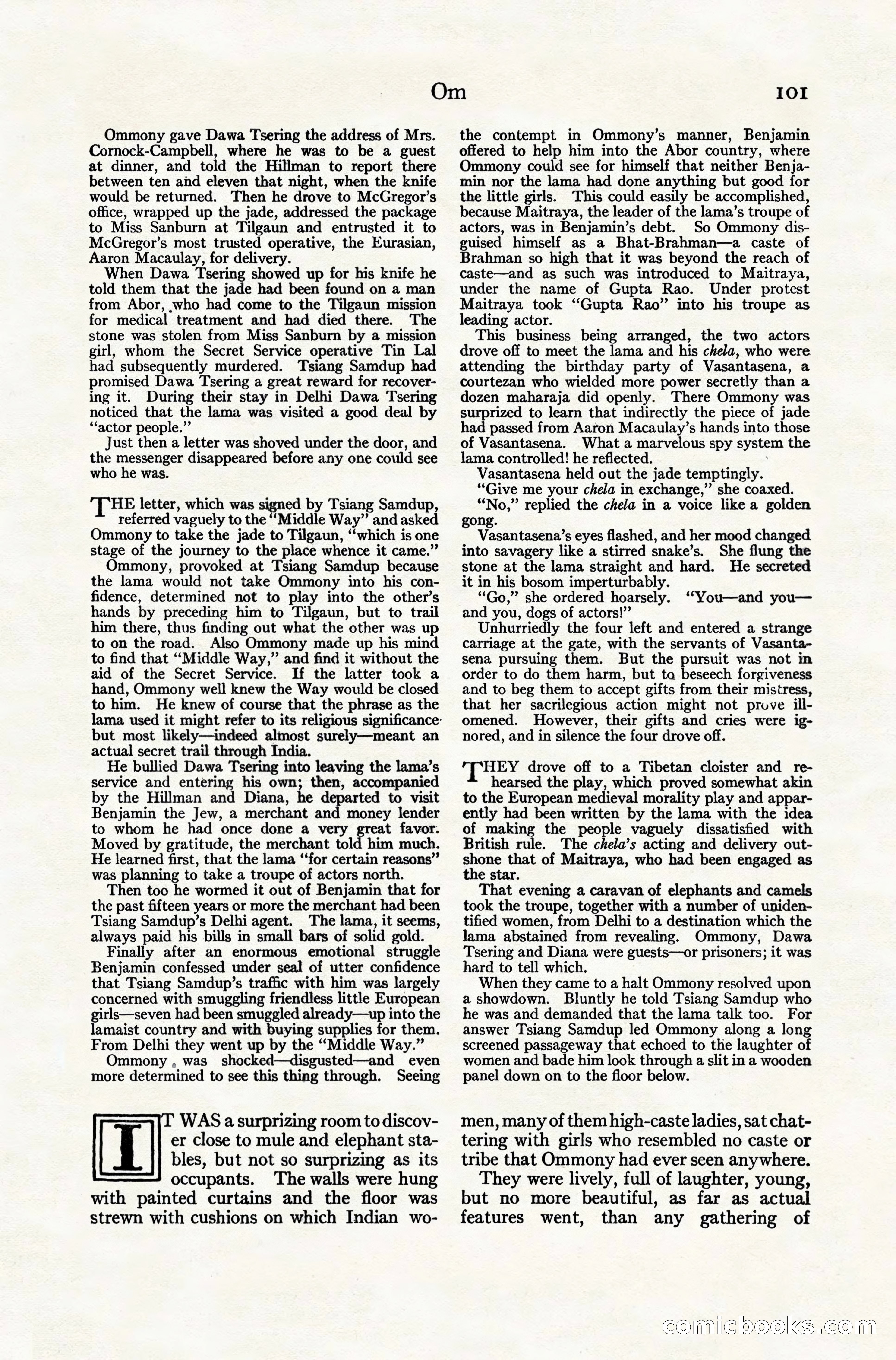
A restored page from Pulp Fiction, 1924. Page through the whole issue in the reader above.
📄 Transcribed text from this page (OCR, searchable)
Machine-transcribed from the original scan — historical spelling and the odd misread are preserved.
Om Ommony gave Dawa Tsering the address of Mrs. Cornock-Campbell, where he was to be a guest at dinner, and told the Hillman to report there between ten and eleven that night, when the knife would be returned. Then he drove to McGregor’s office, wrapped up the jade, addressed the package to Miss Sanburn at Tilgaun and entrusted it to McGregor’s most trusted operative, the Eurasian, Aaron Macaulay, for delivery. When Dawa Tsering showed up for his knife he told them that the jade had been found on a man from Abor, .who had come to the Tilgaun mission for medical’ treatment and had died there. The stone was stolen from Miss Sanburn by a mission girl, whom the Secret Service operative Tin Lal had subsequently murdered. Tsiang Samdup had promised Dawa Tsering a great reward for recover- ing it. During their stay in Delhi Dawa Tsering noticed that the lama was visited a good deal by ‘factor people.” Just then a letter was shoved under the door, and the messenger disappeared before any one could see who he was. "THE letter, which was signed by Tsiang Samdup, referred vaguely to the “Middle Way” and asked Ommony to take the jade to Tilgaun, “which is one stage of the journey to the place whence it came.” Ommony, provoked at Tsiang Samdup because the lama would not take Ommony into his con- fidence, determined not to play into the other’s hands by preceding him to Tilgaun, but to trail him there, thus finding out what the other was up to on the road. Also Ommony made up his mind to find that ‘‘“Middle Way,” and find it without the aid of the Secret Service. If the latter took a hand, Ommony well knew the Way would be closed to him. He knew of course that the phrase as the lama used it might refer to its religious significance: but most likely—indeed almost surely—meant an actual secret trail through India. He bullied Dawa Tsering into leaving the lama’s service and entering his own; then, accompanied by the Hillman and Diana, he departed to visit Benjamin the Jew, a merchant and money lender to whom he had once done a very great favor. Moved by gratitude, the merchant told him much, He learned first, that the lama “for certain reasons’’ was planning to take a troupe of actors north. Then too he wormed it out of Benjamin that for the past fifteen years or more the merchant had been Tsiang Samdup’s Delhi agent. The lama, it seems, always paid his bills in small bars of solid gold. Finally after an enormous emotional struggle Benjamin confessed under seal of utter confidence that Tsiang Samdup’s traffic with him was largely concerned with smuggling friendless little European girls—seven had been smuggled already—up into the lamaist country and with buying supplies for them. From Delhi they went up by the ‘‘Middle Way.” Ommony , was_ shocked—disgusted—and even more determined to see this thing through. Seeing bles, but not so surprizing as its occupants. The walls were hung with painted curtains and the floor was strewn with cushions on which Indian wo- T WAS a surprizing room to discov- er close to mule and elephant sta- IOI the contempt in Ommony’s manner, Benjamin offered to help him into the Abor country, where Ommony could see for himself that neither Benja- min nor the lama had done anything but good for the little girls. This could easily be accomplished, because Maitraya, the leader of the lama’s troupe of actors, was in Benjamin’s debt. So Ommony dis- guised himself as a Bhat-Brahman—a caste of Brahman so high that it was beyond the reach of caste—and as such was introduced to Maitraya, under the name of Gupta Rao. Under protest Maitraya took “Gupta Rao” into his troupe as leading actor. This business being arranged, the two actors drove off to meet the lama and his chela, who were attending the birthday party of Vasantasena, a courtezan who wielded more power secretly than a dozen maharaja did openly. There Ommony was surprized to learn that indirectly the piece of jade had passed from Aaron Macaulay’s hands into those of Vasantasena. What a marvelous spy system the lama controlled! he reflected. Vasantasena held out the jade temptingly. “Give me your chela in exchange,” she coaxed. “No,” replied the chela in a voice like a golden gong. Vasantasena’s eyes flashed, and her mood changed into savagery like a stirred snake’s. She flung the stone at the lama straight and hard. He secreted it in his bosom imperturbably. ““Go,” she ordered hoarsely. and you, dogs of actors!”’ Unhurriedly the four left and entered a strange carriage at the gate, with the servants of Vasanta- sena pursuing them. But the pursuit was not in order to do them harm, but ta beseech forgiveness and to beg them to accept gifts from their mistress, that her sacrilegious action might not prove ill- omened. However, their gifts and cries were ig- nored, and in silence the four drove off. “You—and you— "THEY drove off to a Tibetan cloister and re- hearsed the play, which proved somewhat akin to the European medieval morality play and appar- ently had been written by the lama with the idea of making the people vaguely dissatisfied with British rule. The chela’s acting and delivery out- shone that of Maitraya, who had been engaged as the star. That evening a caravan of elephants and camels took the troupe, together with a number of uniden- tified women, from Delhi to a destination which the lama abstained from revealing. Ommony, Dawa Tsering and Diana were guests—or prisoners; it was hard to tell which. When they came to a halt Ommony resolved upon a showdown. Bluntly he told Tsiang Samdup who he was and demanded that the lama talk too. For answer Tsiang Samdup led Ommony along a long screened passageway that echoed to the laughter of womien and bade him look through a slit in a wooden panel down on to the floor below. men, many of them high-caste ladies, sat chat- tering with girls who resembled no caste or tribe that Ommony had ever seen anywhere. They were lively, full of laughter, young, but no more beautiful, as far as actual features went, than any gathering of COmiclhoo =