
Pulp Fiction, 1924 · page 122 of 194
Adventure Magazine Cover, November 10, 1924 — page 122: what you’re looking at
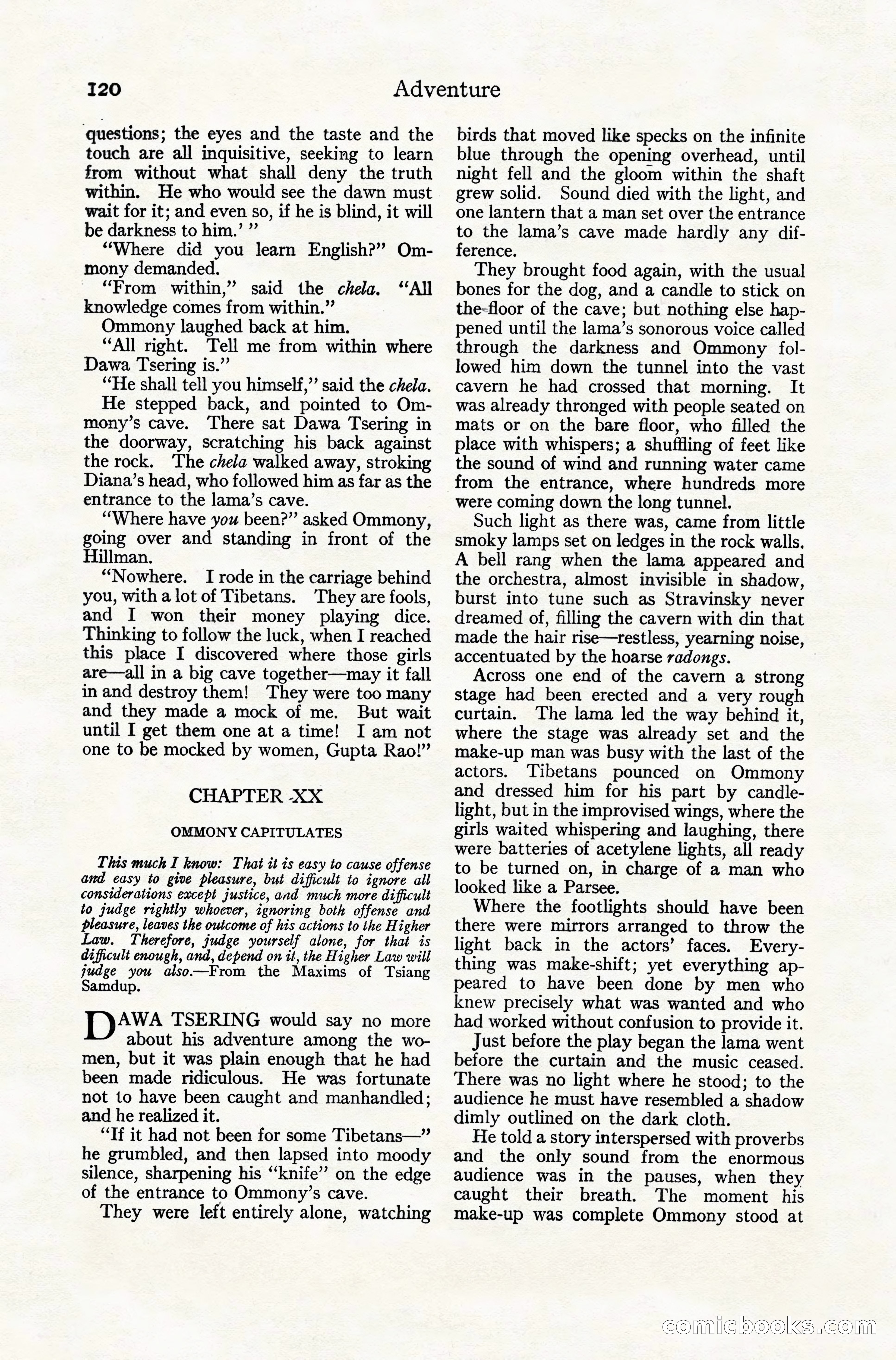
A restored page from Pulp Fiction, 1924. Page through the whole issue in the reader above.
📄 Transcribed text from this page (OCR, searchable)
Machine-transcribed from the original scan — historical spelling and the odd misread are preserved.
I20 questions; the eyes and the taste and the touch are all inquisitive, seeking to learn from without what shall deny the truth within. He who would see the dawn must wait for it; and even so, if he is blind, it will be darkness to him.’ ” “Where did you learn English?” Om- mony demanded. “From within,” said the chela. ‘All knowledge comes from within.” Ommony laughed back at him. “All right. Tell me from within where Dawa Tsering is.”’ “He shall tell you himself,” said the chela. He stepped back, and pointed to Om- mony’s cave. There sat Dawa Tsering in the doorway, scratching his back against the rock. The chela walked away, stroking Diana’s head, who followed him as far as the entrance to the lama’s cave. ‘“‘Where have you been?” asked Ommony, going over and standing in front of the Hillman. “Nowhere. I rode in the carriage behind you, witha lot of Tibetans. They are fools, and I won their money playing dice. Thinking to follow the luck, when I reached this place I discovered where those girls are—all in a big cave together—may it fall in and destroy them! They were too many and they made a mock of me. But wait until I get them one at a time! I am not one to be mocked by women, Gupta Rao!” CHAPTER XX OMMONY CAPITULATES This much I know: That it is easy to cause offense and easy to give pleasure, but difficult to ignore all considerations except justice, and much more difficult to judge rightly whoever, ignoring both offense and pleasure, leaves the outcome of his actions to the Higher Law. Therefore, judge yourself alone, for that is difficult enough, and, depend on it, the Higher Law will judge you also—From the Maxims of Tsiang Samdup. [TAWA TSERING would say no more about his adventure among the wo- men, but it was plain enough that he had been made ridiculous. He was fortunate not to have been caught and manhandled; and he realized it. “Tf it had not been for some Tibetans—”’ he grumbled, and then lapsed into moody silence, sharpening his “‘knife” on the edge of the entrance to Ommony’s cave. They were left entirely alone, watching Adventure birds that moved like specks on the infinite blue through the opening overhead, until night fell and the gloom within the shaft grew solid. Sound died with the light, and one lantern that a man set over the entrance to the lama’s cave made hardly any dif- ference. They brought food again, with the usual bones for the dog, and a candle to stick on the-floor of the cave; but nothing else hap- pened until the lama’s sonorous voice called through the darkness and Ommony fol- lowed him down the tunnel into the vast cavern he had crossed that morning. It was already thronged with people seated on mats or on the bare floor, who filled the place with whispers; a shuffling of feet like the sound of wind and running water came from the entrance, where hundreds more were coming down the long tunnel. Such light as there was, came from little smoky lamps set on ledges in the rock walls. A bell rang when the lama appeared and the orchestra, almost invisible in shadow, burst into tune such as Stravinsky never dreamed of, filling the cavern with din that made the hair rise—restless, yearning noise, accentuated by the hoarse radongs. Across one end of the cavern a strong stage had been erected and a very rough curtain. The lama led the way behind it, where the stage was already set and the make-up man was busy with the last of the actors. Tibetans pounced on Ommony and dressed him for his part by candle- light, but in the improvised wings, where the girls waited whispering and laughing, there were batteries of acetylene lights, all ready to be turned on, in charge of a man who looked like a Parsee. Where the footlights should have been there were mirrors arranged to throw the light back in the actors’ faces. Every- thing was make-shift; yet everything ap- peared to have been done by men who knew precisely what was wanted and who had worked without confusion to provide it. Just before the play began the lama went before the curtain and the music ceased. There was no light where he stood; to the audience he must have resembled a shadow dimly outlined on the dark cloth. He told a story interspersed with proverbs and the only sound from the enormous audience was in the pauses, when they caught their breath. The moment his make-up was complete Ommony stood at CoMmicbook A) C© =