
Pulp Fiction, 1924 · page 126 of 194
Adventure Magazine Cover, November 10, 1924 — page 126: what you’re looking at
A restored page from Pulp Fiction, 1924. Page through the whole issue in the reader above.
📄 Transcribed text from this page (OCR, searchable)
Machine-transcribed from the original scan — historical spelling and the odd misread are preserved.
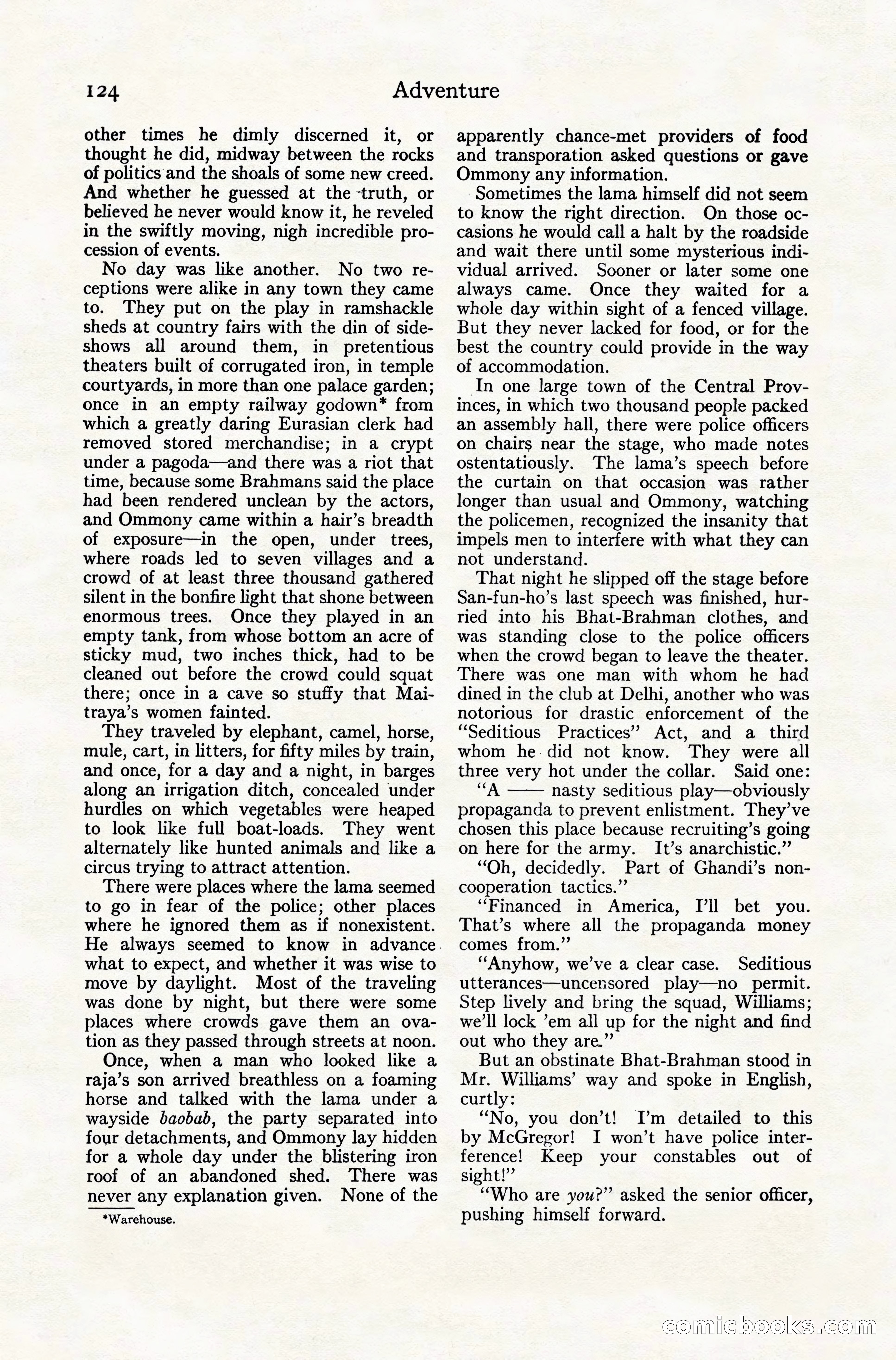
124 other times he dimly discerned it, or thought he did, midway between the rocks of politics and the shoals of some new creed. And whether he guessed at the ‘truth, or believed he never would know it, he reveled in the swiftly moving, nigh incredible pro- cession of events. No day was like another. No two re- ceptions were alike in any town they came to. They put on the play in ramshackle sheds at country fairs with the din of side- shows all around them, in pretentious theaters built of corrugated iron, in temple courtyards, in more than one palace garden; once in an empty railway godown* from which a greatly daring Eurasian clerk had removed stored merchandise; in a crypt under a pagoda—and there was a riot that time, because some Brahmans said the place had been rendered unclean by the actors, and Ommony came within a hair’s breadth of exposure—in the open, under trees, where roads led to seven villages and a crowd of at least three thousand gathered silent in the bonfire light that shone between enormous trees. Once they played in an empty tank, from whose bottom an acre of sticky mud, two inches thick, had to be cleaned out before the crowd could squat there; once in a cave so stuffy that Mai- traya’s women fainted. They traveled by elephant, camel, horse, mule, cart, in litters, for fifty miles by train, and once, for a day and a night, in barges along an irrigation ditch, concealed under hurdles on which vegetables were heaped to look like full boat-loads. They went alternately like hunted animals and like a circus trying to attract attention. There were places where the lama seemed to go in fear of the police; other places where he ignored them as if nonexistent. He always seemed to know in advance. what to expect, and whether it was wise to move by daylight. Most of the traveling was done by night, but there were some places where crowds gave them an ova- tion as they passed through streets at noon. Once, when a man who looked like a raja’s son arrived breathless on a foaming horse and talked with the lama under a wayside baobab, the party separated into four detachments, and Ommony lay hidden for a whole day under the blistering iron roof of an abandoned shed. There was never any explanation given. None of the *Warehouse. Adventure apparently chance-met providers of food and transporation asked questions or gave Ommony any information. Sometimes the lama himself did not seem to know the right direction. On those oc- casions he would call a halt by the roadside and wait there until some mysterious indi- vidual arrived. Sooner or later some one always came. Once they waited for a whole day within sight of a fenced village. But they never lacked for food, or for the best the country could provide in the way of accommodation. In one large town of the Central Prov- inces, in which two thousand people packed an assembly hall, there were police officers on chairs near the stage, who made notes ostentatiously. The lama’s speech before the curtain on that occasion was rather longer than usual and Ommony, watching the policemen, recognized the insanity that impels men to interfere with what they can not understand. That night he slipped off the stage before San-fun-ho’s last speech was finished, hur- ried into his Bhat-Brahman clothes, and was standing close to the police officers when the crowd began to leave the theater. There was one man with whom he had dined in the club at Delhi, another who was notorious for drastic enforcement of the “Seditious Practices” Act, and a third whom he did not know. They were all three very hot under the collar. Said one: ‘“‘A —— nasty seditious play—obviously propaganda to prevent enlistment. They’ve chosen this place because recruiting’s going on here for the army. It’s anarchistic.”’ “Oh, decidedly. Part of Ghandi’s non- cooperation tactics.” “Financed in America, Til bet you. That’s where all the propaganda money comes from.” “Anyhow, we’ve a clear case. Seditious utterances—uncensored play—no permit. Step lively and bring the squad, Williams; we'll lock ’em all up for the night and find out who they are.” But an obstinate Bhat-Brahman stood in Mr. Williams’ way and spoke in English, curtly: “No, you don’t! by McGregor! ference! sight!” ‘‘Who are you?” asked the senior officer, pushing himself forward. I’m detailed to this I won’t have police inter- Keep your constables out of CoOMmiclhoo (© 5}