
Pulp Fiction, 1924 · page 138 of 194
Adventure Magazine Cover, November 10, 1924 — page 138: what you’re looking at
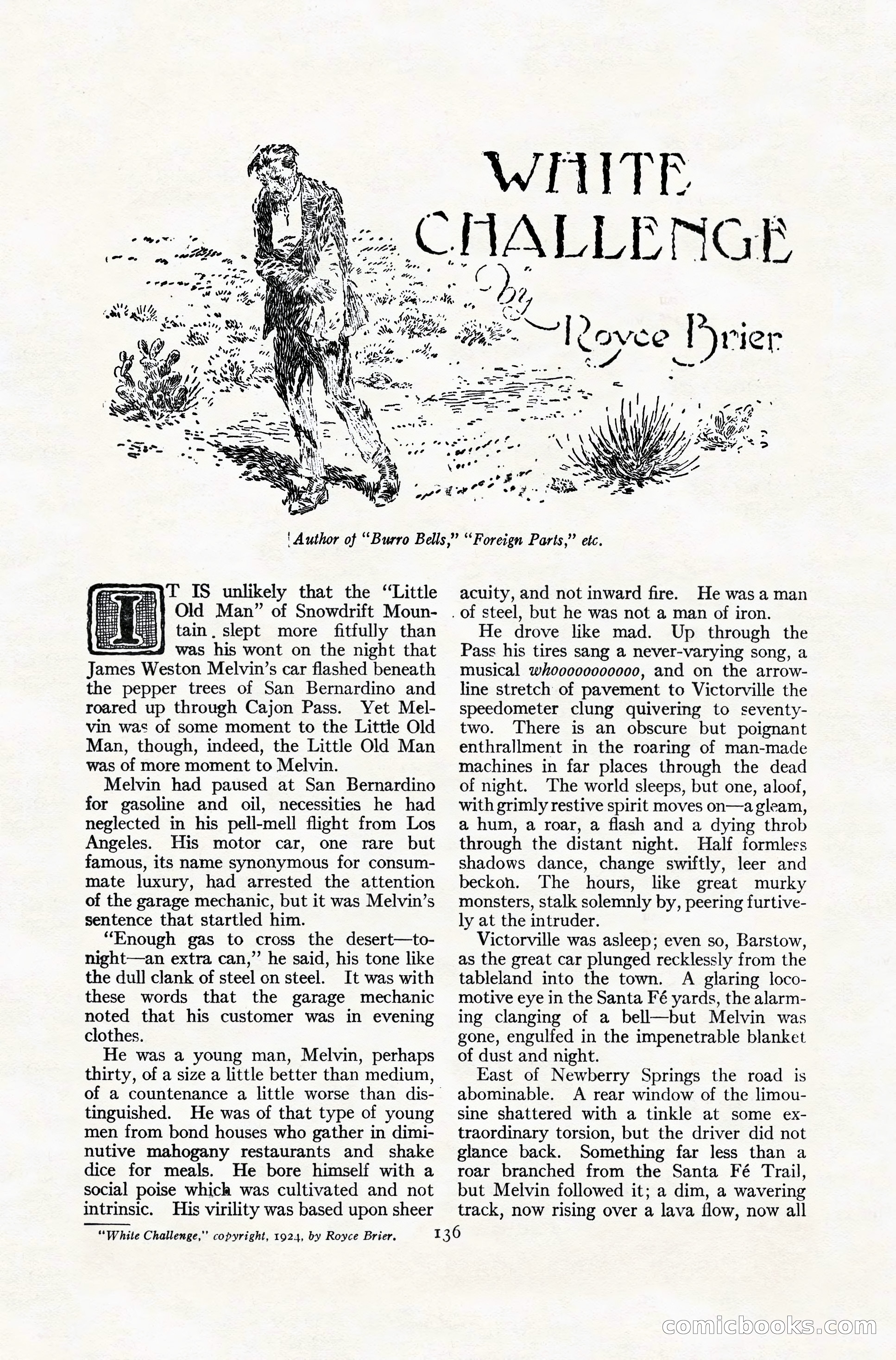
A restored page from Pulp Fiction, 1924. Page through the whole issue in the reader above.
📄 Transcribed text from this page (OCR, searchable)
Machine-transcribed from the original scan — historical spelling and the odd misread are preserved.
WITTE CHALL CNGER Lovee Drier ‘ Author of “Burro Bells,” “Foreign Parts,’ etc. mil IS unlikely that the “Little —#4 Old Man” of Snowdrift Moun- | tain. slept more fitfully than } was his wont on the night that James Weston Melvin’s car flashed beneath the pepper trees of San Bernardino and roared up through Cajon Pass. Yet Mel- vin was of some moment to the Little Old Man, though, indeed, the Little Old Man was of more moment to Melvin. Melvin had paused at San Bernardino for gasoline and oil, necessities he had neglected in his pell-mell flight from Los Angeles. His motor car, one rare but famous, its name synonymous for consum- mate luxury, had arrested the attention of the garage mechanic, but it was Melvin’s sentence that startled him. “Enough gas to cross the desert—to- night—an extra can,” he said, his tone like the dull clank of steel on steel. It was with these words that the garage mechanic noted that his customer was in evening clothes. He was a young man, Melvin, perhaps thirty, of a size a little better than medium, of a countenance a little worse than dis-— tinguished. He was of that type of young men from bond houses who gather in dimi- nutive mahogany restaurants and shake dice for meals. He bore himself with a social poise which was cultivated and not intrinsic. His virility was based upon sheer “White Challenge,’ copyright, 1924, by Royce Brier. acuity, and not inward fire. He was aman . of steel, but he was not a man of iron. He drove like mad. Up through the Pass his tires sang a never-varying song, a musical whooooooo0000, and on the arrow- line stretch of pavement to Victorville the speedometer clung quivering to seventy- two. There is an obscure but poignant enthrallment in the roaring of man-made machines in far places through the dead of night. The world sleeps, but one, aloof, with grimly restive spirit moves on—a gleam, a hum, a roar, a flash and a dying throb through the distant night. Half formless shadows dance, change swiftly, leer and beckon. The hours, like great murky monsters, stalk solemnly by, peering furtive- ly at the intruder. Victorville was asleep; even so, Barstow, as the great car plunged recklessly from the tableland into the town. A glaring loco- motive eye in the Santa Fé yards, the alarm- ing clanging of a bell—but Melvin was gone, engulfed in the impenetrable blanket of dust and night. East of Newberry Springs the road is abominable. A rear window of the limou- sine shattered with a tinkle at some ex- traordinary torsion, but the driver did not glance back. Something far less than a roar branched from the Santa Fé Trail, but Melvin followed it; a dim, a wavering track, now rising over a lava flow, now all 136 CoOMmiclhoo © 5}