
Pulp Fiction, 1924 · page 146 of 194
Adventure Magazine Cover, November 10, 1924 — page 146: what you’re looking at
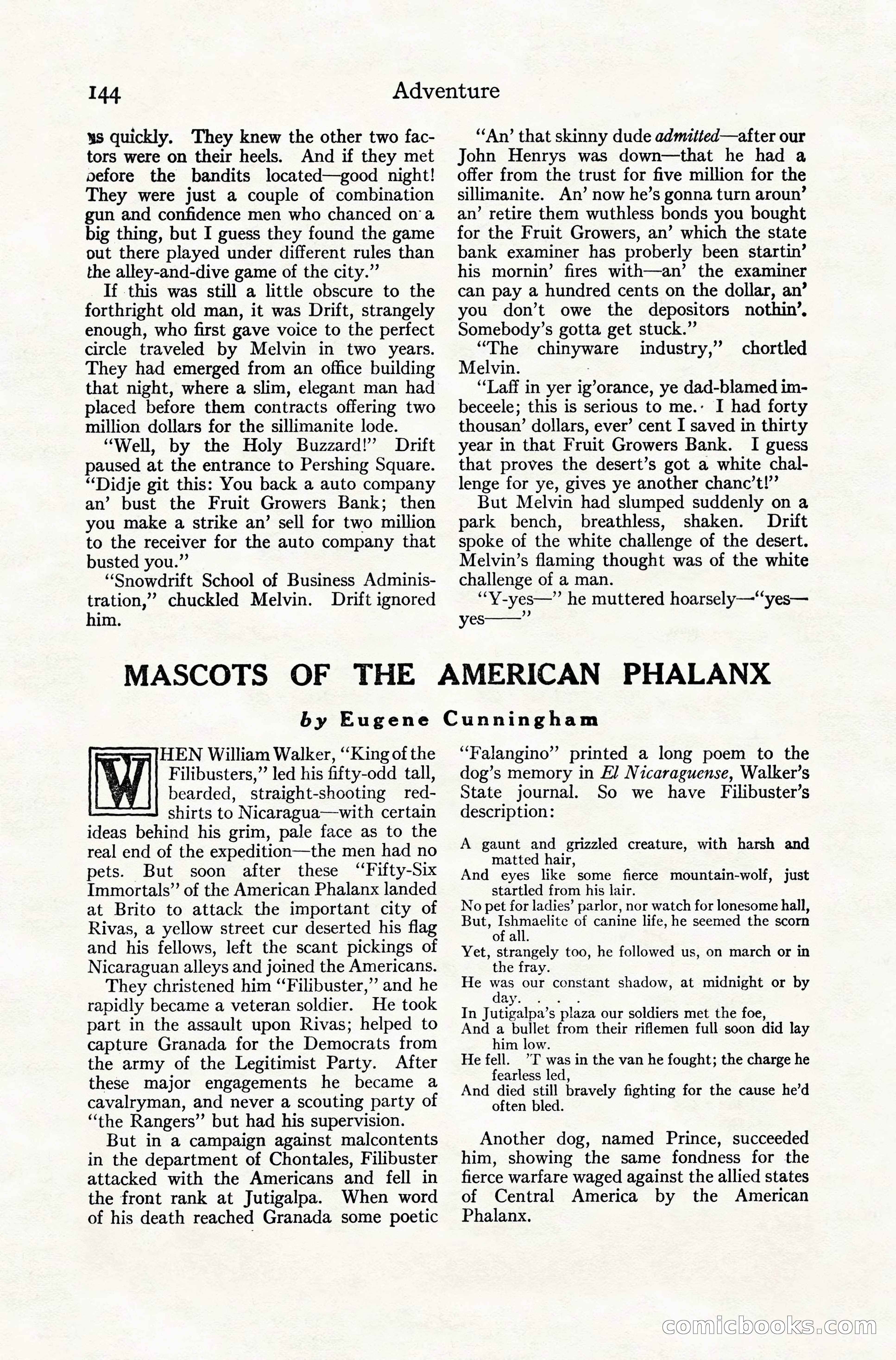
A restored page from Pulp Fiction, 1924. Page through the whole issue in the reader above.
📄 Transcribed text from this page (OCR, searchable)
Machine-transcribed from the original scan — historical spelling and the odd misread are preserved.
144 ys quickly. They knew the other two fac- tors were on their heels. And if they met oefore the bandits located—good night! They were just a couple of combination gun and confidence men who chanced ona big thing, but I guess they found the game out there played under different rules than the alley-and-dive game of the city.” If this was still a little obscure to the forthright old man, it was Drift, strangely enough, who first gave voice to the perfect circle traveled by Melvin in two years. They had emerged from an office building that night, where a slim, elegant man had placed before them contracts offering two million dollars for the sillimanite lode. “Well, by the Holy Buzzard! Drift paused at the entrance to Pershing Square. “Didje git this: You back a auto company an’ bust the Fruit Growers Bank; then you make a strike an’ sell for two million to the receiver for the auto company that busted you.”’ ‘“Snowdrift School of Business Adminis- tration,” chuckled Melvin. Drift ignored him. MASCOTS OF THE AMERICAN Adventure ‘‘An’ that skinny dude admitted—after our John Henrys was down—that he had a offer from the trust for five million for the sillimanite. An’ now he’s gonna turn aroun’ an’ retire them wuthless bonds you bought for the Fruit Growers, an’ which the state bank examiner has proberly been startin’ his mornin’ fires with—an’ the examiner can pay a hundred cents on the dollar, an’ you don’t owe the depositors nothin’, Somebody’s gotta get stuck.” “The chinyware industry,” Melvin. “Laff in yer ig’orance, ye dad-blamed im- beceele; this is serious to me.: I had forty thousan’ dollars, ever’ cent I saved in thirty year in that Fruit Growers Bank. I guess that proves the desert’s got a white chal- lenge for ye, gives ye another chanc’t!’’ But Melvin had slumped suddenly on a park bench, breathless, shaken. Drift spoke of the white challenge of the desert. Melvin’s flaming thought was of the white challenge of a man. ‘“V-yes—” he muttered hoarsely—“yes— ) yeso = chortled PHALANX by Eugene Cunningham wa HEN William Walker, ‘‘King of the M7 Filibusters,” led his fifty-odd tall, wa bearded, straight-shooting red- shirts to Nicaragua—with certain ideas behind his grim, pale face as to the real end of the expedition—the men had no pets. But soon after these “Fifty-Six Immortals” of the American Phalanx landed at Brito to attack the important city of Rivas, a yellow street cur deserted his flag and his fellows, left the scant pickings of Nicaraguan alleys and joined the Americans. They christened him ‘‘Filibuster,”’ and he rapidly became a veteran soldier. He took part in the assault upon Rivas; helped to capture Granada for the Democrats from the army of the Legitimist Party. After these major engagements he became a cavalryman, and never a scouting party of “the Rangers” but had his supervision. But in a campaign against malcontents in the department of Chontales, Filibuster attacked with the Americans and fell in the front rank at Jutigalpa. When word of his death reached Granada some poetic ‘“Falangino” printed a long poem to the dog’s memory in El Nicaraguense, Walker’s State journal. So we have Filibuster’s description: A gaunt and grizzled creature, with harsh and matted hair, And eyes like some fierce mountain-wolf, just startled from his lair. No pet for ladies’ parlor, nor watch for lonesome hall, But, ees of canine life, he seemed the scorn of all. Yet, strangely too, he followed us, on march or in the fray. He was our constant shadow, at midnight or by day 5-2. In Jutigalpa’s plaza our soldiers met the foe, And a bullet from their riflemen full soon did lay him low. He fell. ’I was in the van he fought; the charge he fearless led, And died still bravely fighting for the cause he’d often bled. Another dog, named Prince, succeeded him, showing the same fondness for the fierce warfare waged against the allied states of Central America by the American Phalanx. CoOMmiclhoo (© 5}