
Pulp Fiction, 1924 · page 17 of 194
Adventure Magazine Cover, November 10, 1924 — page 17: what you’re looking at
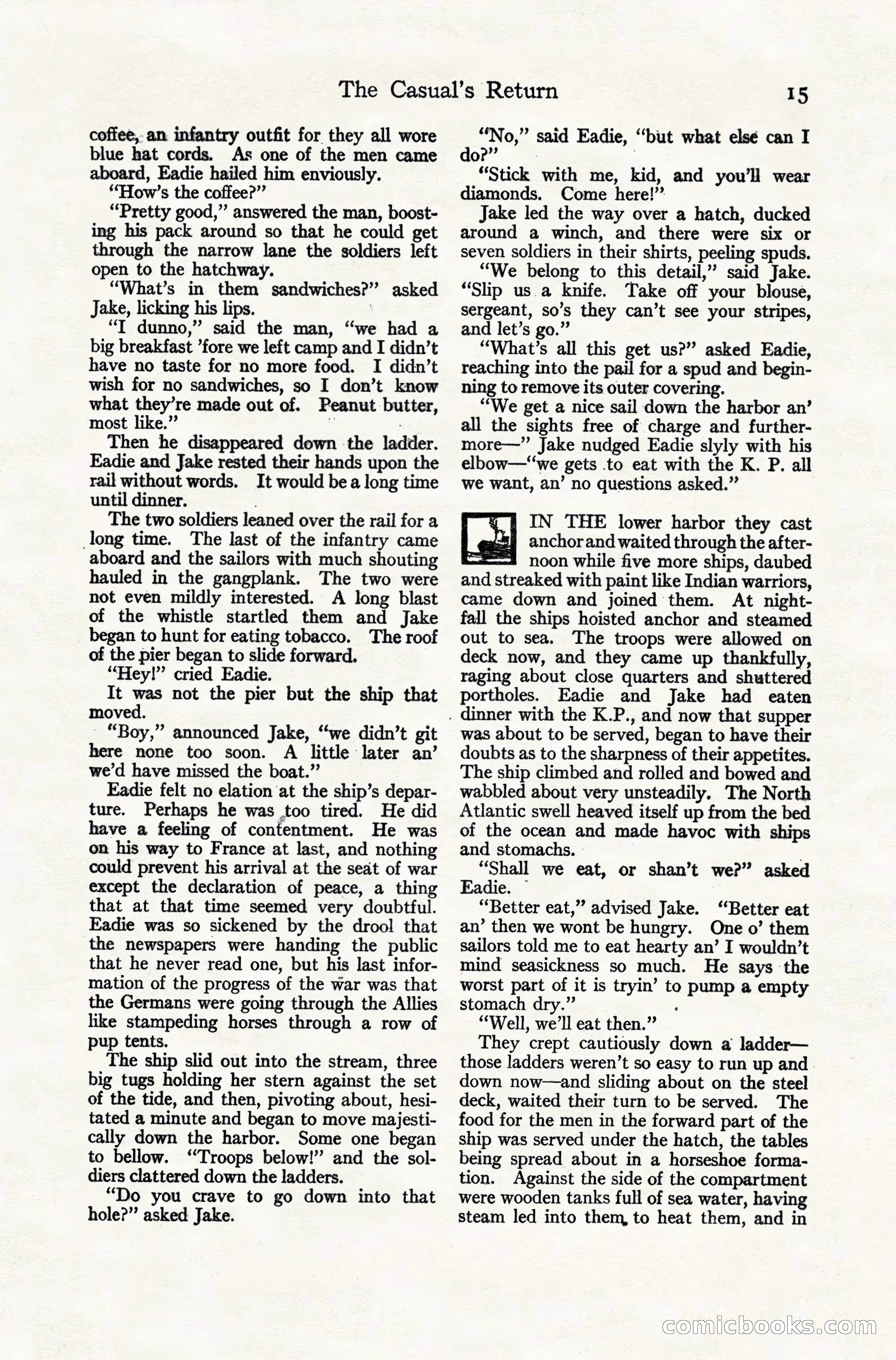
A restored page from Pulp Fiction, 1924. Page through the whole issue in the reader above.
📄 Transcribed text from this page (OCR, searchable)
Machine-transcribed from the original scan — historical spelling and the odd misread are preserved.
The Casual’s Return coffee, an infantry outfit for they all wore blue hat cords. As one of the men came aboard, Eadie hailed him enviously. ““How’s the coffee?” “Pretty good,”’ answered the man, boost- ing his pack around so that he could get through the narrow lane the soldiers left open to the hatchway. “What’s in them sandwiches?” asked Jake, licking his lips. | “I dunno,” said the man, “we had a big breakfast ’fore we left camp and I didn’t have no taste for no more food. I didn’t wish for no sandwiches, so I don’t know what they’re made out of. Peanut butter, most like.” : Then he disappeared down the ladder. Eadie and Jake rested their hands upon the rail without words. It would bea long time until dinner. . The two soldiers leaned over the rail for a long time. The last of the infantry came aboard and the sailors with much shouting hauled in the gangplank. The two were not even mildly interested. A long blast of the whistle startled them and Jake began to hunt for eating tobacco. The roof of the pier began to slide forward. “Hey!” cried Eadie. It was not the pier but the ship that moved. “Boy,” announced Jake, “we didn’t git here none too soon. A little later an’ we'd have missed the boat.” Eadie felt no elation at the ship’s depar- ture. Perhaps he was too tired. He did have a feeling of contentment. He was on his way to France at last, and nothing could prevent his arrival at the seat of war except the declaration of peace, a thing that at that time seemed very doubtful. Eadie was so sickened by the drool that the newspapers were handing the public that he never read one, but his last infor- mation of the progress of the war was that the Germans were going through the Allies hke stampeding horses through a row of pup tents. The ship slid out into the stream, three big tugs holding her stern against the set of the tide, and then, pivoting about, hesi- tated a minute and began to move majesti- cally down the harbor. Some one began to bellow. ‘Troops below!’ and the sol- diers clattered down the ladders. “Do you crave to go down into that hole?” asked Jake. 15 z “No,” said Eadie, “but what elsé can I oP”’ : “Stick with me, kid, and you’ll wear diamonds. Come here!’’ Jake led the way over a hatch, ducked around a winch, and there were six or seven soldiers in their shirts, peeling spuds. “We belong to this detail,’’ said Jake. “Slip us.a knife. Take off your blouse, sergeant, so’s they can’t see your stripes, and let’s go.” “What’s all this get us?” asked Eadie, reaching into the pail for a spud and begin- ning to remove its outer covering. ““We get a nice sail down the harbor an’ all the sights free of charge and further- more—” Jake nudged Eadie slyly with his elbow—‘‘we gets to eat with the K. P. all we want, an’ no questions asked.” a IN THE lower harbor they cast Pas anchor and waited through the after- =< noon while five more ships, daubed and streaked with paint like Indian warriors, came down and joined them. At night- fall the ships hoisted anchor and steamed out to sea. The troops were allowed on deck now, and they came up thankfully, raging about close quarters and shuttered portholes. Eadie and Jake had eaten . dinner with the K.P., and now that supper was about to be served, began to have their doubts as to the sharpness of their appetites. The ship climbed and rolled and bowed and wabbled about very unsteadily. The North Atlantic swell heaved itself up from the bed of the ocean and made havoc with ships and stomachs. | “Shall we eat, or shan’t we?” asked Eadie. — “Better eat,” advised Jake. “Better eat an’ then we wont be hungry. One o’ them sailors told me to eat hearty an’ I wouldn’t mind seasickness so much. He says the worst part of it is tryin’ to pump a empty stomach dry.” “Well, we’ll eat then.” They crept cautiously down a ladder— those ladders weren’t so easy to run up and down now—and sliding about on the steel deck, waited their turn to be served. The food for the men in the forward part of the ship was served under the hatch, the tables being spread about in a horseshoe forma- tion. Against the side of the compartment were wooden tanks full of sea water, having steam led into them, to heat them, and in CoOMmiclhoo (©