
Pulp Fiction, 1924 · page 182 of 194
Adventure Magazine Cover, November 10, 1924 — page 182: what you’re looking at
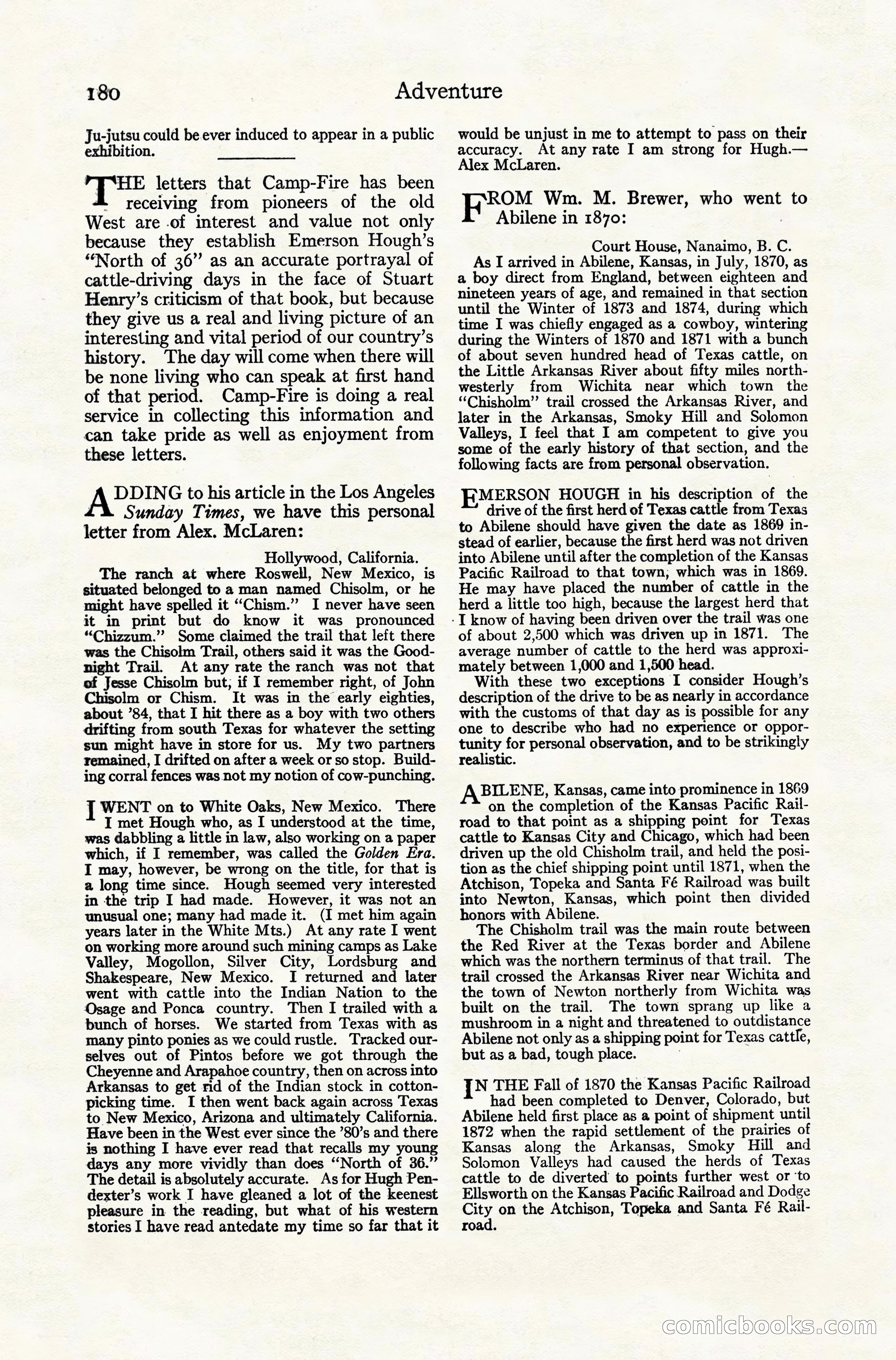
A restored page from Pulp Fiction, 1924. Page through the whole issue in the reader above.
📄 Transcribed text from this page (OCR, searchable)
Machine-transcribed from the original scan — historical spelling and the odd misread are preserved.
180 Ju-jutsu could be ever induced to appear in a public exhibition. HE letters that Camp-Fire has been - receiving from pioneers of the old West are of interest and value not only because they establish Emerson Hough’s “North of 36” as an accurate portrayal of cattle-driving days in the face of Stuart Henry’s criticism of that book, but because they give us a real and living picture of an interesting and vital period of our country’s history. The day will come when there will be none living who can speak at first hand of that period. Camp-Fire is doing a real service in collecting this information and can take pride as well as enjoyment from these letters. A G to his article in the Los Angeles LX Sunday Times, we have this personal letter from Alex. McLaren: Hollywood, California. The ranch at where Roswell, New Mexico, is situated belonged to a man named Chisolm, or he might have spelled it ““Chism.” I never have seen it in print but do know it was _ pronounced “Chizzum.” Some claimed the trail that left there was the Chisolm Trail, others said it was the Good- night Trail. At any rate the ranch was not that of Jesse Chisolm but; if I remember right, of John Chisolm or Chism. It was in the early eighties, about ’84, that I hit there as a boy with two others drifting from south Texas for whatever the setting sun might have in store for us. My two partners remained, I drifted on after a week or so stop. Build- ing corral fences was not my notion of cow-punching. [| WENT on to White Oaks, New Mexico. There I met Hough who, as I understood at the time, was dabbling a little in law, also working on a paper which, if I remember, was called the Golden Era. I may, however, be wrong on the title, for that is a long time since. Hough seemed very interested in the trip I had made. However, it was not an unusual one; many had made it. (I met him again years later in the White Mts.) At any rate I went on working more around such mining camps as Lake Valley, Mogollon, Silver City, Lordsburg and Shakespeare, New Mexico. I returned and later went with cattle into the Indian Nation to the Osage and Ponca country. Then I trailed with a bunch of horses. We started from Texas with as many pinto ponies as we could rustle. Tracked our- selves out of Pintos before we got through the Cheyenne and Arapahoe country, then on across into Arkansas to get rid of the Indian stock in cotton- picking time. I then went back again across Texas to New Mexico, Arizona and ultimately California. Have been in the West ever since the ’80’s and there is nothing I have ever read that recalls my young days any more vividly than does “North of 36.” The detail is absolutely accurate. As for Hugh Pen- dexter’s work I have gleaned a lot of the keenest pleasure in the reading, but what of his western stories I have read antedate my time so far that it Adventure would be unjust in me to attempt to pass on their accuracy. At any rate I am strong for Hugh.— Alex McLaren. ROM Wm. M. Brewer, who went to Abilene in 1870: Court House, Nanaimo, B. C. As I arrived in Abilene, Kansas, in July, 1870, as a boy direct from England, between eighteen and nineteen years of age, and remained in that section until the Winter of 1873 and 1874, during which time I was chiefly engaged as a cowboy, wintering during the Winters of 1870 and 1871 with a bunch of about seven hundred head of Texas cattle, on the Little Arkansas River about fifty miles north- westerly from Wichita near which town the “Chisholm” trail crossed the Arkansas River, and later in the Arkansas, Smoky Hill and Solomon Valleys, I feel that I am competent to give you some of the early history of that section, and the following facts are from personal observation. J{MERSON HOUGH in his description of the drive of the first herd of Texas cattle from Texas to Abilene should have given the date as 1869 in- stead of earlier, because the first herd was not driven into Abilene until after the completion of the Kansas Pacific Railroad to that town; which was in 1869. He may have placed the number of cattle in the herd a little too high, because the largest herd that - I know of having been driven over the trail was one of about 2,500 which was driven up in 1871. The average number of cattle to the herd was approxi- mately between 1,000 and 1,500 head. With these two exceptions I consider Hough’s description of the drive to be as nearly in accordance with the customs of that day as is possible for any one to describe who had no experience or oppor- tunity for personal observation, and to be strikingly realistic. ABILENE, Kansas, came into prominence in 1869 on the completion of the Kansas Pacific Rail- road to that point as a shipping point for Texas cattle to Kansas City and Chicago, which had been driven up the old Chisholm trail, and held the posi- tion as the chief shipping point until 1871, when the Atchison, Topeka and Santa Fé Railroad was built into Newton, Kansas, which point then divided honors with Abilene. The Chisholm trail was the main route between the Red River at the Texas border and Abilene which was the northern terminus of that trail. The trail crossed the Arkansas River near Wichita and the town of Newton northerly from Wichita was built on the trail. The town sprang up like a mushroom in a night and threatened to outdistance Abilene not only as a shipping point for Texas cattle, but as a bad, tough place. {N THE Fall of 1870 the Kansas Pacific Railroad had been completed to Denver, Colorado, but Abilene held first place as a point of shipment until 1872 when the rapid settlement of the prairies of Kansas along the Arkansas, Smoky Hill and Solomon Valleys had caused the herds of Texas cattle to de diverted to points further west or ‘to Ellsworth on the Kansas Pacific Railroad and Dodge ee on the Atchison, Topeka and Santa Fé Rail- road. CoMmiclhoo 5}