
Pulp Fiction, 1924 · page 184 of 194
Adventure Magazine Cover, November 10, 1924 — page 184: what you’re looking at
A restored page from Pulp Fiction, 1924. Page through the whole issue in the reader above.
📄 Transcribed text from this page (OCR, searchable)
Machine-transcribed from the original scan — historical spelling and the odd misread are preserved.
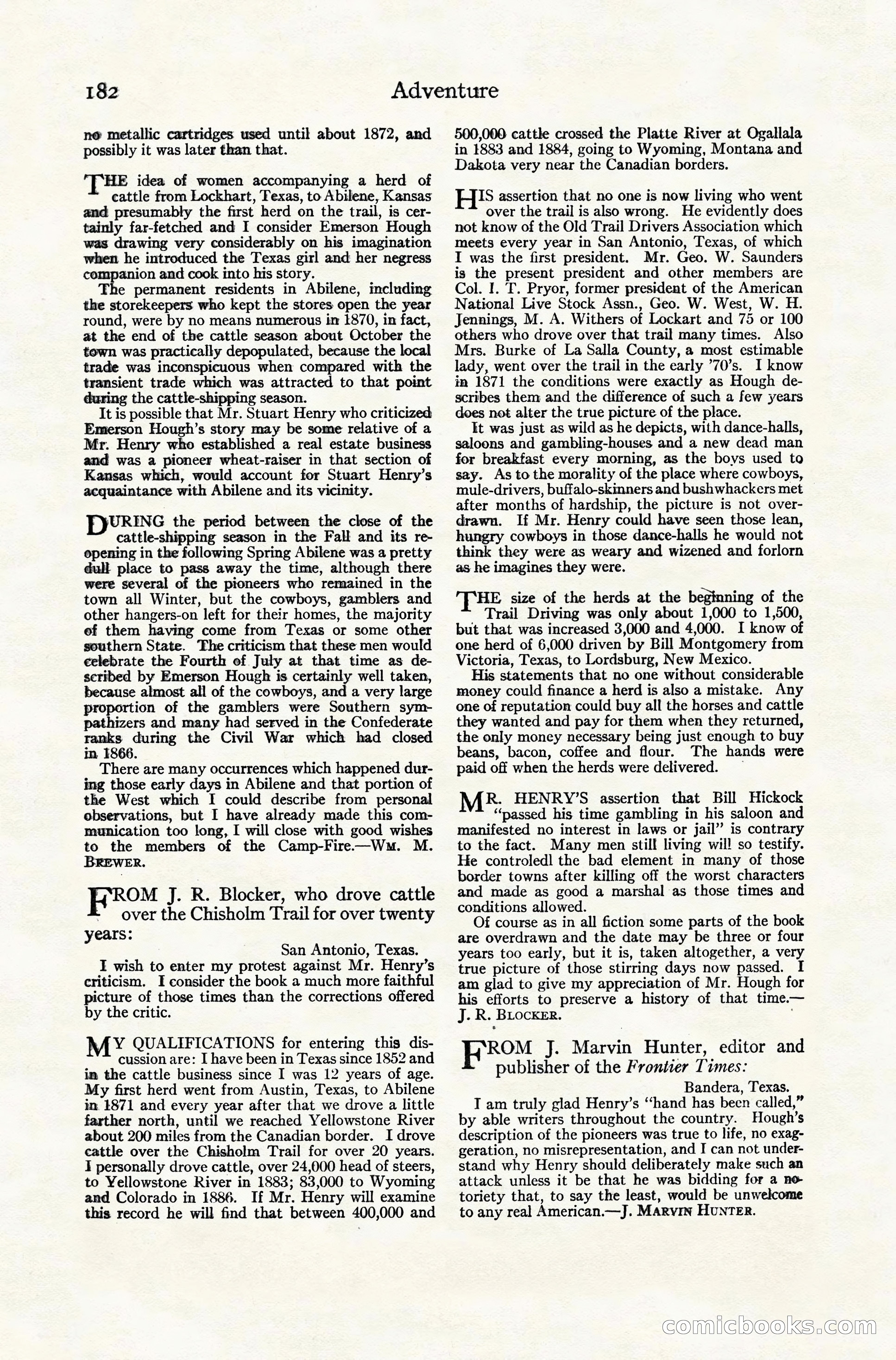
182 no metallic cartridges used until about 1872, and possibly it was later than that. HE idea of women accompanying a herd of cattle from Lockhart, ‘Texas, to Abilene, Kansas and presumably the first herd on the trail, is cer- tainly far-fetched and I consider Emerson Hough was drawing very considerably on his imagination when he introduced the Texas girl and her negress een and cook into his story. The permanent residents in Abilene, including the storekeepers who kept the stores open the year round, were by no means numerous in 1870, in fact, at the end of the cattle season about October the town was practically depopulated, because the local trade was inconspicuous when compared with the transient trade which was attracted to that point during the cattle-shipping season. It is possible that Mr. Stuart Henry who criticized Emerson Hough’s story may be some relative of a Mr. Henry who established a real estate business and was a pioneer wheat-raiser in that section of Kansas which, would account for Stuart Henry’s acquaintance with Abilene and its vicinity. URING the period between the close of the cattle-shipping season in the Fall and its re- opening in the following Spring Abilene was a pretty dull place to pass away the time, although there were several of the pioneers who remained in the town all Winter, but the cowboys, gamblers and other hangers-on left for their homes, the majority ef them having come from Texas or some other southern State. The criticism that these men would eelebrate the Fourth of July at that time as de- scribed by Emerson Hough is certainly well taken, because almost all of the cowboys, and a very large proportion of the gamblers were Southern sym- pathizers and many had served in the Confederate ranks during the Civil War which had closed in 1866. There are many occurrences which happened dur- ing those early days in Abilene and that portion of the West which I could describe from personal observations, but I have already made this com- munication too long, I will close with good wishes to the members of the Camp-Fire——Wm. M. BREWER. 4ROM J. R. Blocker, who drove cattle - over the Chisholm Trail for over twenty years: San Antonio, Texas. I wish to enter my protest against Mr. Henry’s criticism. I consider the book a much more faithful picture of those times than the corrections offered by the critic. MY QUALIFICATIONS for entering this dis- cussion are: I have been in Texas since 1852 and in the cattle business since I was 12 years of age. My first herd went from Austin, Texas, to Abilene in. 1871 and every year after that we drove a little farther north, until we reached Yellowstone River about 200 miles from the Canadian border. I drove cattle over the Chisholm Trail for over 20 years. I personally drove cattle, over 24,000 head of steers, to Yellowstone River in 1883; 83,000 to Wyoming and Colorado in 1886. If Mr. Henry will examine this record he will find that between 400,000 and Adventure 500,000 cattle crossed the Platte River at Ogallala in 1883 and 1884, going to Wyoming, Montana and Dakota very near the Canadian borders. Hs assertion that no one is now living who went over the trail is also wrong. He evidently does not know of the Old Trail Drivers Association which meets every year in San Antonio, Texas, of which I was the first president. Mr. Geo. W. Saunders is the present president and other members are Col. I. TF. Pryor, former president of the American National Live Stock Assn., Geo. W. West, W. H. Jennings, M. A. Withers of Lockart and 75 or 100 others who drove over that trail many times. Also Mrs. Burke of La Salla County, a most estimable lady, went over the trail in the early ’70’s. I know in 1871 the conditions were exactly as Hough de- scribes them and the difference of such a few years does not alter the true picture of the place. It was just as wild as he depicts, with dance-halls, saloons and gambling-houses and a new dead man for breakfast every morning, as the bovs used to say. As tothe morality of the place where cowboys, mule-drivers, buffalo-skinners and bushwhackers met after months of hardship, the picture is not over- drawn. If Mr. Henry could have seen those lean, hungry cowboys in those dance-halls he would not think they were as weary and wizened and forlorn as he imagines they were. ‘THE size of the herds at the beginning of the Trail Driving was only about 1,000 to 1,500, but that was increased 3,000 and 4,000. I know of one herd of 6,000 driven by Bill Montgomery from Victoria, Texas, to Lordsburg, New Mexico. His statements that no one without considerable money could finance a herd is also a mistake. Any one of reputation could buy all the horses and cattle they wanted and pay for them when they returned, the only money necessary being just enough to buy beans, bacon, coffee and flour. The hands were paid off when the herds were delivered. _ Me. HENRY’S assertion that Bill Hickock “passed his time gambling in his saloon and manifested no interest in laws or jail’ is contrary to the fact. Many men still living wil! so testify. He controledl the bad element in many of those border towns after killing off the worst characters and made as good a marshal as those times and conditions allowed. Of course as in all fiction some parts of the book are overdrawn and the date may be three or four years too early, but it is, taken altogether, a very true picture of those stirring days now passed. I am glad to give my appreciation of Mr. Hough for his efforts to preserve a history of that time.— J. R. BLOCKER. ROM J. Marvin Hunter, editor and publisher of the Frontier Times: Bandera, Texas. T am truly glad Henry’s “hand has been called,” by able writers throughout the country. Hough’s description of the pioneers was true to life, no exag- geration, no misrepresentation, and I can not under- stand why Henry should deliberately make such an attack unless it be that he was bidding for a no toriety that, to say the least, would be unwelcome to any real American.—J. Marvin HUNTER. COMmicloo 5}