
Pulp Fiction, 1924 · page 190 of 194
Adventure Magazine Cover, November 10, 1924 — page 190: what you’re looking at
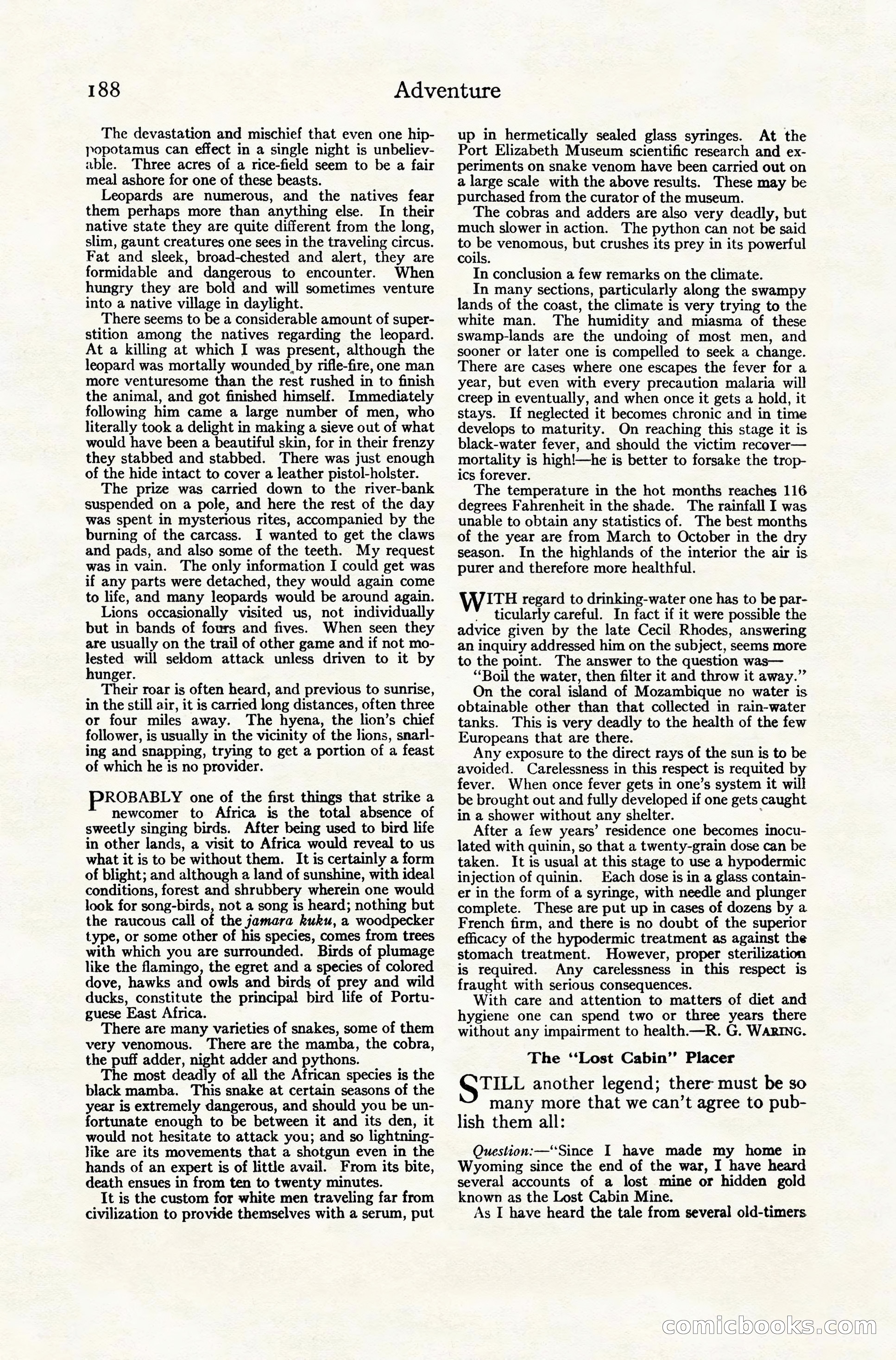
A restored page from Pulp Fiction, 1924. Page through the whole issue in the reader above.
📄 Transcribed text from this page (OCR, searchable)
Machine-transcribed from the original scan — historical spelling and the odd misread are preserved.
188 The devastation and mischief that even one hip- popotamus can effect in a single night is unbeliev- ible. Three acres of a rice-field seem to be a fair meal ashore for one of these beasts. Leopards are numerous, and the natives fear them perhaps more than anything else. In their native state they are quite different from the long, slim, gaunt creatures one sees In the traveling circus. Fat and sleek, broad-chested and alert, they are formidable and dangerous to encounter. When hungry they are bold and will sometimes venture into a native village in daylight. There seems to be a considerable amount of super- stition among the natives regarding the leopard. At a killing at which I was present, although the leopard was mortally wounded _by rifle-fire, one man more venturesome than the rest rushed in to finish the animal, and got finished himself. Immediately following him came a large number of men, who literally took a delight in making a sieve out of what would have been a beautiful skin, for in their frenzy they stabbed and stabbed. There was just enough of the hide intact to cover a leather pistol-holster. The prize was carried down to the river-bank suspended on a pole, and here the rest of the day was spent in mysterious rites, accompanied by the burning of the carcass. I wanted to get the claws and pads, and also some of the teeth. My request was in vain. The only information I could get was if any parts were detached, they would again come to life, and many leopards would be around again. Lions occasionally visited us, not individually but in bands of fours and fives. When seen they are usually on the trail of other game and if not mo- lested will seldom attack unless driven to it by hunger. Their roar is often heard, and previous to sunrise, in the still air, it is carried long distances, often three or four miles away. The hyena, the lion’s chief follower, is usually in the vicinity of the lions, snarl- ing and snapping, trying to get a portion of a feast of which he is no provider. ROBABLY one of the first things that strike a newcomer to Africa is the total absence of sweetly singing birds. After being used to bird life in other lands, a visit to Africa would reveal to us what it is to be without them. It is certainly a form of blight; and although a land of sunshine, with ideal conditions, forest and shrubbery wherein one would look for song-birds, not a song is heard; nothing but the raucous call of the jamara kuku, a woodpecker type, or some other of his species, comes from trees with which you are surrounded. Birds of plumage like the flamingo, the egret and a species of colored dove, hawks and owls and birds of prey and wild ducks, constitute the principal bird life of Portu- guese East Africa. There are many varieties of snakes, some of them very venomous. There are the mamba, the cobra, the puff adder, night adder and pythons. The most deadly of all the African species is the black mamba. This snake at certain seasons of the year is extremely dangerous, and should you be un- fortunate enough to be between it and its den, it would not hesitate to attack you; and so lightning- like are its movements that a shotgun even in the hands of an expert is of little avail. From its bite, death ensues in from ten to twenty minutes. It is the custom for white men traveling far from civilization to provide themselves with a serum, put Adventure up in hermetically sealed glass syringes. At the Port Elizabeth Museum scientific research and ex- periments on snake venom have been carried out on a large scale with the above results. These may be purchased from the curator of the museum. The cobras and adders are also very deadly, but much slower in action. The python can not be said Os venomous, but crushes its prey in its powerful coils. In conclusion a few remarks on the climate. In many sections, particularly along the swampy lands of the coast, the climate is very trying to the white man. The humidity and miasma of these swamp-lands are the undoing of most men, and sooner or later one is compelled to seek a change. There are cases where one escapes the fever for a year, but even with every precaution malaria will creep in eventually, and when once it gets a hold, it stays. If neglected it becomes chronic and in time develops to maturity. On reaching this stage it is black-water fever, and should the victim recover— mortality is high!—he is better to forsake the trop- ics forever. The temperature in the hot months reaches 116 degrees Fahrenheit in the shade. The rainfall I was unable to obtain any statistics of. The best months of the year are from March to October in the dry season. In the highlands of the interior the air is purer and therefore more healthful. ITH regard to drinking-water one has to be par- | ticularly careful. In fact if it were possible the advice given by the late Cecil Rhodes, answering an inquiry addressed him on the subject, seems more to the point. The answer to the question was— “Boil the water, then filter it and throw it away.”’ On the coral island of Mozambique no water is obtainable other than that collected in rain-water tanks. This is very deadly to the health of the few [Europeans that are there. Any exposure to the direct rays of the sun is to be avoided. Carelessness in this respect is requited by fever. When once fever gets in one’s system it will be brought out and fully developed if one gets caught in a shower without any shelter. ; After a few years’ residence one becomes inocu- lated with quinin, so that a twenty-grain dose can be taken. It is usual at this stage to use a hypodermic injection of quinin. Each dose is in a glass contain- er in the form of a syringe, with needle and plunger complete. These are put up in cases of dozens by a French firm, and there is no doubt of the superior efficacy of the hypodermic treatment as against the stomach treatment. However, proper sterilization is required. Any carelessness in this respect is fraught with serious consequences. With care and attention to matters of diet and hygiene one can spend two or three years there without any impairment to health.—R. G. WARING. The ‘‘Lost Cabin’’ Placer GTILL another legend; there must be so many more that we can’t agree to pub- lish them all: Question:—“Since I have made my home in Wyoming since the end of the war, I have heard several accounts of a lost mine or hidden gold known as the Lost Cabin Mine. As I have heard the tale from several old-timers COMmMiclhoo 5}