
Pulp Fiction, 1924 · page 26 of 194
Adventure Magazine Cover, November 10, 1924 — page 26: what you’re looking at
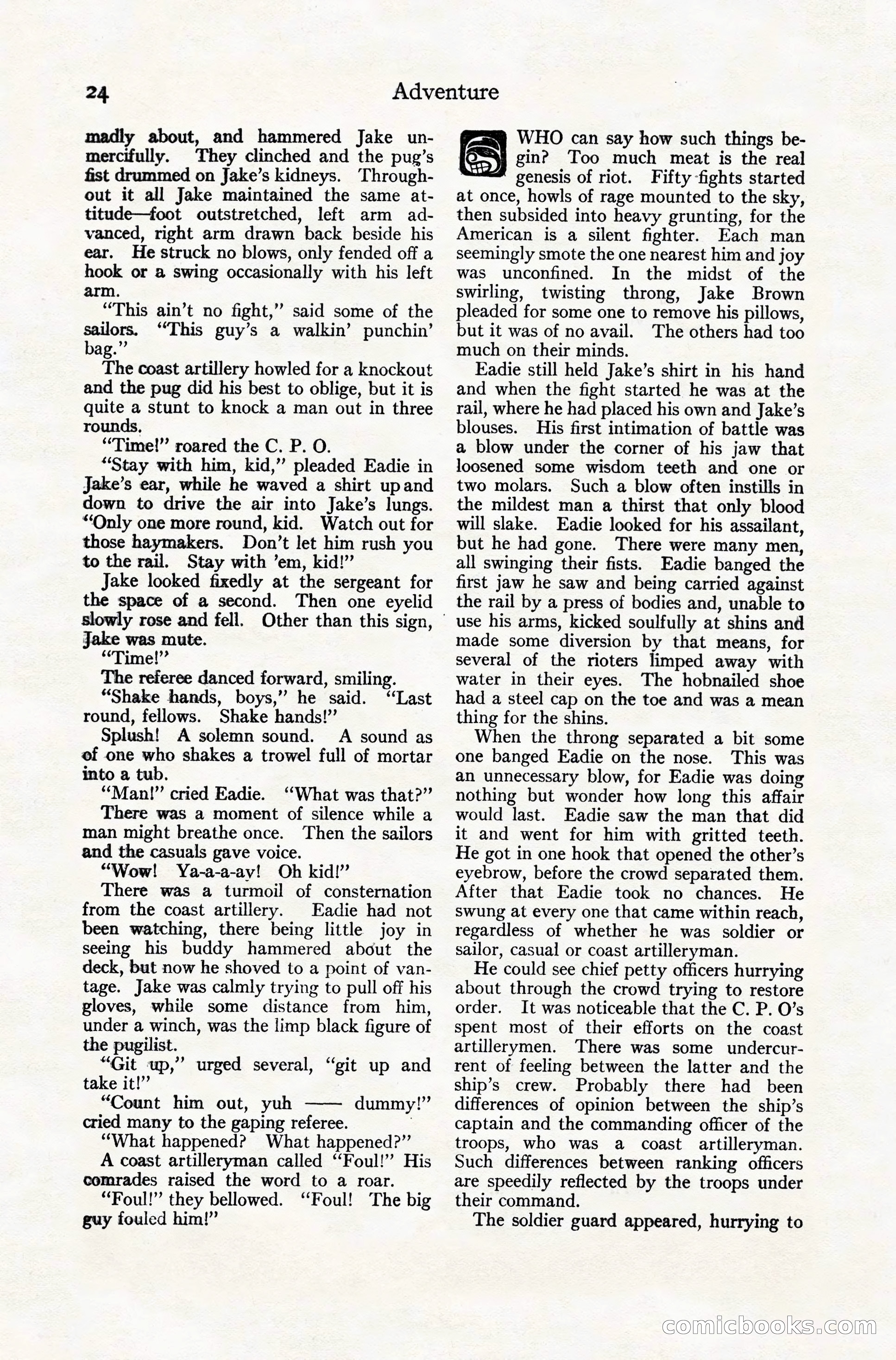
A restored page from Pulp Fiction, 1924. Page through the whole issue in the reader above.
📄 Transcribed text from this page (OCR, searchable)
Machine-transcribed from the original scan — historical spelling and the odd misread are preserved.
24 madly about, and hammered Jake un- mercifully. They clinched and the pug’s fist drummed on Jake’s kidneys. Through- out it all Jake maintained the same at- titude—foot outstretched, left arm ad- vanced, right arm drawn back beside his ear. He struck no blows, only fended off a hook or a swing occasionally with his left arm. “This ain’t no fight,” said some of the sailors. ‘This guy’s a walkin’ punchin’ bag.” The coast artillery howled for a knockout and the pug did his best to oblige, but it is quite a stunt to knock a man out in three rounds, “Time!” roared the C. P. O. “Stay with him, kid,’’ pleaded Eadie in Jake’s ear, while he waved a shirt upand down to drive the air into Jake’s lungs. “Only one more round, kid. Watch out for those haymakers. Don’t let him rush you to the rail. Stay with ’em, kid!” Jake looked fixedly at the sergeant for the space of a second. Then one eyelid slowly rose and fell. Other than this sign, © jake was mute. “Time!” The referee danced forward, smiling. “Shake bands, boys,” he said. ‘Last round, fellows. Shake hands!’’ Splush! A solemn sound. A sound as of one who shakes a trowel full of mortar into a tub. “Man!” cried Eadie. ‘What was that?” There was a moment of silence while a man might breathe once. Then the sailors and the casuals gave voice. “Wow! Ya-a-a-ay! Oh kid!” There was a turmoil of consternation from the coast artillery. Eadie had not been watching, there being little joy in seeing his buddy hammered about the deck, but now he shoved to a point of van- tage. Jake was calmly trying to pull off his gloves, while some distance from him, under a winch, was the limp black figure of the pugilist. “Git up,’ urged several, “git up and take it!” “Count him out, yuh cried many to the gaping referee. “What happened? What happened?”’ A coast artilleryman called ‘Foul!’ His comrades raised the word to a roar. “Foul!” they bellowed. “Foul! The big guy fouled him!” dummy!” Adventure WHO can say how such things be- +4 gin? Too much meat is the real genesis of riot. Fifty fights started at once, howls of rage mounted to the sky, then subsided into heavy grunting, for the American is a silent fighter. Each man seemingly smote the one nearest him and joy was unconfined. In the midst of the swirling, twisting throng, Jake Brown pleaded for some one to remove his pillows, but it was of no avail. The others had too much on their minds. Eadie still held Jake’s shirt in his hand and when the fight started he was at the rail, where he had placed his own and Jake’s blouses. His first intimation of battle was a blow under the corner of his jaw that loosened some wisdom teeth and one or two molars. Such a blow often instills in the mildest man a thirst that only blood will slake. Eadie looked for his assailant, but he had gone. There were many men, all swinging their fists. Eadie banged the first jaw he saw and being carried against the rail by a press of bodies and, unable to use his arms, kicked soulfully at shins and made some diversion by that means, for several of the rioters limped away with water in their eyes. The hobnailed shoe had a steel cap on the toe and was a mean thing for the shins. When the throng separated a bit some one banged Eadie on the nose. This was an unnecessary blow, for Eadie was doing nothing but wonder how long this affair would last. Eadie saw the man that did it and went for him with gritted teeth. He got in one hook that opened the other’s eyebrow, before the crowd separated them. After that Eadie took no chances. He swung at every one that came within reach, regardless of whether he was soldier or sailor, casual or coast artilleryman. He could see chief petty officers hurrying about through the crowd trying to restore order. It was noticeable that the C. P. O’s spent most of their efforts on the coast artillerymen. There was some undercur- rent of feeling between the latter and the ship’s crew. Probably there had been differences of opinion between the ship’s captain and the commanding officer of the troops, who was a coast artilleryman. Such differences between ranking officers are speedily reflected by the troops under their command. The soldier guard appeared, hurrying to CoMmicboook A) CO 5}