
Pulp Fiction, 1924 · page 104 of 216
Adventure Magazine, December 10, 1924 — page 104: what you’re looking at
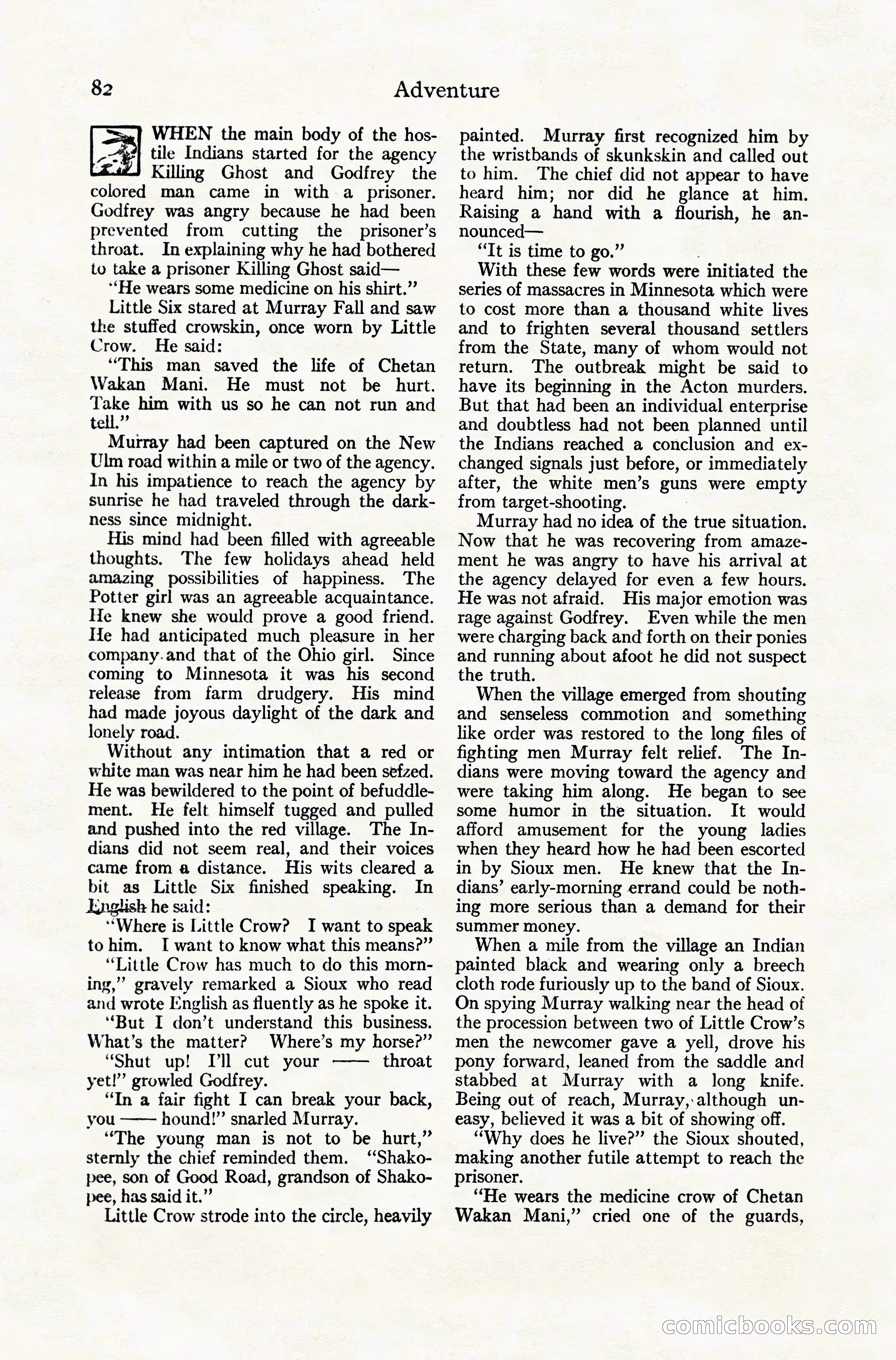
A restored page from Pulp Fiction, 1924. Page through the whole issue in the reader above.
📄 Transcribed text from this page (OCR, searchable)
Machine-transcribed from the original scan — historical spelling and the odd misread are preserved.
82 WHEN the main body of the hos- tile Indians started for the agency Killing Ghost and Godfrey the colored man came in with a prisoner. Godfrey was angry because he had been prevented from cutting the prisoner’s throat. In explaining why he had bothered to take a prisoner Killing Ghost said— ‘‘He wears some medicine on his shirt.” Little Six stared at Murray Fall and saw the stuffed crowskin, once worn by Little Crow. He said: “This man saved the life of Chetan Wakan Mani. He must not be hurt. Take him with us so he can not run and tell.” Murray had been captured on the New Ulm road within a mile or two of the agency. In his impatience to reach the agency by sunrise he had traveled through the dark- ness since midnight. His mind had been filled with agreeable thoughts. The few holidays ahead held amazing possibilities of happiness. The Potter girl was an agreeable acquaintance. He knew she would prove a good friend. He had anticipated much pleasure in her company.and that of the Ohio girl. Since coming to Minnesota it was his second release from farm drudgery. His mind had made joyous daylight of the dark and lonely road. Without any intimation that a red or white man was near him he had been sefzed. He was bewildered to the point of befuddle- ment. He felt himself tugged and pulled and pushed into the red village. The In- dians did not seem real, and their voices came from a distance. His wits cleared a bit as Little Six finished speaking. In Lnelish he said: ‘Where is Little Crow? I want to speak tohim. I want to know what this means?” “Little Crow has much to do this morn- ing,” gravely remarked a Sioux who read and wrote English as fluently as he spoke it. ‘But I don’t understand this business. What’s the matter? Where’s my horse?” “Shut up! Dll cut your —— throat yet!” growled Godfrey. “In a fair fight I can break your back, you —— hound!” snarled Murray. ‘“‘The young man is not to be hurt,” sternly the chief reminded them. ‘‘Shako- pee, son of Good Road, grandson of Shako- pee, has said it.” Little Crow strode into the circle, heavily Adventure painted. Murray first recognized him by the wristbands of skunkskin and called out to him. The chief did not appear to have heard him; nor did he glance at him. Raising a hand with a flourish, he an- nounced— “Tt is time to go.” With these few words were initiated the series of massacres in Minnesota which were to cost more than a thousand white lives and to frighten several thousand settlers from the State, many of whom would not return. The outbreak might be said to have its beginning in the Acton murders. But that had been an individual enterprise and doubtless had not been planned until the Indians reached a conclusion and ex- changed signals just before, or immediately after, the white men’s guns were empty from target-shooting. Murray had no idea of the true situation. Now that he was recovering from amaze- ment he was angry to have his arrival at the agency delayed for even a few hours. He was not afraid. His major emotion was rage against Godfrey. Even while the men were charging back and forth on their ponies and running about afoot he did not suspect the truth. When the village emerged from shouting and senseless commotion and something like order was restored to the long files of fighting men Murray felt relief. The In- dians were moving toward the agency and were taking him along. He began to see some humor in the situation. It would afford amusement for the young ladies when they heard how he had been escorted in by Sioux men. He knew that the In- dians’ early-morning errand could be noth- ing more serious than a demand for their summer money. When a mile from the village an Indian painted black and wearing only a breech cloth rode furiously up to the band of Sioux. On spying Murray walking near the head of the procession between two of Little Crow’s men the newcomer gave a yell, drove his pony forward, leaned from the saddle and stabbed at Murray with a long knife. Being out of reach, Murray,:although un- easy, believed it was a bit of showing off. “Why does he live?” the Sioux shouted, making another futile attempt to reach the prisoner. “‘He wears the medicine crow of Chetan Wakan Mani,” cried one of the guards, COmiclbook (© =