
Pulp Fiction, 1924 · page 112 of 216
Adventure Magazine, December 10, 1924 — page 112: what you’re looking at
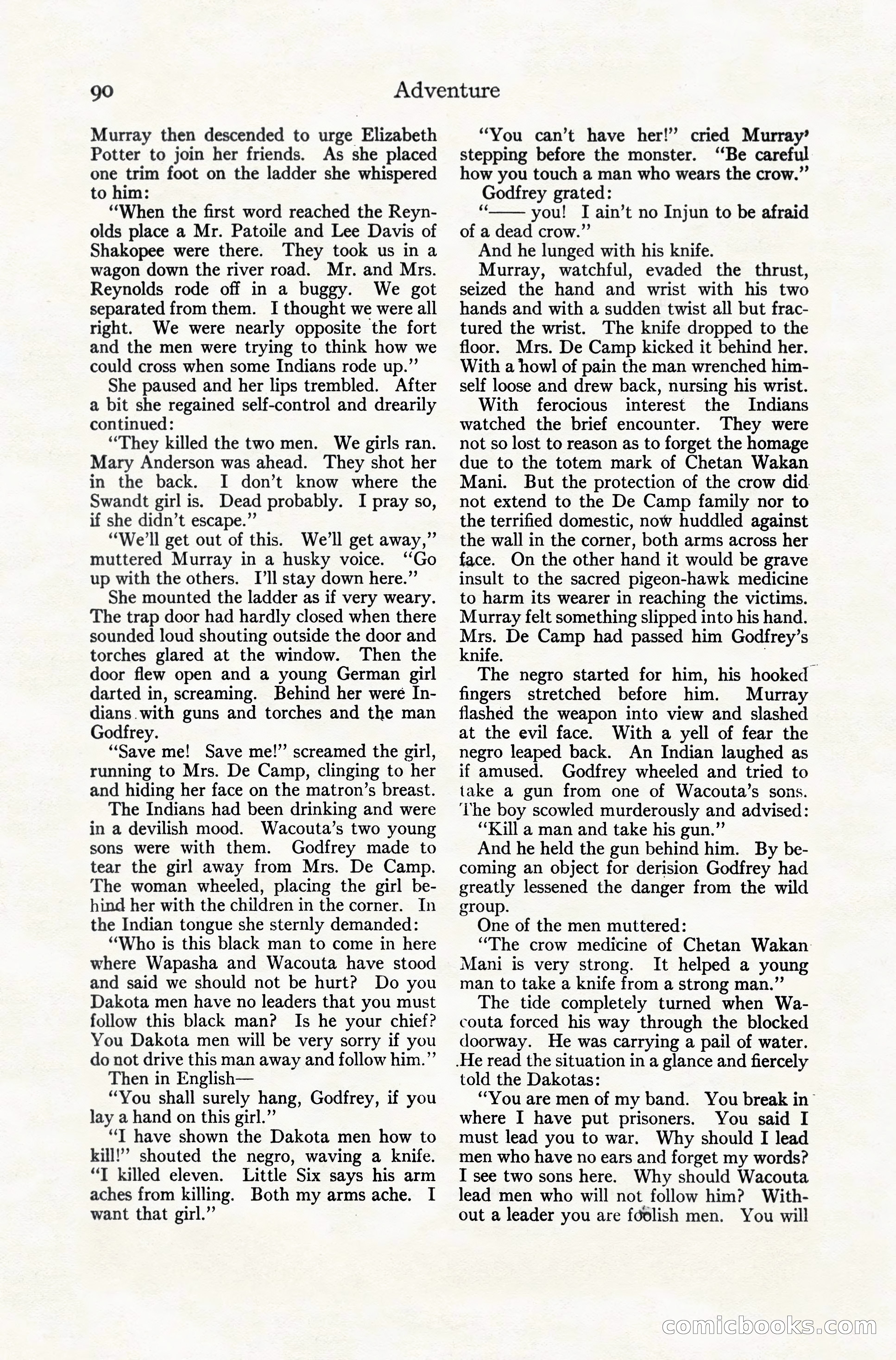
A restored page from Pulp Fiction, 1924. Page through the whole issue in the reader above.
📄 Transcribed text from this page (OCR, searchable)
Machine-transcribed from the original scan — historical spelling and the odd misread are preserved.
gO Murray then descended to urge Elizabeth Potter to join her friends. As she placed one trim foot on the ladder she whispered to him: ‘‘When the first word reached the Reyn- olds place a Mr. Patoile and Lee Davis of Shakopee were there. They took us in a wagon down the river road. Mr. and Mrs. Reynolds rode off in a buggy. We got separated from them. I thought we were all right. We were nearly opposite the fort and the men were trying to think how we could cross when some Indians rode up.” She paused and her lips trembled. After a bit she regained self-control and drearily continued: “They killed the two men. We girls ran. Mary Anderson was ahead. They shot her in the back. I don’t know where the Swandt girl is. Dead probably. I pray so, if she didn’t escape.” “We'll get out of this. We'll get away,” muttered Murray in a husky voice. ‘Go up with the others. I'll stay down here.” She mounted the ladder as if very weary. The trap door had hardly closed when there sounded loud shouting outside the door and torches glared at the window. Then the door flew open and a young German girl darted in, screaming. Behind her were In- dians with guns and torches and the man Godfrey. “Save me! Save me!” screamed the girl, running to Mrs. De Camp, clinging to her and hiding her face on the matron’s breast. The Indians had been drinking and were in a devilish mood. Wacouta’s two young sons were with them. Godfrey made to tear the girl away from Mrs. De Camp. The woman wheeled, placing the girl be- hind her with the children in the corner. In the Indian tongue she sternly demanded: ‘Who is this black man to come in here where Wapasha and Wacouta have stood and said we should not be hurt? Do you Dakota men have no leaders that you must follow this black man? Is he your chief? You Dakota men will be very sorry if you do not drive this man away and follow him.” Then in English— “You shall surely hang, Godfrey, if you lay a hand on this girl.” “T have shown the Dakota men how to kill!” shouted the negro, waving a knife. “T killed eleven. Little Six says his arm aches from killing. Both my arms ache. I want that girl.”’ Adventure “You can’t have her!” cried Murray’ stepping before the monster. “Be careful how you touch a man who wears the crow.” Godfrey grated: ‘you! I ain’t no Injun to be afraid of a dead crow.” And he lunged with his knife. Murray, watchful, evaded the thrust, seized the hand and wrist with his two hands and with a sudden twist all but frac- tured the wrist. The knife dropped to the floor. Mrs. De Camp kicked it behind her. With a howl of pain the man wrenched him- self loose and drew back, nursing his wrist. With ferocious interest the Indians watched the brief encounter. They were not so lost to reason as to forget the homage due to the totem mark of Chetan Wakan Mani. But the protection of the crow did not extend to the De Camp family nor to the terrified domestic, now huddled against the wall in the corner, both arms across her face. On the other hand it would be grave insult to the sacred pigeon-hawk medicine to harm its wearer in reaching the victims. Murray felt something slipped into his hand. Mrs. De Camp had passed him Godfrey’s knife. The negro started for him, his hooked fingers stretched before him. Murray flashed the weapon into view and slashed at the evil face. With a yell of fear the negro leaped back. An Indian laughed as if amused. Godfrey wheeled and tried to take a gun from one of Wacouta’s sons. ‘The boy scowled murderously and advised: “Kill a man and take his gun.”’ And he held the gun behind him. By be- coming an object for derision Godfrey had greatly lessened the danger from the wild group. One of the men muttered: “The crow medicine of Chetan Wakan Mani is very strong. It helped a young man to take a knife from a strong man.” The tide completely turned when Wa- couta forced his way through the blocked doorway. He was carrying a pail of water. -He read the situation in a glance and fiercely told the Dakotas: “You are men of my band. You break in’ where I have put prisoners. You said I must lead you to war. Why should I lead men who have no ears and forget my words? I see two sons here. Why should Wacouta lead men who will not follow him? With- out a leader you are foolish men. You will CoOMmiclbook A) © =