
Pulp Fiction, 1924 · page 128 of 216
Adventure Magazine, December 10, 1924 — page 128: what you’re looking at
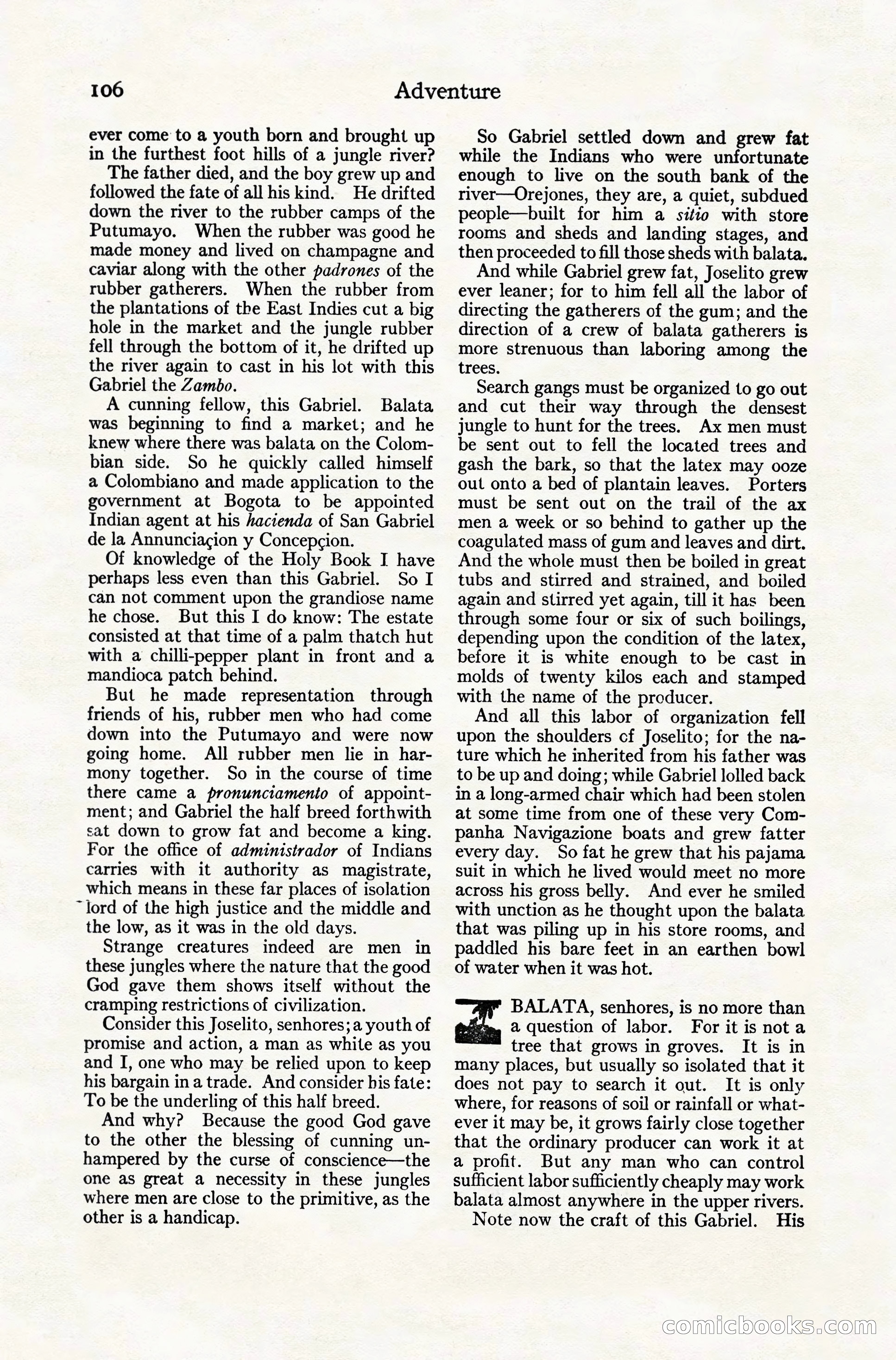
A restored page from Pulp Fiction, 1924. Page through the whole issue in the reader above.
📄 Transcribed text from this page (OCR, searchable)
Machine-transcribed from the original scan — historical spelling and the odd misread are preserved.
106 ever come to a youth born and brought up in the furthest foot hills of a jungle river? The father died, and the boy grew up and followed the fate of all his kind. He drifted down the river to the rubber camps of the Putumayo. When the rubber was good he made money and lived on champagne and caviar along with the other padrones of the rubber gatherers. When the rubber from the plantations of the East Indies cut a big hole in the market and the jungle rubber fell through the bottom of it, he drifted up the river again to cast in his lot with this Gabriel the Zambo. A cunning fellow, this Gabriel. Balata was beginning to find a market; and he knew where there was balata on the Colom- bian side. So he quickly called himself a Colombiano and made application to the government at Bogota to be appointed Indian agent at his hacienda of San Gabriel de la Annunciacion y Concepcion. Of knowledge of the Holy Book I have perhaps less even than this Gabriel. So I can not comment upon the grandiose name he chose. But this I do know: The estate consisted at that time of a palm thatch hut with a chilli-pepper plant in front and a mandioca patch behind. But he made representation through friends of his, rubber men who had come down into the Putumayo and were now going home. All rubber men lie in har- mony together. So in the course of time there came a pronunciamento of appoint- ment; and Gabriel the half breed forthwith sat down to grow fat and become a king. For the office of administrador of Indians carries with it authority as magistrate, which means in these far places of isolation “lord of the high justice and the middle and the low, as it was in the old days. Strange creatures indeed are men in these jungles where the nature that the good God gave them shows itself without the cramping restrictions of civilization. Consider this Joselito, senhores; a youth of promise and action, a man as white as you and I, one who may be relied upon to keep his bargain ina trade. And consider his fate: To be the underling of this half breed. And why? Because the good God gave to the other the blessing of cunning un- hampered by the curse of conscience—the one as great a necessity in these jungles where men are close to the primitive, as the other is a handicap. Adventure So Gabriel settled down and grew fat while the Indians who were unfortunate enough to live on the south bank of the river—Orejones, they are, a quiet, subdued people—built for him a sitio with store rooms and sheds and landing stages, and then proceeded to fill those sheds with balata. And while Gabriel grew fat, Joselito grew ever leaner; for to him fell all the labor of directing the gatherers of the gum; and the direction of a crew of balata gatherers is more strenuous than laboring among the trees. Search gangs must be organized to go out and cut their way through the densest jungle to hunt for the trees. Ax men must be sent out to fell the located trees and gash the bark, so that the latex may ooze out onto a bed of plantain leaves. Porters must be sent out on the trail of the ax men a week or so behind to gather up the coagulated mass of gum and leaves and dirt. And the whole must then be boiled in great tubs and stirred and strained, and boiled again and stirred yet again, till it has been through some four or six of such boilings, depending upon the condition of the latex, before it is white enough to be cast in molds of twenty kilos each and stamped with the name of the producer. And all this labor of organization fell upon the shoulders cf Joselito; for the na- ture which he inherited from his father was to be up and doing; while Gabriel lolled back in a long-armed chair which had been stolen at some time from one of these very Com- panha Navigazione boats and grew fatter every day. So fat he grew that his pajama suit in which he lived would meet no more across his gross belly. And ever he smiled with unction as he thought upon the balata that was piling up in his store rooms, and paddled his bare feet in an earthen bowl of water when it was hot. BALATA, senhores, is no more than a question of labor. For it is not a tree that grows in groves. It is in many places, but usually so isolated that it does not pay to search it out. It is only where, for reasons of soil or rainfall or what- ever it may be, it grows fairly close together that the ordinary producer can work it at a profit. But any man who can control sufficient labor sufficiently cheaply may work balata almost anywhere in the upper rivers. Note now the craft of this Gabriel. His ma CoMmicbool A) (© =