
Pulp Fiction, 1924 · page 197 of 216
Adventure Magazine, December 10, 1924 — page 197: what you’re looking at
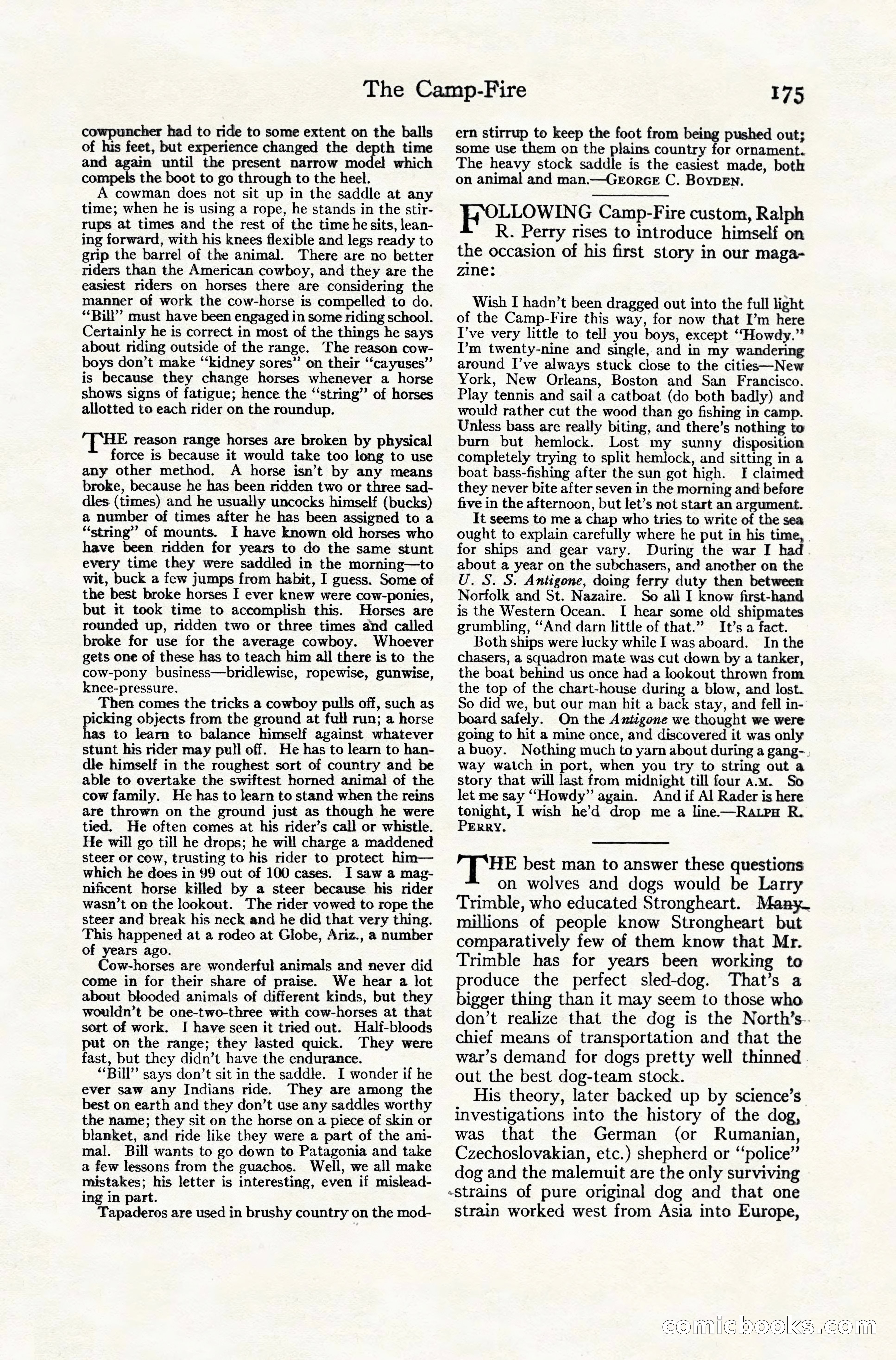
A restored page from Pulp Fiction, 1924. Page through the whole issue in the reader above.
📄 Transcribed text from this page (OCR, searchable)
Machine-transcribed from the original scan — historical spelling and the odd misread are preserved.
The Camp-Fire cowpuncher had to ride to some extent on the balls of his feet, but experience changed the depth time and again until the present narrow model which compels the boot to go through to the heel. A cowman does not sit up in the saddle at any time; when he is using a rope, he stands in the stir- rups at times and the rest of the time he sits, lean- ing forward, with his knees flexible and legs ready to grip the barrel of the animal. There are no better riders than the American cowboy, and they are the easiest riders on horses there are considering the manner of work the cow-horse is compelled to do. ‘Bill’ must have been engaged in some riding school. Certainly he is correct in most of the things he says about riding outside of the range. The reason cow- boys don’t make “‘kidney sores”’ on their ‘‘cayuses’’ is because they change horses whenever a horse shows signs of fatigue; hence the “‘string” of horses allotted to each rider on the roundup. ‘THE reason range horses are broken by physical force is because it would take too long to use any other method. A horse isn’t by any means broke, because he has been ridden two or three sad- dles (times) and he usually uncocks himself (bucks) a number of times after he has been assigned to a “string” of mounts. I have known old horses who have been ridden for years to do the same stunt every time they were saddled in the morning—to wit, buck a few jumps from habit, I guess. Some of the best broke horses I ever knew were cow-ponies, but it took time to accomplish this. Horses are rounded up, ridden two or three times and called broke for use for the average cowboy. Whoever gets one of these has to teach him all there is to the cow-pony business—bridlewise, ropewise, gunwise, knee-pressure. Then comes the tricks a cowboy pulls off, such as picking objects from the ground at full run; a horse has to learn to balance himself against whatever stunt his rider may pull off. He has to learn to han- dle himself in the roughest sort of country and be able to overtake the swiftest horned animal of the cow family. He has to learn to stand when the reins are thrown on the ground just as though he were tied. He often comes at his rider’s call or whistle. He will go till he drops; he will charge a maddened steer or cow, trusting to his rider to protect him— which he does in 99 out of 100 cases. I saw a mag- nificent horse killed by a steer because his rider wasn’t on the lookout. The rider vowed to rope the steer and break his neck and he did that very thing. This happened at a rodeo at Globe, Ariz., a number of years ago. Cow-horses are wonderful animals and never did come in for their share of praise. We hear a lot about blooded animals of different kinds, but they wouldn’t be one-two-three with cow-horses at that sort of work. I have seen it tried out. Half-bloods put on the range; they lasted quick. They were fast, but they didn’t have the endurance. “Bill” says don’t sit in the saddle. I wonder if he ever saw any Indians ride. They are among the best on earth and they don’t use any saddles worthy the name; they sit on the horse on a piece of skin or blanket, and ride like they were a part of the ani- mal. Bill wants to go down to Patagonia and take a few lessons from the guachos. Well, we all make mistakes; his letter is interesting, even if mislead- ing in part. Tapaderos are used in brushy country on the mod- 175 ern stirrup to keep the foot from being pushed out; some use them on the plains country for ornament. The heavy stock saddle is the easiest made, both on animal and man.—GeEorcE C. BoypDEN. He ONG Camp-Fire custom, Ralph R. Perry rises to introduce himself on the occasion of his first story in our maga- zine: Wish I hadn’t been dragged out into the full light of the Camp-Fire this way, for now that I’m here I’ve very little to tell you boys, except “Howdy.” I’m twenty-nine and single, and in my wandering around I’ve always stuck close to the cities—New York, New Orleans, Boston and San Francisco. Play tennis and sail a catboat (do both badly) and would rather cut the wood than go fishing in camp. Unless bass are really biting, and there’s nothing to burn but hemlock. Lost my sunny disposition completely trying to split hemlock, and sitting in a boat bass-fishing after the sun got high. I claimed they never bite after seven in the morning and before five in the afternoon, but let’s not start an argument. It seems to me a chap who tries to write of the sea ought to explain carefully where he put in his time, . for ships and gear vary. During the war I had about a year on the subchasers, and another on the U. S. S. Antigone, doing ferry duty then between Norfolk and St. Nazaire. So all I know first-hand is the Western Ocean. I hear some old shipmates grumbling, ‘‘And darn little of that.” It’s a fact. Both ships were lucky while I was aboard. In the chasers, a squadron mate was cut down by a tanker, the boat behind us once had a lookout thrown from the top of the chart-house during a blow, and lost. So did we, but our man hit a back stay, and fell in- board safely. On the Aztigone we thought we were going to hit a mine once, and discovered it was only a buoy. Nothing much to yarn about during a gang-. way watch in port, when you try to string out a story that will last from midnight till four a.m. So let me say ‘““Howdy”’ again. And if Al Rader is here jonlE hE I wish he’d drop me a line.—Ratpy R. ERRY. "TE best man to answer these questions on wolves and dogs would be Larry Trimble, who educated Strongheart. Many millions of people know Strongheart but comparatively few of them know that Mr. Trimble has for years been working to produce the perfect sled-dog. That’s a bigger thing than it may seem to those who don’t realize that the dog is the North’s- chief means of transportation and that the war’s demand for dogs pretty well thinned . out the best dog-team stock. His theory, later backed up by science’s investigations into the history of the dog, was that the German (or Rumanian, Czechoslovakian, etc.) shepherd or ‘‘police” dog and the malemuit are the only surviving © «strains of pure original dog and that one strain worked west from Asia into Europe, CoOMmicloo 5}