
Pulp Fiction, 1924 · page 200 of 216
Adventure Magazine, December 10, 1924 — page 200: what you’re looking at
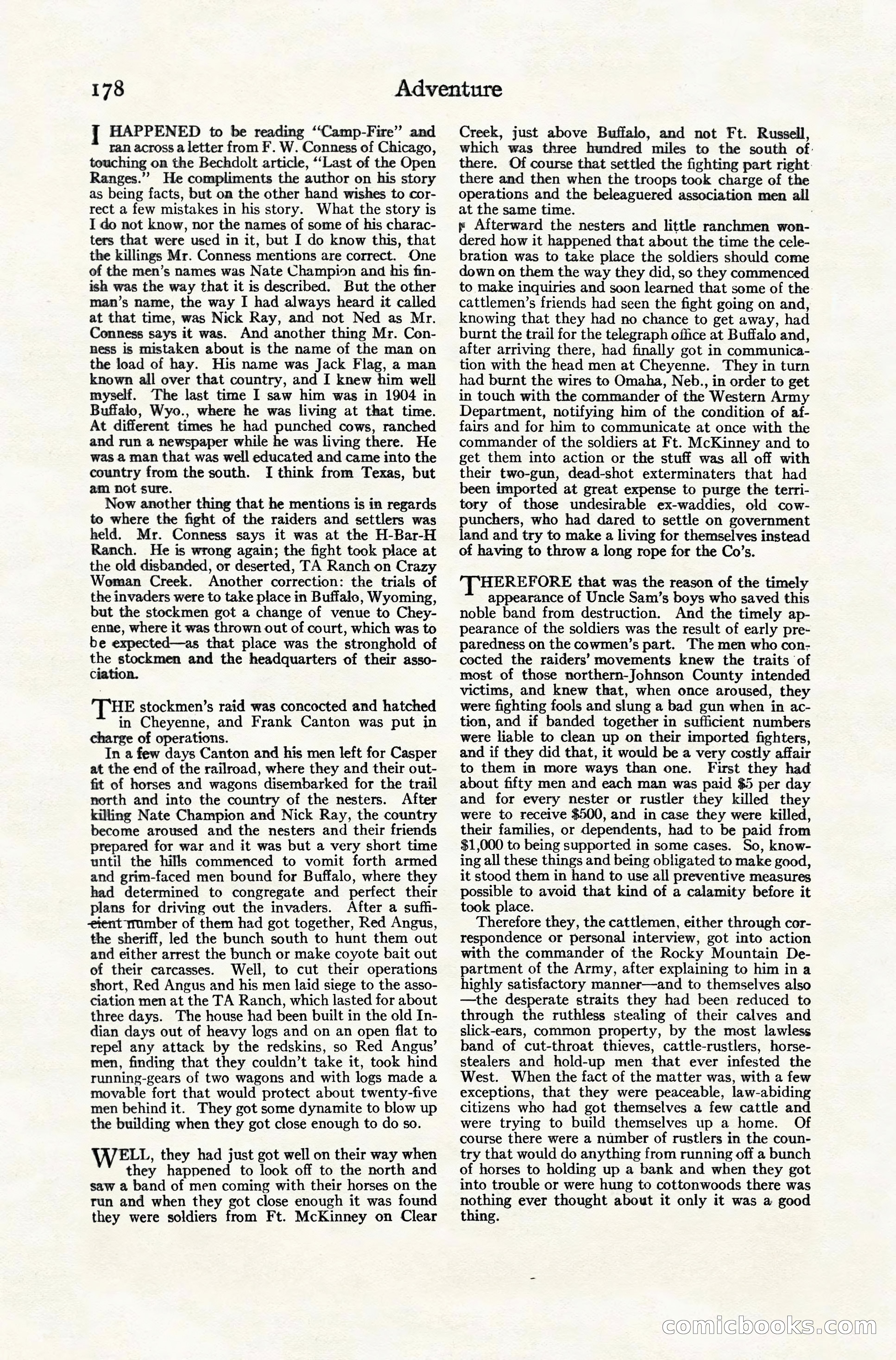
A restored page from Pulp Fiction, 1924. Page through the whole issue in the reader above.
📄 Transcribed text from this page (OCR, searchable)
Machine-transcribed from the original scan — historical spelling and the odd misread are preserved.
178 ] HAPPENED to be reading ‘‘Camp-Fire” and ran across a letter from F. W. Conness of Chicago, touching on the Bechdolt article, ‘‘Last of the Open Ranges.’”’ He compliments the author on his story as being facts, but on the other hand wishes to cor- rect a few mistakes in his story. What the story is I do not know, nor the names of some of his charac- ters that were used in it, but I do know this, that the killings Mr. Conness mentions are correct. One of the men’s names was Nate Champion and his fin- ish was the way that it is described. But the other man’s name, the way I had always heard it called at that time, was Nick Ray, and not Ned as Mr. Conness says it was. And another thing Mr. Con- ness is mistaken about is the name of the man on the load of hay. His name was Jack Flag, a man known all over that country, and I knew him well myself. The last time I saw him was in 1904 in Buffalo, Wyo., where he was living at that time. At different times he had punched cows, ranched and run a newspaper while he was living there. He was a man that was well educated and came into the country from the south. I think from Texas, but am not sure. Now another thing that he mentions is in regards to where the fight of the raiders and settlers was held. Mr. Conness says it was at the H-Bar-H Ranch. He is wrong again; the fight took place at the old disbanded, or deserted, TA Ranch on Crazy Woman Creek. Another correction: the trials of the invaders were to take place in Buffalo, Wyoming, but the stockmen got a change of venue to Chey- enne, where it was thrown out of court, which was to be expected—as that place was the stronghold of the stockmen and the headquarters of their asso- Ciation. ‘THE stockmen’s raid was concocted and hatched in Cheyenne, and Frank Canton was put in charge of operations. In a few days Canton and his men left for Casper at the end of the railroad, where they and their out- fit of horses and wagons disembarked for the trail north and into the country of the nesters. After killing Nate Champion and Nick Ray, the country become aroused and the nesters and their friends prepared for war and it was but a very short time until the hills commenced to vomit forth armed and grim-faced men bound for Buffalo, where they had determined to congregate and perfect their plans for driving out the invaders. After a suffi- tent rmmber of them had got together, Red Angus, the sheriff, led the bunch south to hunt them out and either arrest the bunch or make coyote bait out of their carcasses. Well, to cut their operations short, Red Angus and his men laid siege to the asso- ciation men at the TA Ranch, which lasted for about three days. The house had been built in the old In- dian days out of heavy logs and on an open flat to repel any attack by the redskins, so Red Angus’ men, finding that they couldn’t take it, took hind running-gears of two wagons and with logs made a movable fort that would protect about twenty-five men behind it. They got some dynamite to blow up the building when they got close enough to do so. ELL, they had just got well on their way when they happened to look off to the north and saw a band of men coming with their horses on the run and when they got close enough it was found they were soldiers from Ft. McKinney on Clear Adventure Creek, just above Buffalo, and not Ft. Russell, which was three hundred miles to the south of: there. Of course that settled the fighting part right. there and then when the troops took charge of the operations and the beleaguered association men all at the same time. ! s) Afterward the nesters and little ranchmen won- dered how it happened that about the time the cele- bration was to take place the soldiers should come down on them the way they did, so they commenced to make inquiries and soon learned that some of the: cattlemen’s friends had seen the fight going on and, knowing that they had no chance to get away, had burnt the trail for the telegraph office at Buffalo and, after arriving there, had finally got in communica- tion with the head men at Cheyenne. They in turn had burnt the wires to Omaha, Neb., in order to get in touch with the commander of the Western Army Department, notifying him of the condition of af- fairs and for him to communicate at once with the commander of the soldiers at Ft. McKinney and to get them into action or the stuff was all off with their two-gun, dead-shot exterminaters that had been imported at great expense to purge the terri- tory of those undesirable ex-waddies, old cow- punchers, who had dared to settle on government land and try to make a living for themselves instead of having to throw a long rope for the Co’s. (T HEREF ORE that was the reason of the timely appearance of Uncle Sam’s boys who saved this noble band from destruction. And the timely ap- pearance of the soldiers was the result of early pre- paredness on the cowmen’s part. The men who con- cocted the raiders’ movements knew the traits of most of those northern-Johnson County intended victims, and knew that, when once aroused, they were fighting fools and slung a bad gun when in ac- tion, and if banded together in sufficient numbers were liable to clean up on their imported fighters, and if they did that, it would be a very costly affair to them in more ways than one. First they had about fifty men and each man was paid $5 per day and for every nester or rustler they killed they were to receive $500, and in case they were killed, their families, or dependents, had to be paid from $1,000 to being supported in some cases. So, know- ing all these things and being obligated to make good, it stood them in hand to use all preventive measures possible to avoid that kind of a calamity before it took place. Therefore they, the cattlemen, either through cor- respondence or personal interview, got into action with the commander of the Rocky Mountain De- partment of the Army, after explaining to him in a highly satisfactory manner—and to themselves also —the desperate straits they had been reduced to through the ruthless stealing of their calves and slick-ears, common property, by the most lawless band of cut-throat thieves, cattle-rustlers, horse- stealers and hold-up men that ever infested the West. When the fact of the matter was, with a few exceptions, that they were peaceable, law-abiding citizens who had got themselves a few cattle and were trying to build themselves up a home. Of course there were a number of rustlers in the coun- try that would do anything from running off a bunch of horses to holding up a bank and when they got into trouble or were hung to cottonwoods there was nothing ever thought about it only it was a good thing. CoOMmiclhoo =