
Pulp Fiction, 1924 · page 205 of 216
Adventure Magazine, December 10, 1924 — page 205: what you’re looking at
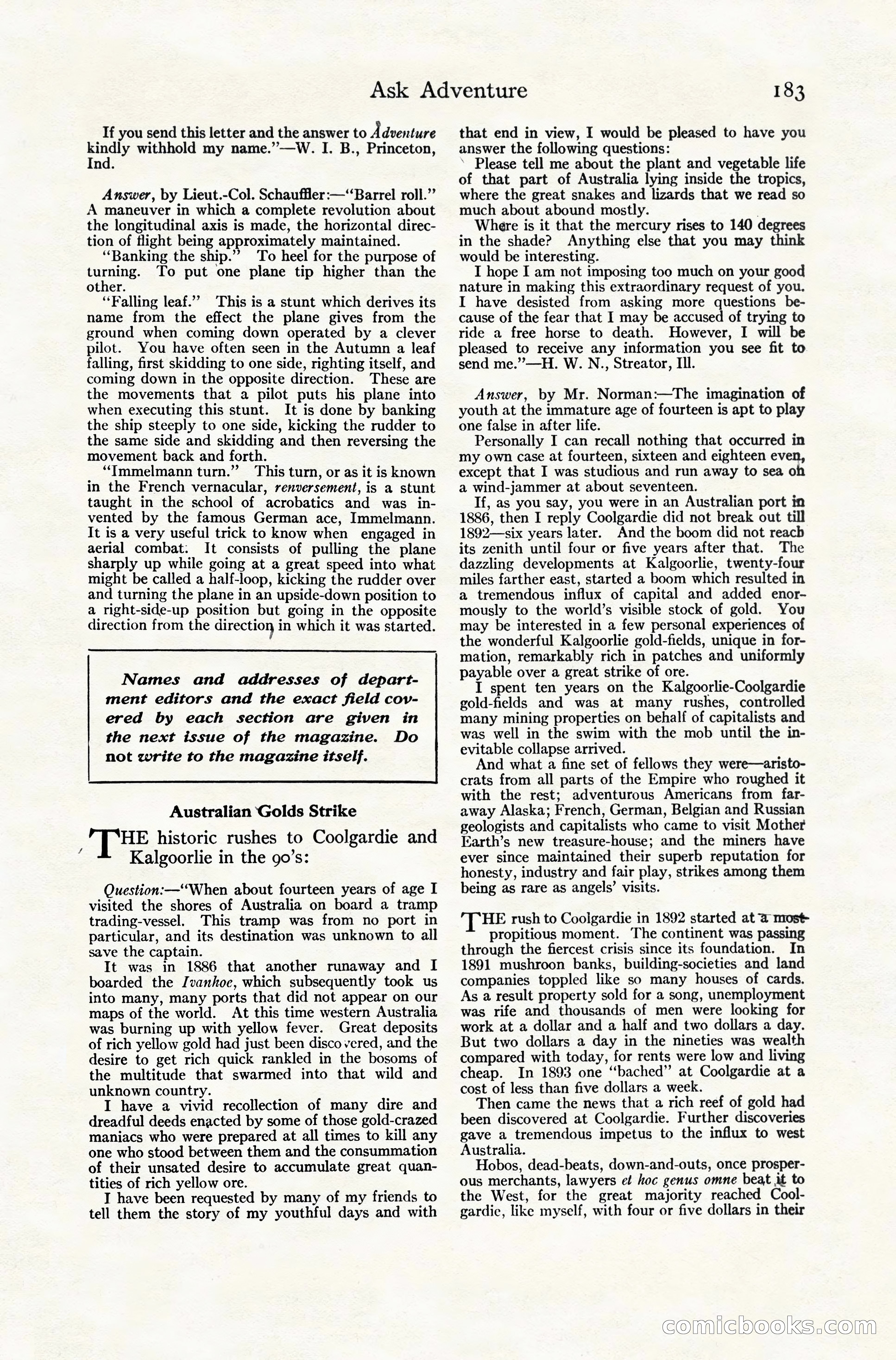
A restored page from Pulp Fiction, 1924. Page through the whole issue in the reader above.
📄 Transcribed text from this page (OCR, searchable)
Machine-transcribed from the original scan — historical spelling and the odd misread are preserved.
NS Ask Adventure If you send this letter and the answer to Adventure ae withhold my name.”—W. I. B., Princeton, Ind. Answer, by Lieut.-Col. Schauffler:—‘“‘Barrel roll.’’ A maneuver in which a complete revolution about the longitudinal axis is made, the horizontal direc- tion of flight being approximately maintained. “Banking the ship.” ‘To heel for the purpose of turning. To put one plane tip higher than the other. “Falling leaf.’’ This is a stunt which derives its name from the effect the plane gives from the ground when coming down operated by a clever pilot. You have often seen in the Autumn a leaf falling, first skidding to one side, righting itself, and coming down in the opposite direction. These are the movements that a pilot puts his plane into when executing this stunt. It is done by banking the ship steeply to one side, kicking the rudder to the same side and skidding and then reversing the movement back and forth. 3 “Tmmelmann turn.” This turn, or as it is known in the French vernacular, renversement, is a stunt taught in the school of acrobatics and was in- vented by the famous German ace, Immelmann. It is a very useful trick to know when engaged in aerial combat. It consists of pulling the plane sharply up while going at a great speed into what might be called a half-loop, kicking the rudder over and turning the plane in an upside-down position to a right-side-up position but going in the opposite direction from the direction in which it was started. Names and addresses of depart- ment editors and the exact field cov- ered by each section are given in the next issue of the magazine. not write to the magazine itself. Do Australian ‘Golds Strike "THE historic rushes to Coolgardie and Kalgoorlie in the go’s: Question: —“When about fourteen years of age I visited the shores of Australia on board a tramp trading-vessel. This tramp was from no port in particular, and its destination was unknown to all save the captain. It was in 1886 that another runaway and I boarded the Jvankoe, which subsequently took us into many, many ports that did not appear on our maps of the world. At this time western Australia was burning up with yellow fever. Great deposits of rich yellow gold had just been discovered, and the desire to get rich quick rankled in the bosoms of the multitude that swarmed into that wild and unknown country. I have a vivid recollection of many dire and dreadful deeds enacted by some of those gold-crazed maniacs who were prepared at all times to kill any one who stood between them and the consummation of their unsated desire to accumulate great quan- tities of rich yellow ore. I have been requested by many of my friends to tell them the story of my youthful days and with 183 that end in view, I would be pleased to have you answer the following questions: ’ Please tell me about the plant and vegetable life of that part of Australia lying inside the tropics, where the great snakes and lizards that we read so much about abound mostly. Where is it that the mercury rises to 140 degrees in the shade? Anything else that you may think would be interesting. I hope I am not imposing too much on your good nature in making this extraordinary request of you. I have desisted from asking more questions be- cause of the fear that I may be accused of trying to ride a free horse to death. However, I will be pleased to receive any information you see fit to send me.”—H. W. N., Streator, Il. Answer, by Mr. Norman:—The imagination of youth at the immature age of fourteen is apt to play one false in after life. Personally I can recall nothing that occurred in my own case at fourteen, sixteen and eighteen even, except that I was studious and run away to sea oh a wind-jammer at about seventeen. If, as you say, you were in an Australian port in 1886, then I reply Coolgardie did not break out till 1892—six years later. And the boom did not reach its zenith until four or five years after that. The dazzling developments at Kalgoorlie, twenty-four miles farther east, started a boom which resulted in a tremendous influx of capital and added enor- mously to the world’s visible stock of gold. You may be interested in a few personal experiences of the wonderful Kalgoorlie gold-fields, unique in for- mation, remarkably rich in patches and uniformly payable over a great strike of ore. I spent ten years on the Kalgoorlie-Coolgardie gold-fields and was at many rushes, controlled many mining properties on behalf of capitalists and was well in the swim with the mob until the in- evitable collapse arrived. And what a fine set of fellows they were—aristo- crats from all parts of the Empire who roughed it with the rest; adventurous Americans from far- away Alaska; French, German, Belgian and Russian geologists and capitalists who came to visit Mother Earth’s new treasure-house; and the miners have ever since maintained their superb reputation for honesty, industry and fair play, strikes among them being as rare as angels’ visits. HE rush to Coolgardie in 1892 started at a most propitious moment. The continent was passing through the fiercest crisis since its foundation. In 1891 mushroon banks, building-societies and land companies toppled like so many houses of cards. As a result property sold for a song, unemployment was rife and thousands of men were looking for work at a dollar and a half and two dollars a day. But two dollars a day in the nineties was wealth compared with today, for rents were low and living cheap. In 1893 one “bached” at Coolgardie at a cost of less than five dollars a week. Then came the news that a rich reef of gold had been discovered at Coolgardie. Further discoveries gave a tremendous impetus to the influx to west Australia. Hobos, dead-beats, down-and-outs, once prosper- ous merchants, lawyers ef hoc genus omne beat it to the West, for the great majority reached Cool- gardic, like myself, with four or five dollars in their = CoOMmiclhoo 5}