
Pulp Fiction, 1924 · page 210 of 216
Adventure Magazine, December 10, 1924 — page 210: what you’re looking at
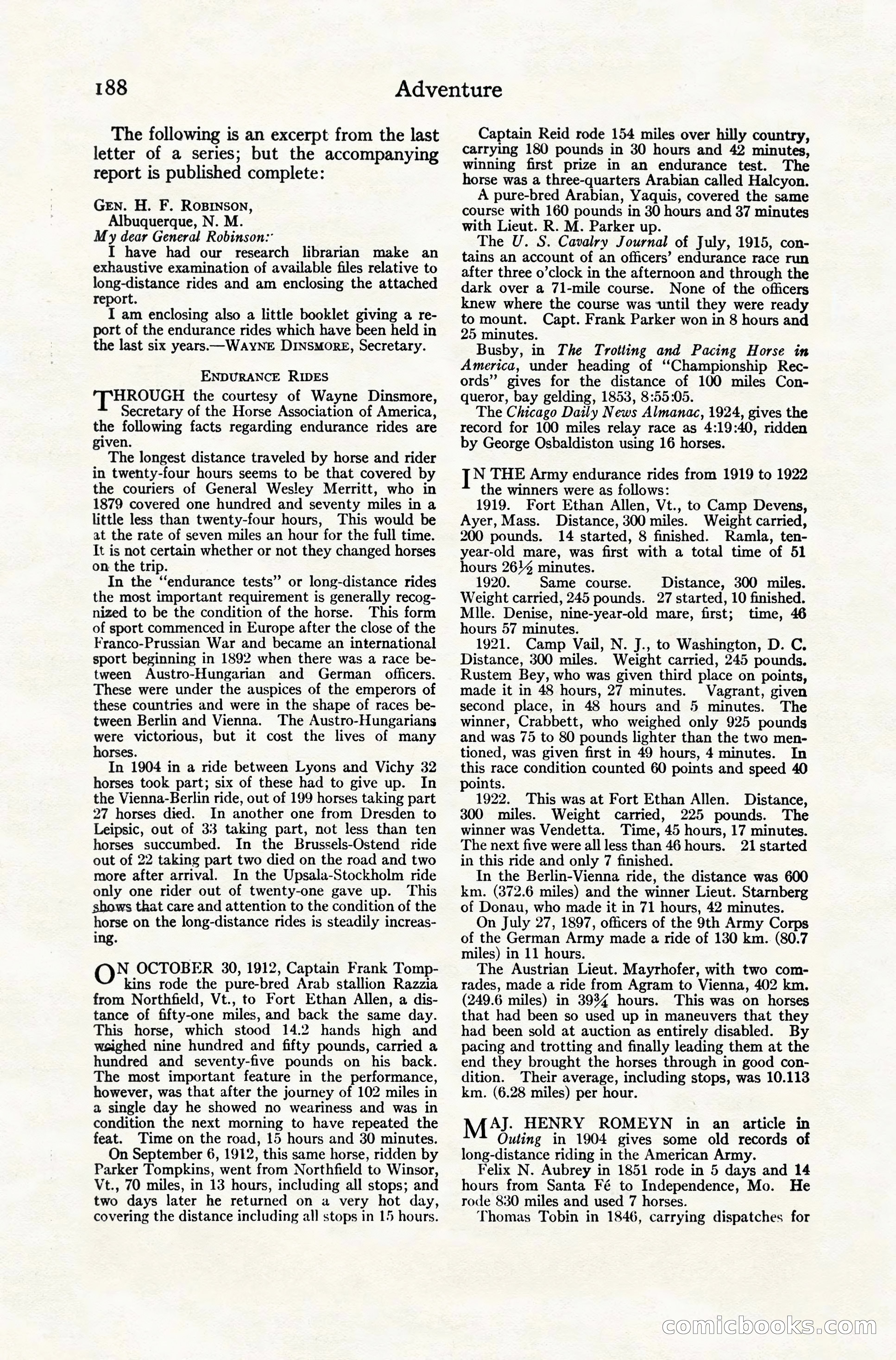
A restored page from Pulp Fiction, 1924. Page through the whole issue in the reader above.
📄 Transcribed text from this page (OCR, searchable)
Machine-transcribed from the original scan — historical spelling and the odd misread are preserved.
188 The following is an excerpt from the last letter of a series; but the accompanying report is published complete: GEN. H. F. RosBInson, Albuquerque, N. M. My dear General Robinson: I have had our research librarian make an exhaustive examination of available files relative to long-distance rides and am enclosing the attached report. I am enclosing also a little booklet giving a re- port of the endurance rides which have been held in the last six years.— WAYNE DINSMORE, Secretary. ENDURANCE RIDES (THROUGH the courtesy of Wayne Dinsmore, Secretary of the Horse Association of America, the following facts regarding endurance rides are given. The longest distance traveled by horse and rider in twenty-four hours seems to be that covered by the couriers of General Wesley Merritt, who in 1879 covered one hundred and seventy miles in a little less than twenty-four hours, This would be at the rate of seven miles an hour for the full time. It is not certain whether or not they changed horses on the trip. In the ‘‘endurance tests” or long-distance rides the most important requirement is generally recog- nized to be the condition of the horse. This form of sport commenced in Europe after the close of the Franco-Prussian War and became an international sport beginning in 1892 when there was a race be- tween Austro-Hungarian and German officers. These were under the auspices of the emperors of these countries and were in the shape of races be- tween Berlin and Vienna. The Austro-Hungarians were victorious, but it cost the lives of many horses. In 1904 in a ride between Lyons and Vichy 32 horses took part; six of these had to give up. In the Vienna-Berlin ride, out of 199 horses taking part 27 horses died. In another one from Dresden to Leipsic, out of 33 taking part, not less than ten horses succumbed. In the Brussels-Ostend ride out of 22 taking part two died on the road and two more after arrival. In the Upsala-Stockholm ride only one rider out of twenty-one gave up. This shows that care and attention to the condition of the horse on the long-distance rides is steadily increas- ing. N OCTOBER 30, 1912, Captain Frank Tomp- kins rode the pure-bred Arab stallion Razzia from Northfield, Vt., to Fort Ethan Allen, a dis- tance of fifty-one miles, and back the same day. This horse, which stood 14.2 hands high and weighed nine hundred and fifty pounds, carried a hundred and seventy-five pounds on his back. The most important feature in the performance, however, was that after the journey of 102 miles in a single day he showed no weariness and was in condition the next morning to have repeated the feat. Time on the road, 15 hours and 30 minutes. On September 6, 1912, this same horse, ridden by Parker Tompkins, went from Northfield to Winsor, Vt., 70 miles, in 13 hours, including all stops; and two days later he returned on a very hot day, covering the distance including all stops in 15 hours. Adventure Captain Reid rode 154 miles over hilly country, carrying 180 pounds in 30 hours and 42 minutes, winning first prize in an endurance test. The horse was a three-quarters Arabian called Halcyon. A pure-bred Arabian, Yaquis, covered the same course with 160 pounds in 30 hours and 37 minutes with Lieut. R. M. Parker up. The U. S. Cavalry Journal of July, 1915, con- tains an account of an officers’ endurance race run after three o’clock in the afternoon and through the dark over a 71-mile course. None of the officers knew where the course was until they were ready to mount. Capt. Frank Parker won in 8 hours and 25 minutes. Busby, in The Trotting and Pacing Horse in America, under heading of “(Championship Rec- ords” gives for the distance of 100 miles Con- queror, bay gelding, 1853, 8:55:05. The Chicago Daily News Almanac, 1924, gives the record for 100 miles relay race as 4:19:40, ridden by George Osbaldiston using 16 horses. IN THE Army endurance rides from 1919 to 1922 the winners were as follows: 1919. Fort Ethan Allen, Vt., to Camp Devens, Ayer, Mass. Distance, 300 miles. Weight carried, 200 pounds. 14 started, 8 finished. Ramla, ten- year-old mare, was first with a total time of 51 hours 2614 minutes. 1920. Same course. Distance, 300 miles. Weight carried, 245 pounds. 27 started, 10 finished. Mlle. Denise, nine-year-old mare, first; time, 46 hours 57 minutes. 1921. Camp Vail, N. J., to Washington, D. C. Distance, 300 miles. Weight carried, 245 pounds. Rustem Bey, who was given third place on points, made it in 48 hours, 27 minutes. Vagrant, given second place, in 48 hours and 5 minutes. The winner, Crabbett, who weighed only 925 pounds and was 75 to 80 pounds lighter than the two men- tioned, was given first in 49 hours, 4 minutes. In this race condition counted 60 points and speed 40 points. 1922. This was at Fort Ethan Allen. Distance, 300 miles. Weight carried, 225 pounds. The winner was Vendetta. Time, 45 hours, 17 minutes. The next five were all less than 46 hours. 21 started in this ride and only 7 finished. In the Berlin-Vienna ride, the distance was 600 km. (372.6 miles) and the winner Lieut. Starnberg of Donau, who made it in 71 hours, 42 minutes. On July 27, 1897, officers of the 9th Army Corps of the German Army made a ride of 130 km. (80.7 miles) in 11 hours. The Austrian Lieut. Mayrhofer, with two com- rades, made a ride from Agram to Vienna, 402 km. (249.6 miles) in 3934 hours. This was on horses that had been so used up in maneuvers that they had been sold at auction as entirely disabled. By pacing and trotting and finally leading them at the end they brought the horses through in good con- dition. Their average, including stops, was 10.113 km. (6.28 miles) per hour. M4. HENRY ROMEYN in an #article in Outing in 1904 gives some old records of long-distance riding in the American Army. Felix N. Aubrey in 1851 rode in 5 days and 14 hours from Santa Fé to Independence, Mo. He rode 830 miles and used 7 horses. Thomas Tobin in 1846, carrying dispatches for CoOMmiclhoo =