
Pulp Fiction, 1924 · page 212 of 216
Adventure Magazine, December 10, 1924 — page 212: what you’re looking at
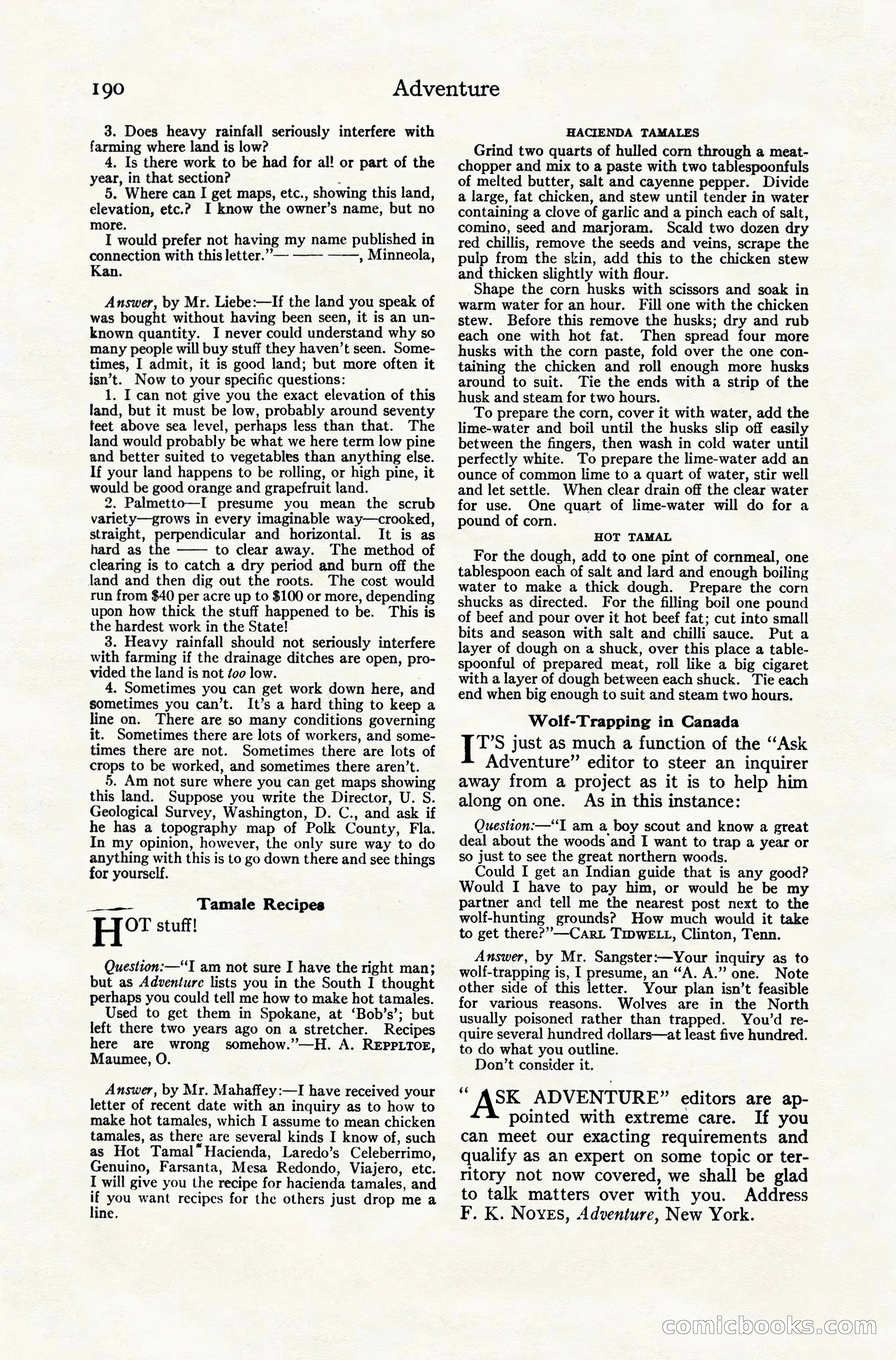
A restored page from Pulp Fiction, 1924. Page through the whole issue in the reader above.
📄 Transcribed text from this page (OCR, searchable)
Machine-transcribed from the original scan — historical spelling and the odd misread are preserved.
190 3. Does heavy rainfall seriously interfere with farming where land is low? 4, Is there work to be had for al! or part of the year, in that section? i 5. Where can I get maps, etc., showing this land, elevation, etc.? I know the owner’s name, but no more. I would prefer not having my name published in connection with this letter.’’— —— , Minneola, Kan. Answer, by Mr. Liebe:—If the land you speak of was bought without having been seen, it is an un- known quantity. I never could understand why so many people will buy stuff they haven’t seen. Some- times, I admit, it is good land; but more often it isn’t. Now to your specific questions: 1. I can not give you the exact elevation of this land, but it must be low, probably around seventy teet above sea level, perhaps less than that. The land would probably be what we here term low pine and better suited to vegetables than anything else. If your land happens to be rolling, or high pine, it would be good orange and grapefruit land. 2. Palmetto—I presume you mean the scrub variety—grows in every imaginable way—crooked, straight, perpendicular and horizontal. It is as hard as the —— to clear away. The method of clearing is to catch a dry period and burn off the land and then dig out the roots. The cost would run from $40 per acre up to $100 or more, depending upon how thick the stuff happened to be. This is the hardest work in the State! 3. Heavy rainfall should not seriously interfere with farming if the drainage ditches are open, pro- vided the land is not too low. 4. Sometimes you can get work down here, and sometimes you can’t. It’s a hard thing to keep a line on. There are so many conditions governing it. Sometimes there are lots of workers, and some- times there are not. Sometimes there are lots of crops to be worked, and sometimes there aren’t. 5. Am not sure where you can get maps showing this land. Suppose you write the Director, U. S. Geological Survey, Washington, D. C., and ask if he has a topography map of Polk County, Fla. In my opinion, however, the only sure way to do anything with this is to go down there and see things for yourself. HOt stu! Question:—“T am not sure I have the right man; but as Adventure lists you in the South I thought perhaps you could tell me how to make hot tamales. Used to get them in Spokane, at ‘Bob’s’; but left there two years ago on a stretcher. Recipes here are wrong somehow.”—H. A. REPPLTOE, Maumee, O Tamale Recipes Answer, by Mr. Mahaffey:—I have received your letter of recent date with an inquiry as to how to make hot tamales, which I assume to mean chicken tamales, as there are several kinds I know of, such as Hot Tamal“Hacienda, Laredo’s Celeberrimo, Genuino, Farsanta, Mesa Redondo, Viajero, etc. I will give you the recipe for hacienda tamales, and LY you want recipes for the others just drop me a ine. Adventure HACIENDA TAMALES Grind two quarts of hulled corn through a meat- chopper and mix to a paste with two tablespoonfuls of melted butter, salt and cayenne pepper. Divide a large, fat chicken, and stew until tender in water containing a clove of garlic and a pinch each of salt, comino, seed and marjoram. Scald two dozen dry red chillis, remove the seeds and veins, scrape the pulp from the skin, add this to the chicken stew and thicken slightly with flour. Shape the corn husks with scissors and soak in warm water for an hour. Fill one with the chicken stew. Before this remove the husks; dry and rub each one with hot fat. Then spread four more husks with the corn paste, fold over the one con- taining the chicken and roll enough more husks around to suit. Tie the ends with a strip of the husk and steam for two hours. To prepare the corn, cover it with water, add the lime-water and boil until the husks slip off easily between the fingers, then wash in cold water until perfectly white. To prepare the lime-water add an ounce of common lime to a quart of water, stir well and let settle. When clear drain off the clear water for use. One quart of lime-water will do for a pound of corn. HOT TAMAL For the dough, add to one pint of cornmeal, one tablespoon each of salt and lard and enough boiling water to make a thick dough. Prepare the corn shucks as directed. For the filling boil one pound of beef and pour over it hot beef fat; cut into small bits and season with salt and chilli sauce. Put a layer of dough on a shuck, over this place a table- spoonful of prepared meat, roll like a big cigaret with a layer of dough between each shuck. Tie each end when big enough to suit and steam two hours. Wolf-Trapping in Canada i> just as much a function of the “Ask Adventure” editor to steer an inquirer away from a project as it is to help him along on one. As in this instance: Question: —“T am a boy scout and know a great deal about the woods and I want to trap a year or so Just to see the great northern woods. Could I get an Indian guide that is any good? Would I have to pay him, or would he be my partner and tell me the nearest post next to the wolf-hunting grounds? How much would it take to get there?” —CariL TIDWELL, Clinton, Tenn. Answer, by Mr. Sangster:—Your inquiry as to wolf-trapping is, I presume, an “A. A.” one. Note other side of this letter. Your plan isn’t feasible for various reasons. Wolves are in the North usually poisoned rather than trapped. You’d re- quire several hundred dollars—at least five hundred. to do what you outline. Don’t consider it. ‘“ ASK ADVENTURE” editors are ap- pointed with extreme care. If you can meet our exacting requirements and qualify as an expert on some topic or ter- ritory not now covered, we shall be glad to talk matters over with you. Address F. K. Noyes, Adventure, New York. CoOMmiclhoo S} =