
Pulp Fiction, 1924 · page 29 of 216
Adventure Magazine, December 10, 1924 — page 29: what you’re looking at
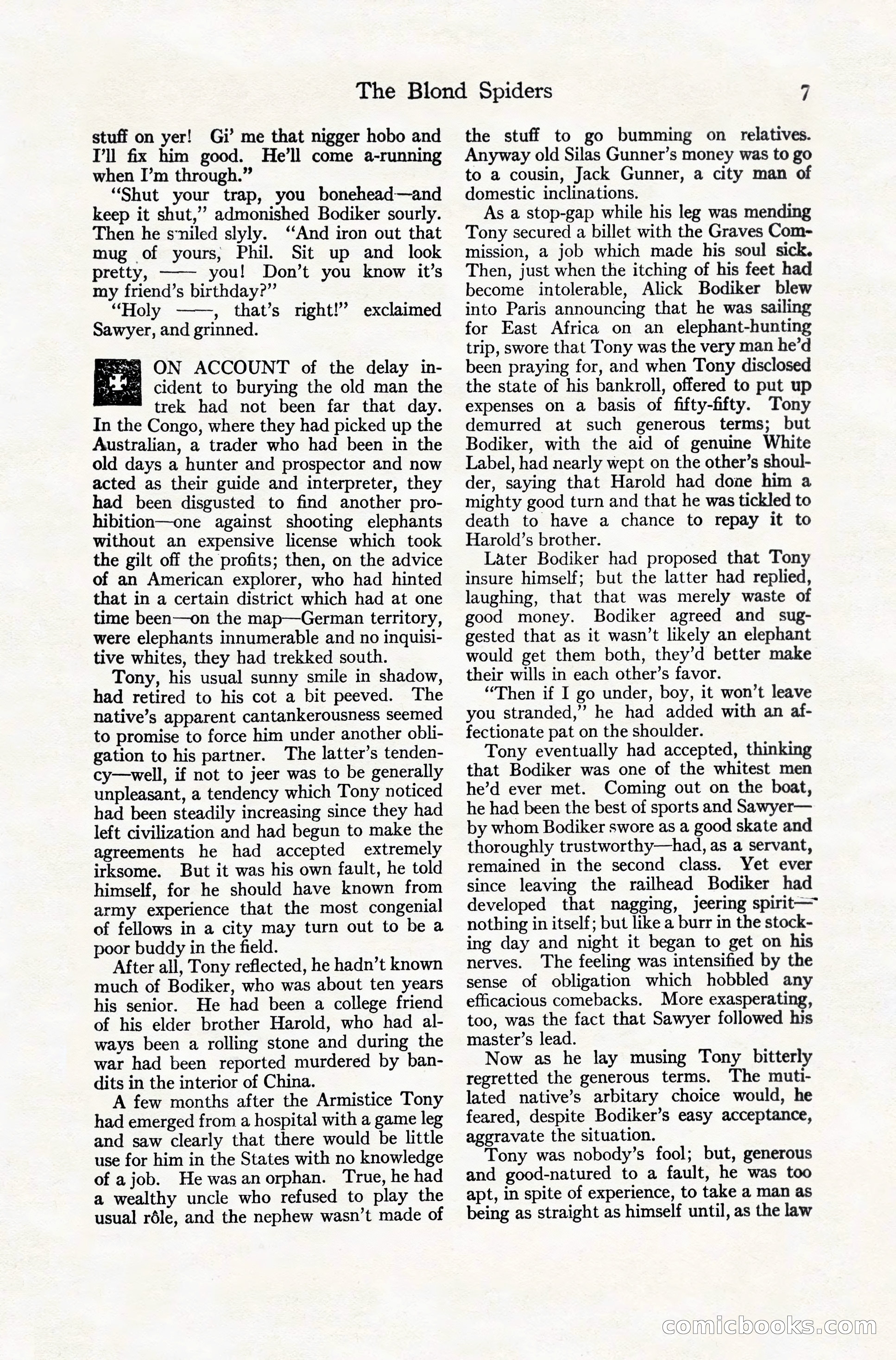
A restored page from Pulp Fiction, 1924. Page through the whole issue in the reader above.
📄 Transcribed text from this page (OCR, searchable)
Machine-transcribed from the original scan — historical spelling and the odd misread are preserved.
The Blond Spiders 7 stuff on yer! Gi’ me that nigger hobo and T’ll fix him good. He’ll come a-running when I’m through.” “Shut your trap, you bonehead—and keep it shut,’’ admonished Bodiker sourly. Then he sniled slyly. “And iron out that mug of yours, Phil. Sit up and look pretty, ——- you! Don’t you know it’s my friend’s birthday?” “Holy , that’s right!’ exclaimed Sawyer, and grinned. sas) ON ACCOUNT of the delay in- eeexeq cident to burying the old man the ™ trek had not been far that day. In the Congo, where they had picked up the Australian, a trader who had been in the old days a hunter and prospector and now acted as their guide and interpreter, they had been disgusted to find another pro- hibition—one against shooting elephants without an expensive license which took the gilt off the profits; then, on the advice of an American explorer, who had hinted that in a certain district which had at one time been—on the map—German territory, were elephants innumerable and no inquisi- tive whites, they had trekked south. Tony, his usual sunny smile in shadow, had retired to his cot a bit peeved. The native’s apparent cantankerousness seemed to promise to force him under another obli- gation to his partner. The latter’s tenden- cy—well, if not to jeer was to be generally unpleasant, a tendency which Tony noticed had been steadily increasing since they had left civilization and had begun to make the agreements he had accepted extremely irksome. But it was his own fault, he told himself, for he should have known from army experience that the most congenial of fellows in a city may turn out to be a poor buddy in the field. After all, Tony reflected, he hadn’t known much of Bodiker, who was about ten years his senior. He had been a college friend of his elder brother Harold, who had al- ways been a rolling stone and during the war had been reported murdered by ban- dits in the interior of China. A few months after the Armistice Tony had emerged from a hospital with a game leg and saw clearly that there would be little use for him in the States with no knowledge of ajob. Hewasanorphan. True, he had a wealthy uncle who refused to play the usual réle, and the nephew wasn’t made of the stuff to go bumming on relatives. Anyway old Silas Gunner’s money was to go to a cousin, Jack Gunner, a city man of domestic inclinations. As a stop-gap while his leg was mending Tony secured a billet with the Graves Com- mission, a job which made his soul sick. Then, just when the itching of his feet had become intolerable, Alick Bodiker blew into Paris announcing that he was sailing for East Africa on an elephant-hunting trip, swore that Tony was the very man he’d been praying for, and when Tony disclosed the state of his bankroll, offered to put up expenses on a basis of fifty-fifty. Tony demurred at such generous terms; but Bodiker, with the aid of genuine White Label, had nearly wept on the other’s shoul- der, saying that Harold had done him a mighty good turn and that he was tickled to death to have a chance to repay it to Harold’s brother. Later Bodiker had proposed that Tony insure himself; but the latter had replied, laughing, that that was merely waste of good money. Bodiker agreed and sug- gested that as it wasn’t likely an elephant would get them both, they’d better make their wills in each other’s favor. “Then if I go under, boy, it won’t leave you stranded,” he had added with an af- fectionate pat on the shoulder. Tony eventually had accepted, thinking that Bodiker was one of the whitest men he’d ever met. Coming out on the boat, he had been the best of sports and Sawyer— by whom Bodiker swore as a good skate and thoroughly trustworthy—had, as a servant, remained in the second class. Yet ever since leaving the railhead Bodiker had developed that nagging, jeering spirit— nothing in itself; but like a burr in the stock- ing day and night it began to get on his nerves. ‘The feeling was intensified by the sense of obligation which hobbled any efficacious comebacks. More exasperating, too, was the fact that Sawyer followed his master’s lead. Now as he lay musing Tony bitterly regretted the generous terms. The muti- lated native’s arbitary choice would, he feared, despite Bodiker’s easy acceptance, aggravate the situation. Tony was nobody’s fool; but, generous and good-natured to a fault, he was too apt, in spite of experience, to take a man as being as straight as himself until, as the law Comicbhool< ) (© =