
Pulp Fiction, 1924 · page 63 of 216
Adventure Magazine, December 10, 1924 — page 63: what you’re looking at
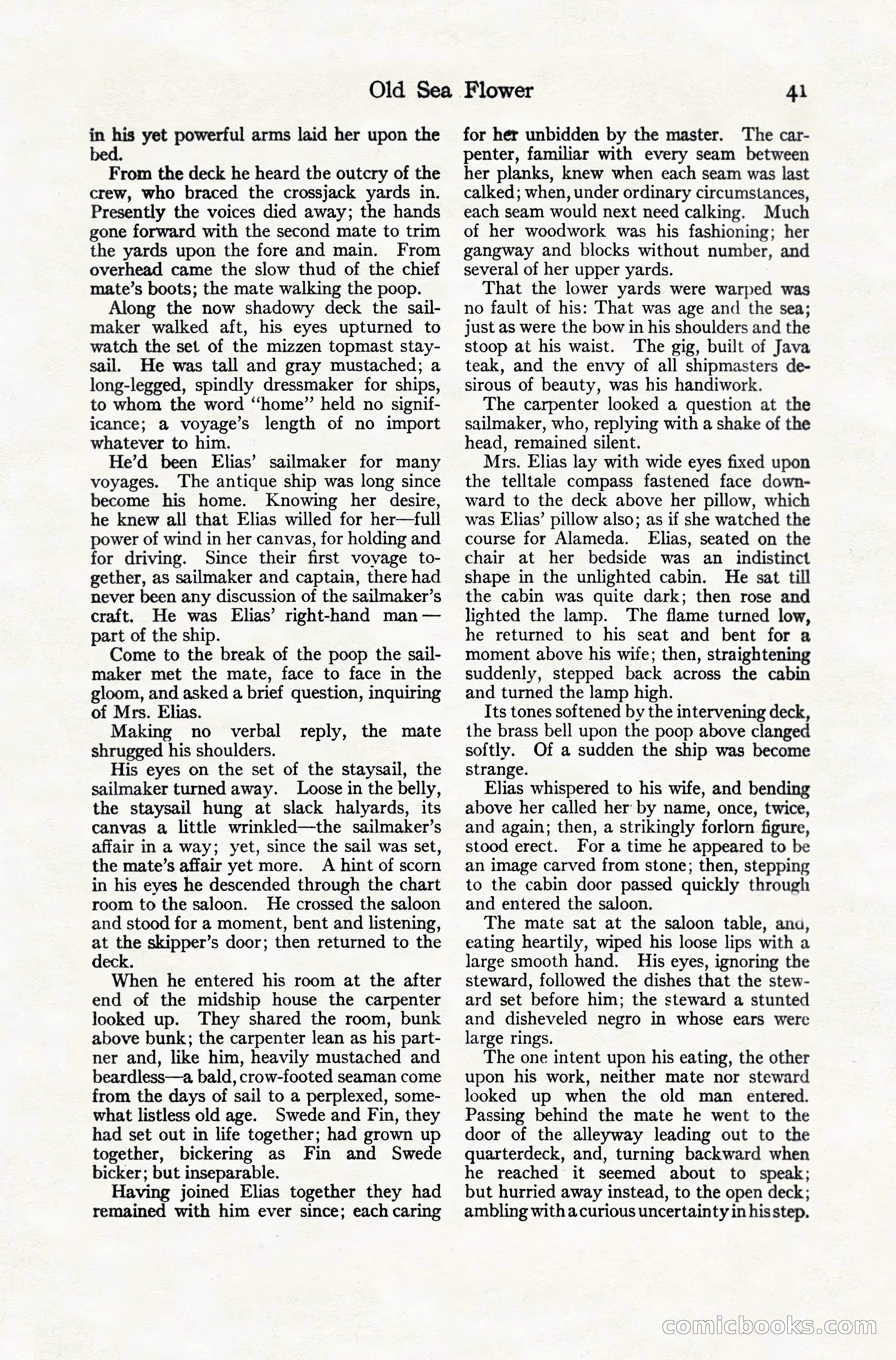
A restored page from Pulp Fiction, 1924. Page through the whole issue in the reader above.
📄 Transcribed text from this page (OCR, searchable)
Machine-transcribed from the original scan — historical spelling and the odd misread are preserved.
Old Sea Flower in his yet powerful arms laid her upon the bed From the deck he heard the outcry of the crew, who braced the crossjack yards in. Presently the voices died away; the hands gone forward with the second mate to trim the yards upon the fore and main. From overhead came the slow thud of the chief mate’s boots; the mate walking the poop. Along the now shadowy deck the sail- maker walked aft, his eyes upturned to watch the set of the mizzen topmast stay- sail. He was tall and gray mustached; a long-legged, spindly dressmaker for ships, to whom the word “home” held no signif- icance; a voyage’s length of no import whatever to him. He’d been Elias’ sailmaker for many voyages. ‘The antique ship was long since become his home. Knowing her desire, he knew all that Elias willed for her—full power of wind in her canvas, for holding and for driving. Since their first voyage to- gether, as sailmaker and captain, there had never been any discussion of the sailmaker’s craft. He was Elias’ right-hand man — part of the ship. Come to the break of the poop the sail- maker met the mate, face to face in the gloom, and asked a brief question, inquiring of Mrs. Elias. Making no_ verbal shrugged his shoulders. His eyes on the set of the staysail, the sailmaker turned away. Loose in the belly, the staysail hung at slack halyards, its canvas a little wrinkled—the sailmaker’s affair in a way; yet, since the sail was set, the mate’s affair yet more. A hint of scorn in his eyes he descended through the chart room to the saloon. He crossed the saloon and stood for a moment, bent and listening, at the skipper’s door; then returned to the deck. When he entered his room at the after end of the midship house the carpenter looked up. They shared the room, bunk above bunk; the carpenter lean as his part- ner and, like him, heavily mustached and beardless—a bald, crow-footed seaman come from the days of sail to a perplexed, some- what listless old age. Swede and Fin, they had set out in life together; had grown up together, bickering as Fin and Swede bicker; but inseparable. Having joined Elias together they had remained with him ever since; each caring reply, the mate 41 for her unbidden by the master. The car- penter, familiar with every seam between her planks, knew when each seam was last calked; when, under ordinary circumstances, each seam would next need calking. Much of her woodwork was his fashioning; her gangway and blocks without number, and several of her upper yards. That the lower yards were warped was no fault of his: That was age and the sea; just as were the bow in his shoulders and the stoop at his waist. The gig, built of Java teak, and the envy of all shipmasters de- sirous of beauty, was his handiwork. The carpenter looked a question at the sailmaker, who, replying with a shake of the head, remained silent. Mrs. Elias lay with wide eyes fixed upon the telltale compass fastened face down- ward to the deck above her pillow, which was Elias’ pillow also; as if she watched the course for Alameda. Elias, seated on the chair at her bedside was an_ indistinct shape in the unlighted cabin. He sat till the cabin was quite dark; then rose and lighted the lamp. The flame turned low, he returned to his seat and bent for a moment above his wife; then, straightening suddenly, stepped back across the cabin and turned the lamp high. Its tones softened by the intervening deck, the brass bell upon the poop above clanged softly. Of a sudden the ship was become strange. Elias whispered to his wife, and bending above her called her by name, once, twice, and again; then, a strikingly forlorn figure, stood erect. For a time he appeared to be an image carved from stone; then, stepping to the cabin door passed quickly through and entered the saloon. The mate sat at the saloon table, anu, eating heartily, wiped his loose lips with a large smooth hand. His eyes, ignoring the steward, followed the dishes that the stew- ard set before him; the steward a stunted and disheveled negro in whose ears were large rings. The one intent upon his eating, the other upon his work, neither mate nor steward looked up when the old man entered. Passing behind the mate he went to the door of the alleyway leading out to the quarterdeck, and, turning backward when he reached it seemed about to speak; but hurried away instead, to the open deck; ambling with acurious uncertainty in his step. CoMmiclboolk Wh) CO 5}