
Pulp Fiction, 1924 · page 67 of 216
Adventure Magazine, December 10, 1924 — page 67: what you’re looking at
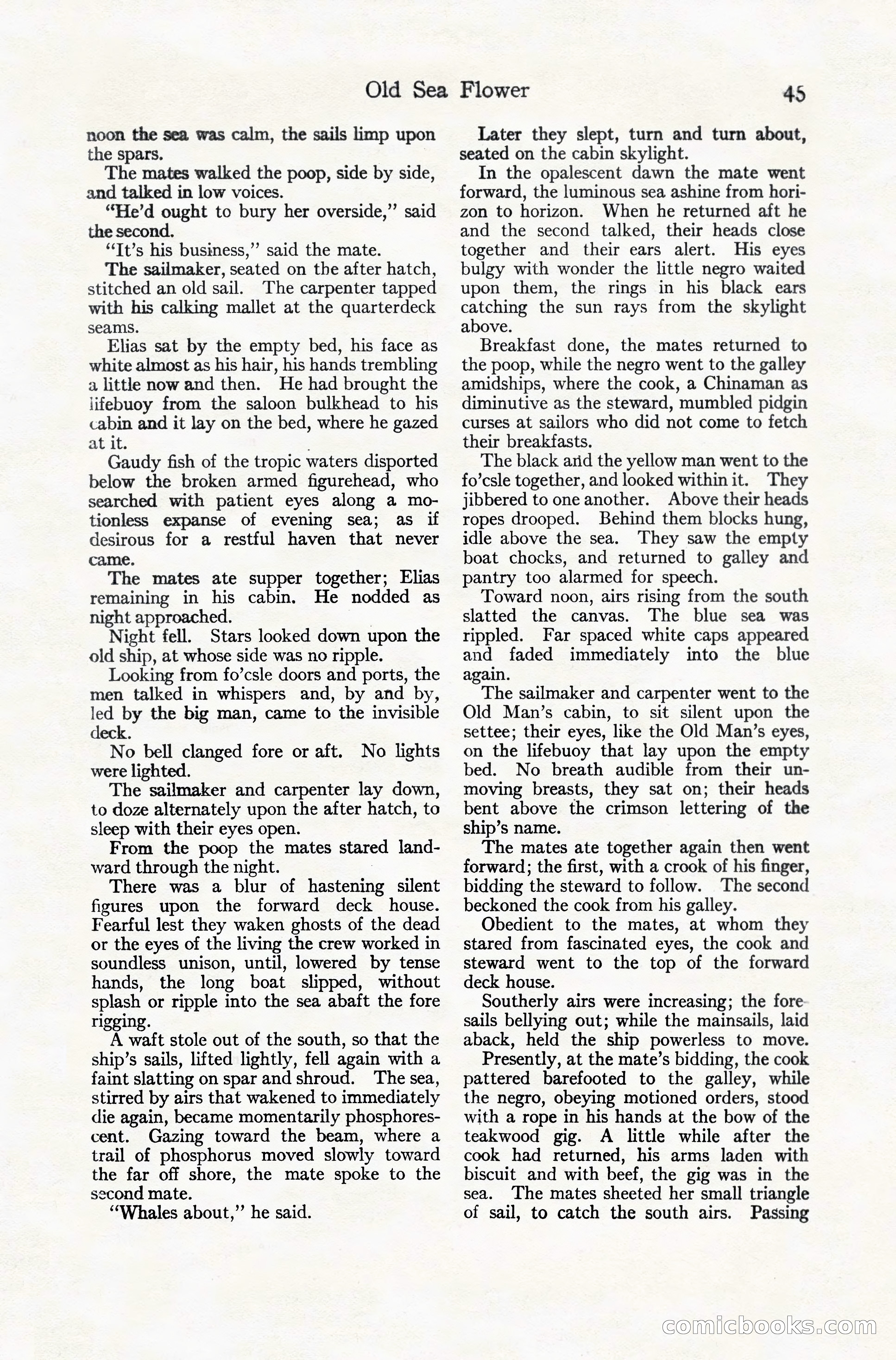
A restored page from Pulp Fiction, 1924. Page through the whole issue in the reader above.
📄 Transcribed text from this page (OCR, searchable)
Machine-transcribed from the original scan — historical spelling and the odd misread are preserved.
Old Sea Flower noon the sea was calm, the sails limp upon the spars. The mates walked the poop, side by side, and talked in low voices. “He’d ought to bury her overside,”’ the second. ‘It’s his business,”’ said the mate. The sailmaker, seated on the after hatch, stitched an old sail. The carpenter tapped with his calking mallet at the quarterdeck seams. Elias sat by the empty bed, his face as white almost as his hair, his hands trembling a little now and then. He had brought the lifebuoy from the saloon bulkhead to his cabin and it lay on the bed, where he gazed at it. Gaudy fish of the tropic waters disported below the broken armed figurehead, who searched with patient eyes along a mo- tionless expanse of evening sea; as if desirous for a restful haven that never came. The mates ate supper together; Elias remaining in his cabin. He nodded as night approached. Night fell. Stars looked down upon the old ship, at whose side was no ripple. Looking from fo’csle doors and ports, the men talked in whispers and, by and by, led by the big man, came to the invisible deck. No bell clanged fore or aft. were lighted. The sailmaker and carpenter lay down, to doze alternately upon the after hatch, to sleep with their eyes open. From the poop the mates stared land- ward through the night. There was a blur of hastening silent figures upon the forward deck house. Fearful lest they waken ghosts of the dead or the eyes of the living the crew worked in soundless unison, until, lowered by tense hands, the long boat slipped, without splash or ripple into the sea abaft the fore rigging. A waft stole out of the south, so that the ship’s sails, lifted lightly, fell again with a faint slatting on spar and shroud. The sea, stirred by airs that wakened to immediately die again, became momentarily phosphores- cent. Gazing toward the beam, where a trail of phosphorus moved slowly toward the far off shore, the mate spoke to the second mate. “Whales about,”’ he said. said No lights 45 Later they slept, turn and turn about, seated on the cabin skylight. In the opalescent dawn the mate went forward, the luminous sea ashine from hori- zon to horizon. When he returned aft he and the second talked, their heads close together and their ears alert. His eyes bulgy with wonder the little negro waited upon them, the rings in his black ears catching the sun rays from the skylight above. Breakfast done, the mates returned to the poop, while the negro went to the galley amidships, where the cook, a Chinaman as diminutive as the steward, mumbled pidgin curses at sailors who did not come to fetch their breakfasts. The black arid the yellow man went to the fo’csle together, and looked within it. They jibbered to one another. Above their heads ropes drooped. Behind them blocks hung, idle above the sea. They saw the empty boat chocks, and returned to galley and pantry too alarmed for speech. Toward noon, airs rising from the south slatted the canvas. The blue sea was rippled. Far spaced white caps appeared and faded immediately into the blue again. The sailmaker and carpenter went to the Old Man’s cabin, to sit silent upon the settee; their eyes, like the Old Man’s eyes, on the lifebuoy that lay upon the empty bed. No breath audible from their un- moving breasts, they sat on; their heads bent above the crimson lettering of the ship’s name. The mates ate together again then went forward; the first, with a crook of his finger, bidding the steward to follow. The second beckoned the cook from his galley. Obedient to the mates, at whom they stared from fascinated eyes, the cook and steward went to the top of the forward deck house. Southerly airs were increasing; the fore sails bellying out; while the mainsails, laid aback, held the ship powerless to move. Presently, at the mate’s bidding, the cook pattered barefooted to the galley, while the negro, obeying motioned orders, stood with a rope in his hands at the bow of the teakwood gig. A little while after the cook had returned, his arms laden with biscuit and with beef, the gig was in the sea. ‘The mates sheeted her small triangle of sail, to catch the south airs. Passing COMICMOOlksS. Conn