
Pulp Fiction, 1925 · page 107 of 212
Adventure Magazine Cover, March 20, 1925 — page 107: what you’re looking at
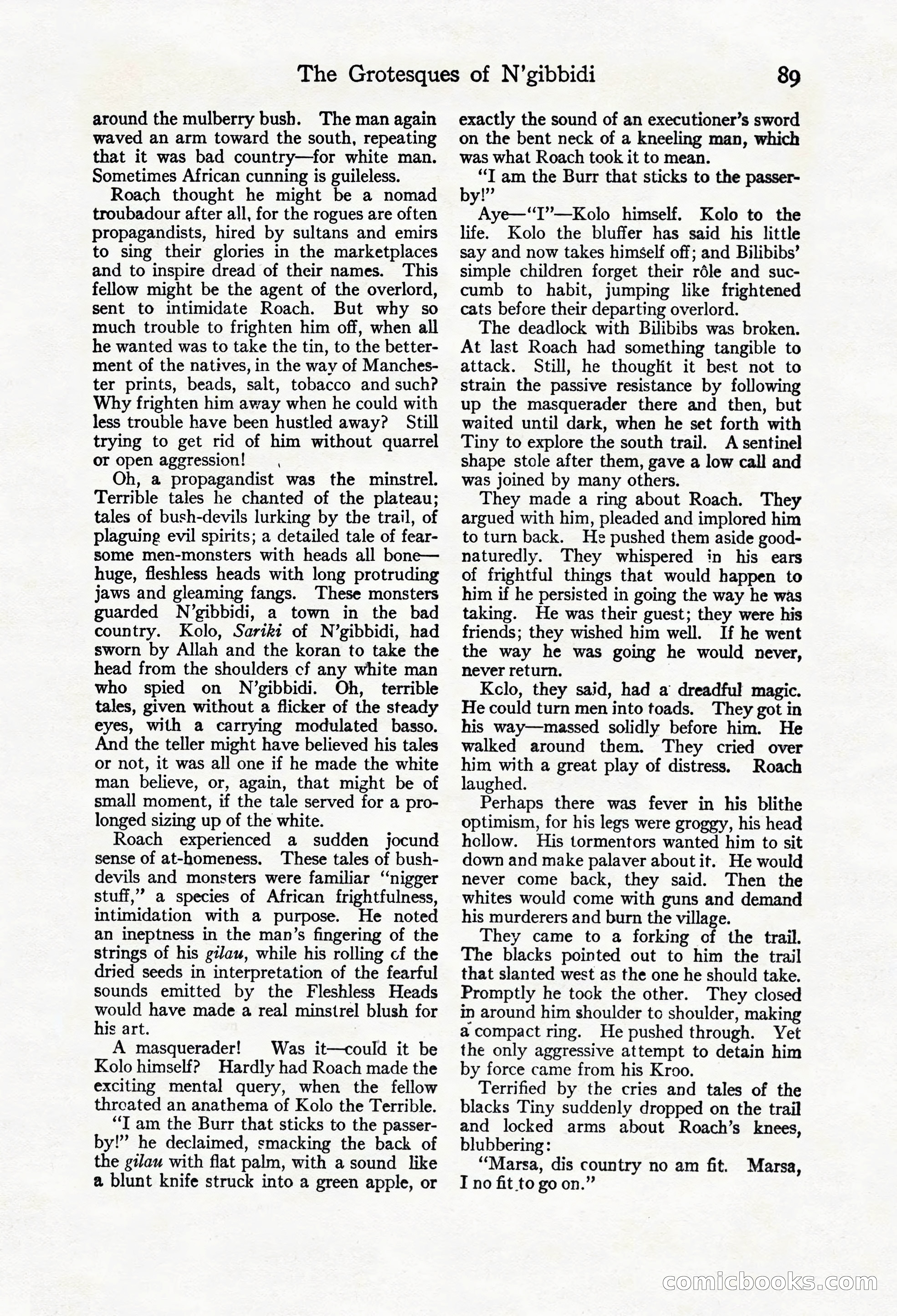
A restored page from Pulp Fiction, 1925. Page through the whole issue in the reader above.
📄 Transcribed text from this page (OCR, searchable)
Machine-transcribed from the original scan — historical spelling and the odd misread are preserved.
The Grotesques of N’gibbidi around the mulberry bush. The man again waved an arm toward the south, repeating that it was bad country—for white man. Sometimes African cunning is guileless. Roach thought he might be a nomad troubadour after all, for the rogues are often propagandists, hired by sultans and emirs to sing their glories in the marketplaces and to inspire dread of their names. This fellow might be the agent of the overlord, sent to intimidate Roach. But why so much trouble to frighten him off, when all he wanted was to take the tin, to the better- ment of the natives, in the way of Manches- ter prints, beads, salt, tobacco and such? Why frighten him away when he could with less trouble have been hustled away? Still trying to get rid of him without quarrel Or open aggression! Oh, a propagandist was the minstrel. Terrible tales he chanted of the plateau; tales of bush-devils lurking by the trail, of plaguing evil spirits; a detailed tale of fear- some men-monsters with heads all bone— huge, fleshless heads with long protruding jaws and gleaming fangs. These monsters guarded N’gibbidi, a town in the bad country. Kolo, Sariki of N’gibbidi, had sworn by Allah and the koran to take the head from the shoulders cf any white man who spied on N’gibbidi. Oh, terrible tales, given without a flicker of the steady eyes, with a carrying modulated basso. And the teller might have believed his tales or not, it was all one if he made the white man believe, or, again, that might be of small moment, if the tale served for a pro- longed sizing up of the white. Roach experienced a sudden jocund sense of at-homeness. These tales of bush- devils and monsters were familiar “nigger stuff,’ a species of African frightfulness, intimidation with a purpose. He noted an ineptness in the man’s fingering of the strings of his gilau, while his rolling cf the dried seeds in interpretation of the fearful sounds emitted by the Fleshless Heads would have made a real minstrel blush for his art. A masquerader! Was it—could it be Kolo himself? Hardly had Roach made the exciting mental query, when the fellow threated an anathema of Kolo the Terrible. “Tam the Burr that sticks to the passer- by!” he declaimed, smacking the back of the gilau with flat palm, with a sound like a blunt knife struck into a green apple, or 89 exactly the sound of an executioner’s sword on the bent neck of a kneeling man, which was what Roach took it to mean. “T am the Burr that sticks to the passer- by!” Aye—“‘T’”—Kolo himself. Kolo to the life. Kolo the bluffer has said his little say and now takes himself off; and Bilibibs’ simple children forget their réle and suc- cumb to habit, jumping like frightened cats before their departing overlord. The deadlock with Bilibibs was broken. At last Roach had something tangible to attack. Still, he thouglit it best not to strain the passive resistance by following up the masquerader there and then, but waited until dark, when he set forth with Tiny to explore the south trail. A sentinel shape stole after them, gave a low call and was joined by many others. They made a ring about Roach. They argued with him, pleaded and implored him to turn back. He pushed them aside good- naturedly. They whispered in his ears of frightful things that would happen to him if he persisted in going the way he was taking. He was their guest; they were his friends; they wished him well. If he went the way he was going he would never, never return. Kclo, they said, had a dreadful magic. He could turn men into toads. They got in his way—massed solidly before him. He walked around them. They cried over him with a great play of distress. Roach laughed. Perhaps there was fever in his blithe optimism, for his legs were groggy, his head hollow. His tormentors wanted him to sit down and make palaver about it. He would never come back, they said. Then the whites would come with guns and demand his murderers and burn the village. They came to a forking of the trail. The blacks pointed out to him the trail that slanted west as the one he should take. Promptly he tock the other. They closed in around him shoulder to shoulder, making a compact ring. He pushed through. Yet the only aggressive attempt to detain him by force came from his Kroo. Terrified by the cries and tales of the blacks Tiny suddenly dropped on the trail and locked arms about Roach’s knees, blubbering: ‘Marsa, dis country no am fit. Marsa I no fit to go on.” MICLOOO (©