
Pulp Fiction, 1925 · page 180 of 212
Adventure Magazine Cover, March 20, 1925 — page 180: what you’re looking at
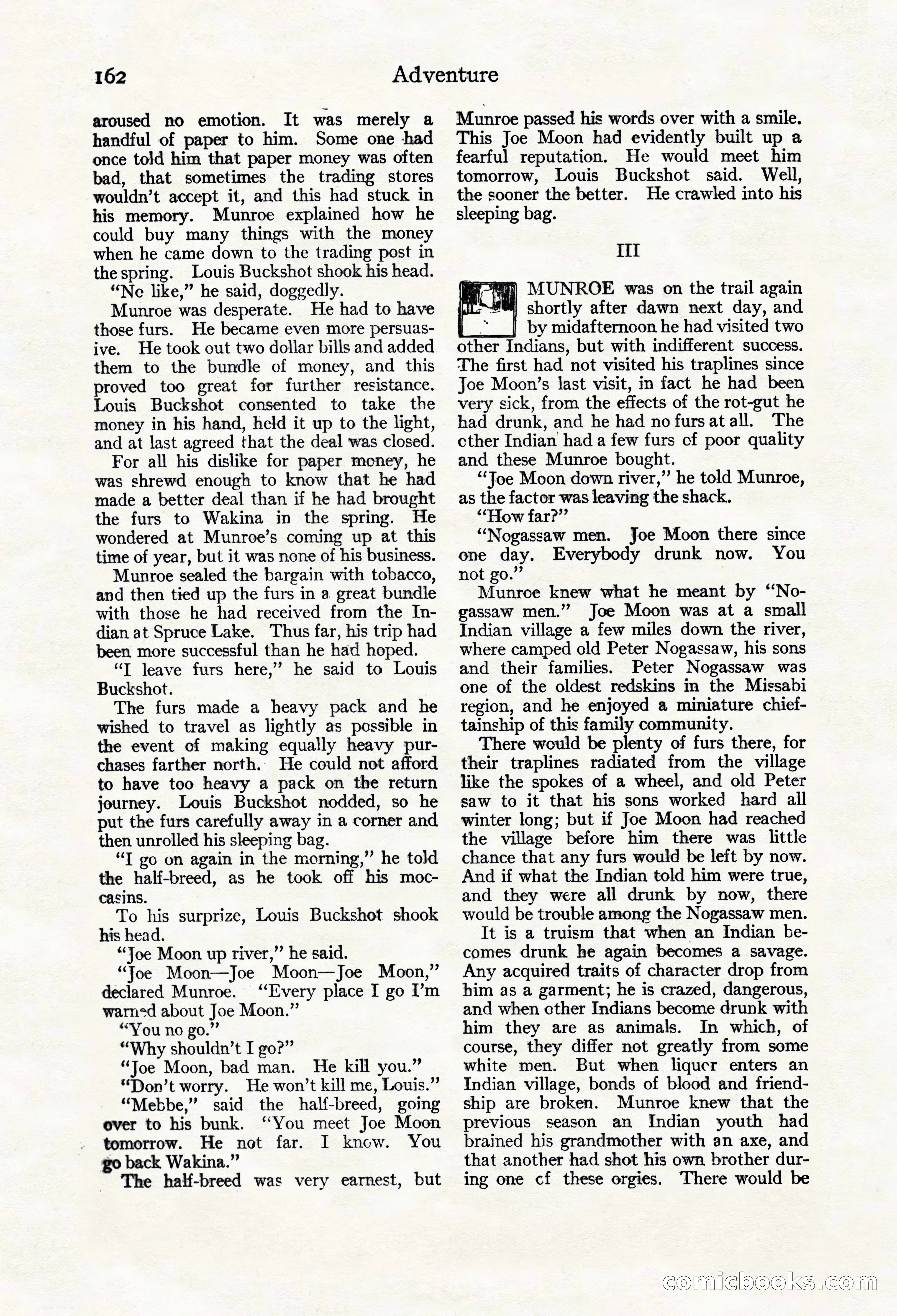
A restored page from Pulp Fiction, 1925. Page through the whole issue in the reader above.
📄 Transcribed text from this page (OCR, searchable)
Machine-transcribed from the original scan — historical spelling and the odd misread are preserved.
162 aroused no emotion. It was merely a handful of paper to him. Some one had once told him that paper money was often bad, that sometimes the trading stores -wouldn’t accept it, and this had stuck in his memory. Munroe explained how he could buy many things with the money when he came down to the trading post in the spring. Louis Buckshot shook his head. “Ne like,” he said, doggedly. Munroe was desperate. He had to have those furs. He became even more persuas- ive. He took out two dollar bills and added them to the bundle of money, and this proved too great for further resistance. Louis Buckshot consented to take the money in his hand, held it up to the light, and at last agreed that the deal was closed. For all his dislike for paper meney, he was shrewd enough to know that he had made a better deal than if he had brought the furs to Wakina in the spring. He wondered at Munroe’s coming up at this time of year, but it was none of his business. Munroe sealed the bargain with tobacco, and then tied up the furs in a great bundle with those he had received from the In- dian at Spruce Lake. Thus far, his trip had been more successful than he had hoped. “T leave furs here,” he said to Louis Buckshot. The furs made a heavy pack and he wished to travel as lightly as possible in the event of making equally heavy pur- chases farther north. He could not afford to have too heavy a pack on the return journey. Louis Buckshot nodded, so he put the furs carefully away in a corner and then unrolled his sleeping bag. “T go on again in the morning,” he told the half-breed, as he took off his moc- casins. To his surprize, Louis Buckshot shook his head. “Joe Moon up river,”’ he said. “Joe Moon—Joe Moon—Joe Moon,” declared Munroe. ‘Every place I go I’m warned about Joe Moon.” “You no go.” “Why shouldn’t I go?” “Joe Moon, bad man. He kill you.” “Don’t worry. He won’t kill me, Louis.” ‘“Mebbe,” said the half-breed, going over to his bunk. “You meet Joe Moon tomorrow. He not far. I know. You go back Wakina.” The half-breed was very earnest, but Adventure Munroe passed his words over with a smile. This Joe Moon had evidently built up a fearful reputation. He would meet him tomorrow, Louis Buckshot said. Well, the sooner the better. He crawled into his sleeping bag. Iil itn) MUNROE was on the trail again i i shortly after dawn next day, and “| by midafternoon he had visited two other Indians, but with indifferent success. The first had not visited his traplines since Joe Moon’s last visit, in fact he had been very sick, from the effects of the rot-gut he had drunk, and he had no fursatall. The cther Indian had a few furs cf poor quality and these Munroe bought. “Toe Moon down river,” he told Munroe, as the factor was leaving the shack. ““How far?” “Nogassaw men, Joe Moon there since one day. Everybody drunk now. You not go.” Munroe knew what he meant by ‘No- gassaw men.”’ Joe Moon was at a small Indian village a few miles down the river, where camped old Peter Nogassaw, his sons and their families. Peter Nogassaw was one of the oldest redskins in the Missabi region, and he enjoyed a miniature chief- tainship of this family community. There would be plenty of furs there, for their traplines radiated from the village like the spokes of a wheel, and old Peter saw to it that his sons worked hard all winter long; but if Joe Moon had reached the village before him there was little chance that any furs would be left by now. And if what the Indian told him were true, and they were all drunk by now, there would be trouble among the Nogassaw men. It is a truism that when an Indian be- comes drunk he again becomes a savage. Any acquired traits of character drop from him as a garment; he is crazed, dangerous, and when other Indians become drunk with him they are as animals. In which, of course, they differ not greatly from some white men. But when liqucr enters an Indian village, bonds of blood and friend- ship are broken. Munroe knew that the previous season an Indian youth had brained his grandmother with an axe, and that another had shot his own brother dur- ing one cf these orgies. There would be Gloo nn (C©