
Pulp Fiction, 1925 · page 188 of 212
Adventure Magazine Cover, March 20, 1925 — page 188: what you’re looking at
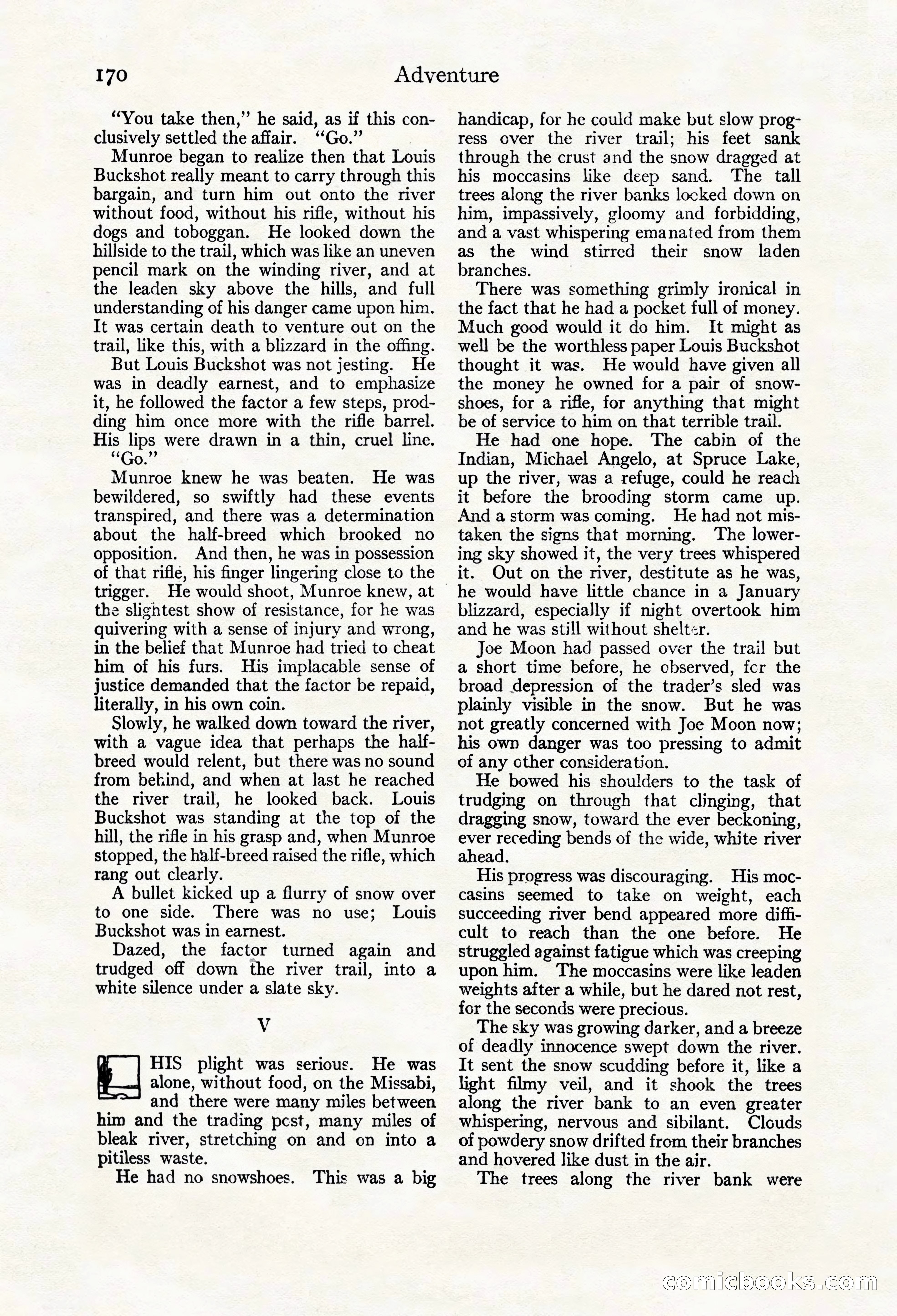
A restored page from Pulp Fiction, 1925. Page through the whole issue in the reader above.
📄 Transcribed text from this page (OCR, searchable)
Machine-transcribed from the original scan — historical spelling and the odd misread are preserved.
170 “You take then,” he said, as if this con- clusively settled the affair. “Go. . Munroe began to realize then that Louis Buckshot really meant to carry through this bargain, and turn him out onto the river without food, without his rifle, without his dogs and toboggan. He looked down the hillside to the trail, which was like an uneven pencil mark on the winding river, and at the leaden sky above the hills, and full understanding of his danger came upon him. It was certain death to venture out on the trail, like this, with a blizzard in the offing. But Louis Buckshot was not jesting. He was in deadly earnest, and to emphasize it, he followed the factor a few steps, prod- ding him once more with the rifle barrel. His lips were drawn in a thin, cruel line. 19 Go.” Munroe knew he was beaten. He was bewildered, so swiftly had these events transpired, and there was a determination about the half-breed which brooked no opposition. And then, he was in possession of that rifle, his finger lingering close to the trigger. e slightest show of resistance, for he was quivering with a sense of injury and wrong, in the belief that Munroe had tried to cheat him of his furs. His implacable sense of justice demanded that the factor be repaid, literally, in his own coin. Slowly, he walked down toward the river, with a vague idea that perhaps the half- breed would relent, but there was no sound from behind, and when at last he reached the river trail, he looked back. Louis Buckshot was standing at the top of the hill, the rifle in his grasp and, when Munroe stopped, the half-breed raised the rifle, which rang out clearly. A bullet kicked up a flurry of snow over to one side. There was no use; Louis Buckshot was in earnest. Dazed, the factor turned again and trudged off down the river trail, into a white silence under a slate sky. a alone, without food, on the Missabi, and there were many miles between him and the trading pcst, many miles of bleak river, stretching on and on into a pitiless waste. He had no snowshoes. This was a big V HIS plight was serious. He was He would shoot, Munroe knew, at — Adventure handicap, for he could make but slow prog- ress over the river trail; his feet sank through the crust and the snow dragged at his moccasins like deep sand. The tall trees along the river banks locked down on him, impassively, gloomy and forbidding, and a vast whispering emanated from them as the wind stirred their snow laden branches. There was something grimly ironical in the fact that he had a pocket full of money. Much good would it do him. It might as well be the worthless paper Louis Buckshot thought it was. He would have given all the money he owned for a pair of snow- shoes, for a rifle, for anything that might be of service to him on that terrible trail. He had one hope. The cabin of the Indian, Michael Angelo, at Spruce Lake, up the river, was a refuge, could he reach it before the brooding storm came up. And a storm was coming. He had not mis- taken the signs that morning. The lower- ing sky showed it, the very trees whispered it. Out on the river, destitute as he was, he would have little chance in a January blizzard, especially if night overtook him and he was still without shelter. Joe Moon had passed over the trail but a short time before, he cbserved, fcr the broad depression of the trader’s sled was plainly visible in the snow. But he was not greatly concerned with Joe Moon now; his own danger was too pressing to admit of any other consideration. He bowed his shoulders to the task of trudging on through that clinging, that dragging snow, toward the ever beckoning, ever receding bends of the wide, white river ahead. His progress was discouraging. His moc- casins seemed to take on weight, each succeeding river bend appeared more diffi- cult to reach than the one before. He struggled against fatigue which was creeping upon him. The moccasins were like leaden weights after a while, but he dared not rest, for the seconds were precious. The sky was growing darker, and a breeze of deadly innocence swept down the river. It sent the snow scudding before it, like a light filmy veil, and it shook the trees along the river bank to an even greater whispering, nervous and sibilant. Clouds of powdery snow drifted from their branches and hovered like dust in the air. The trees along the river bank were GOMIGIOO (C©