
Pulp Fiction, 1925 · page 190 of 212
Adventure Magazine Cover, March 20, 1925 — page 190: what you’re looking at
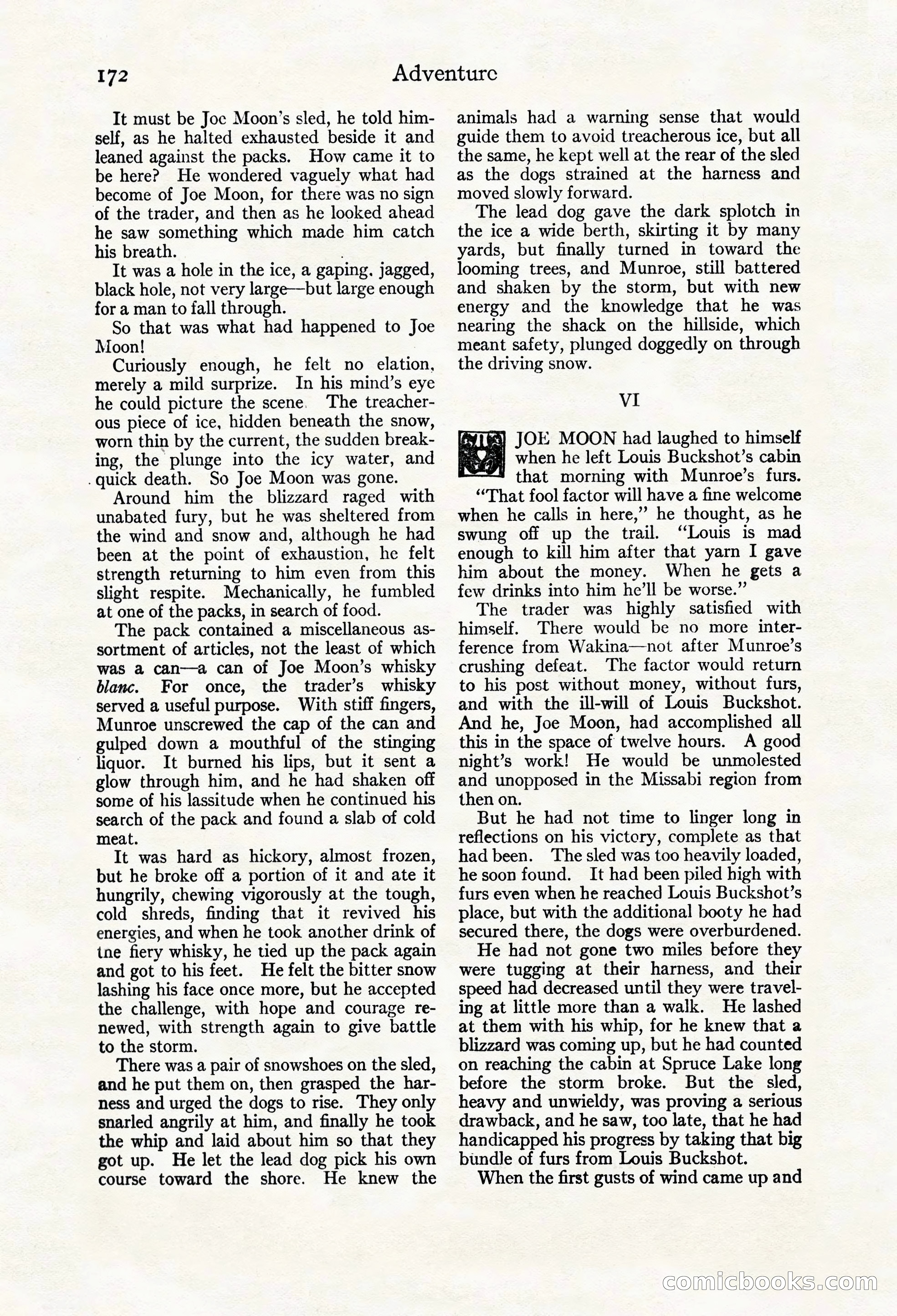
A restored page from Pulp Fiction, 1925. Page through the whole issue in the reader above.
📄 Transcribed text from this page (OCR, searchable)
Machine-transcribed from the original scan — historical spelling and the odd misread are preserved.
172 It must be Joc Moon’s sled, he told him- self, as he halted exhausted beside it and leaned against the packs. How came it to be here? He wondered vaguely what had become of Joe Moon, for there was no sign of the trader, and then as he looked ahead he saw something which made him catch his breath. It was a hole in the ice, a gaping. jagged, black hole, not very large—but large enough for a man to fall through. So that was what had happened to Joe Moon! Curiously enough, he felt no elation, merely a mild surprize. In his mind’s eye he could picture the scene. The treacher- ous piece of ice, hidden beneath the snow, worn thin by the current, the sudden break- ing, the plunge into the icy water, and .quick death. So Joe Moon was gone. Around him the blizzard raged with unabated fury, but he was sheltered from the wind and snow and, although he had been at the point of exhaustion, he felt strength returning to him even from this slight respite. Mechanically, he fumbled at one of the packs, in search of food. The pack contained a miscellaneous as- sortment of articles, not the least of which was a can—a can of Joe Moon’s whisky blanc. For once, the trader’s whisky served a useful purpose. With stiff fingers, Munroe unscrewed the cap of the can and gulped down a mouthful of the stinging liquor. It burned his lips, but it sent a glow through him, and he had shaken off some of his lassitude when he continued his search of the pack and found a slab of cold meat. It was hard as hickory, almost frozen, but he broke off a portion of it and ate it hungrily, chewing vigorously at the tough, cold shreds, finding that it revived his energies, and when he took another drink of tne fiery whisky, he tied up the pack again and got to his feet. He felt the bitter snow lashing his face once more, but he accepted the challenge, with hope and courage re- newed, with strength again to give battle to the storm. There was a pair of snowshoes on the sled, and he put them on, then grasped the har- ness and urged the dogs to rise. They only snarled angrily at him, and finally he took the whip and laid about him so that they got up. He let the lead dog pick his own course toward the shore. He knew the Adventure animals had a warning sense that would guide them to avoid treacherous ice, but all the same, he kept well at the rear of the sled as the dogs strained at the harness and moved slowly forward. The lead dog gave the dark splotch in the ice a wide berth, skirting it by many yards, but finally turned in toward the looming trees, and Munroe, still battered and shaken by the storm, but with new energy and the knowledge that he was nearing the shack on the hillside, which meant safety, plunged doggedly on through the driving snow. VI A) JOE MOON had laughed to himself mi when he left Louis Buckshot’s cabin that morning with Munroe’s furs. “That fool factor will have a fine welcome when he calls in here,” he thought, as he swung off up the trail. “Louis is mad enough to kill him after that yarn I gave him about the money. When he gets a few drinks into him he’ll be worse.” The trader was highly satisfied with himself. There would be no more inter- ference from Wakina—not after Munroe’s crushing defeat. The factor would return to his post without money, without furs, and with the ill-will of Louis Buckshot. And he, Joe Moon, had accomplished all this in the space of twelve hours. A good night’s work! He would be unmolested and unopposed in the Missabi region from then on. But he had not time to linger long in reflections on his victory, complete as that had been. The sled was too heavily loaded, he soon found. It had been piled high with furs even when he reached Louis Buckshot’s place, but with the additional booty he had secured there, the dogs were overburdened. He had not gone two miles before they were tugging at their harness, and their speed had decreased until they were travel- ing at little more than a walk. He lashed at them with his whip, for he knew that a blizzard was coming up, but he had counted on reaching the cabin at Spruce Lake long before the storm broke. But the sled, heavy and unwieldy, was proving a serious drawback, and he saw, too late, that he had handicapped his progress by taking that big bundle of furs from Louis Buckshot. When the first gusts of wind came up and CORnNICLaOe (©