
Pulp Fiction, 1925 · page 208 of 212
Adventure Magazine Cover, March 20, 1925 — page 208: what you’re looking at
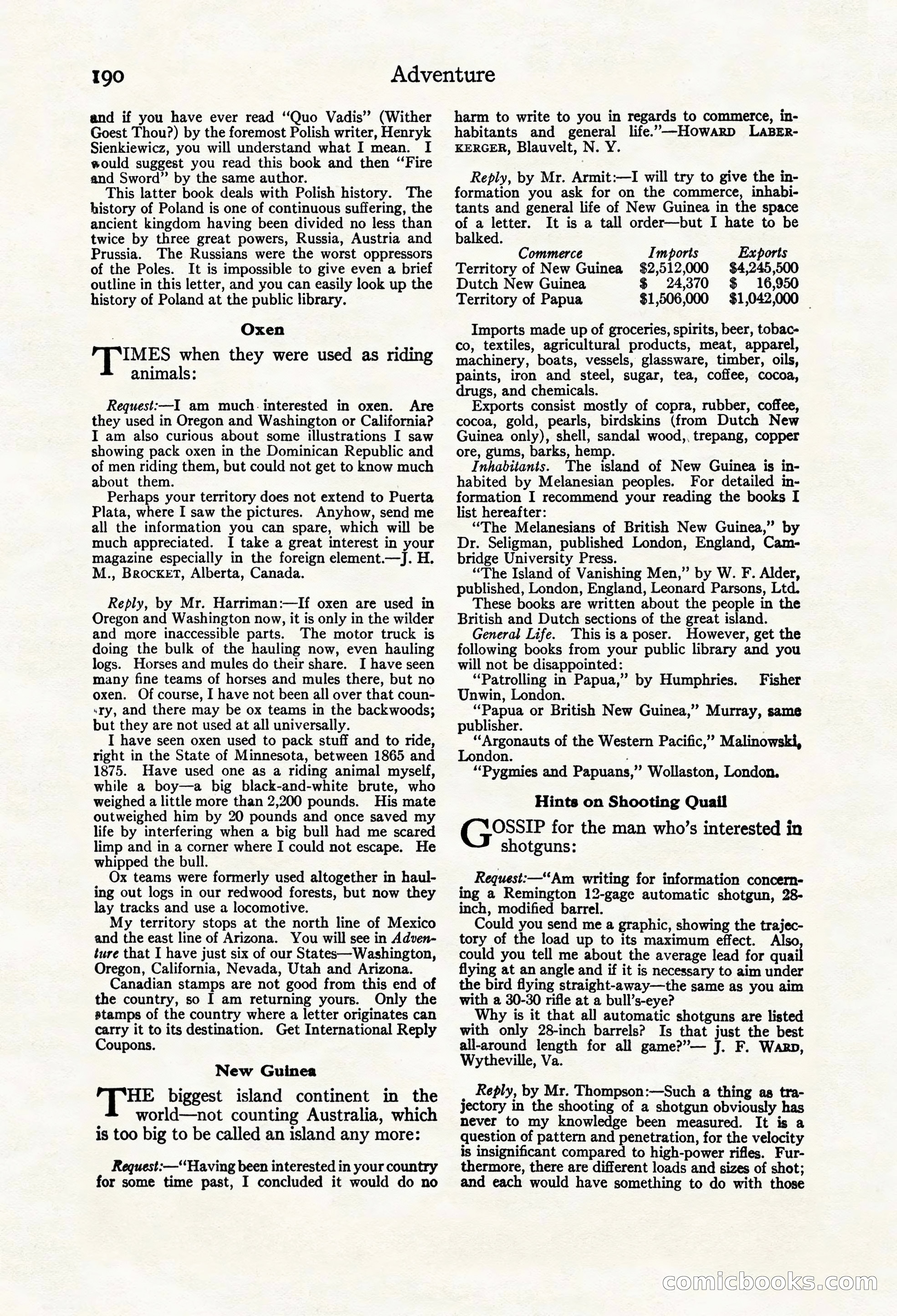
A restored page from Pulp Fiction, 1925. Page through the whole issue in the reader above.
📄 Transcribed text from this page (OCR, searchable)
Machine-transcribed from the original scan — historical spelling and the odd misread are preserved.
190 and if you have ever read “Quo Vadis” (Wither Goest Thou?) by the foremost Polish writer, Henryk Sienkiewicz, you will understand what I mean. I would suggest you read this book and then ‘Fire and Sword” by the same author. This latter book deals with Polish history. The history of Poland is one of continuous suffering, the ancient kingdom having been divided no less than twice by three great powers, Russia, Austria and Prussia. The Russians were the worst oppressors of the Poles. It is impossible to give even a brief outline in this letter, and you can easily look up the history of Poland at the public library. Oxen [ME when they were used as riding animals: Request:—I am much. interested in oxen. Are they used in Oregon and Washington or California? I am also curious about some illustrations I saw showing pack oxen in the Dominican Republic and of men riding them, but could not get to know much about them. Perhaps your territory does not extend to Puerta Plata, where I saw the pictures. Anyhow, send me all the information you can spare, which will be much appreciated. I take a great interest in your magazine especially in the foreign element.—J. H. M., BrockeET, Alberta, Canada. Reply, by Mr. Harriman:—If oxen are used in Oregon and Washington now, it is only in the wilder and more inaccessible parts. The motor truck is doing the bulk of the hauling now, even hauling logs. Horses and mules do their share. I have seen many fine teams of horses and mules there, but no oxen. Of course, I have not been all over that coun- sry, and there may be ox teams in the backwoods; but they are not used at all universally. I have seen oxen used to pack stuff and to ride, right in the State of Minnesota, between 1865 and 1875. Have used one as a riding animal myself, while a boy—a big black-and-white brute, who weighed a little more than 2,200 pounds. His mate outweighed him by 20 pounds and once saved my life by interfering when a big bull had me scared limp and in a corner where I could not escape. He whipped the bull. Ox teams were formerly used altogether in haul- ing out logs in our redwood forests, but now they lay tracks and use a locomotive. My territory stops at the north line of Mexico and the east line of Arizona. You will see in Adven- ture that I have just six of our States—Washington, Oregon, California, Nevada, Utah and Arizona. Canadian stamps are not good from this end of the country, so I am returning yours. Only the stamps of the country where a letter originates can carry it to its destination. Get International Reply Coupons. New Guinea rT BE biggest island continent in the world—not counting Australia, which is too big to be called an island any more: Request: —‘‘Having been interested in your country for some time past, I concluded it would do no Adventure harm to write to you in regards to commerce, in- habitants and general life.’—Howarp LABER- KERGER, Blauvelt, N. Y. Reply, by Mr. Armit:—I will try to give the in- formation you ask for on the commerce, inhabi- tants and general life of New Guinea in the space of a letter. It is a tall order—but I hate to be balked. Commerce Imports Exports Territory of New Guinea $2,512,000 $4,245,500 Dutch New Guinea $ 24370 $ 16,950 Territory of Papua $1,506,000 $1,042,000 — Imports made up of groceries, spirits, beer, tobac- co, textiles, agricultural products, meat, apparel, machinery, boats, vessels, glassware, timber, oils, paints, iron and steel, sugar, tea, coffee, cocoa, drugs, and chemicals. Exports consist mostly of copra, rubber, coffee, cocoa, gold, pearls, birdskins (from Dutch New Guinea only), shell, sandal wood,, trepang, copper ore, gums, barks, hemp. Inhabitants. The island of New Guinea is in- habited by Melanesian peoples. For detailed in- formation I recommend your reading the books I list hereafter: “The Melanesians of British New Guinea,” by Dr. Seligman, published London, England, Cam- bridge University Press. “The Island of Vanishing Men,” by W. F. Alder, published, London, England, Leonard Parsons, Ltd. These books are written about the people in the British and Dutch sections of the great island. General Life. This is a poser. However, get the following books from your public library and you will not be disappointed: “Patrolling in Papua,” by Humphries. Fisher Unwin, London. “Papua or British New Guinea,” Murray, same publisher. | “Argonauts of the Western Pacific,” Malinowski, London. “Pygmies and Papuans,” Wollaston, London. Hints on Shooting Quail OSSIP for the man who’s interested in shotguns: _ Request:—‘Am writing for information concern- ing a Remington 12-gage automatic shotgun, 28- inch, modified barrel. Could you send me a graphic, showing the trajec- tory of the load up to its maximum effect. Also could you tell me about the average lead for quail flying at an angle and if it is necessary to aim under the bird flying straight-away—the same as you aim with a 30-30 rifle at a bull’s-eye? Why is it that all automatic shotguns are listed with only 28-inch barrels? Is that just the best all-around length for all game?”— J. F. Warp, Wytheville, Va. _ Reply, by Mr. Thompson:—Such a thing as tra- jectory in the shooting of a shotgun obviously has never to my knowledge been measured. It is a question of pattern and penetration, for the velocity is insignificant compared to high-power rifles. Fur- thermore, there are different loads and sizes of shot; and each would have something to do with those GOMIGIOO (C©