
Pulp Fiction, 1925 · page 24 of 212
Adventure Magazine Cover, March 20, 1925 — page 24: what you’re looking at
A restored page from Pulp Fiction, 1925. Page through the whole issue in the reader above.
📄 Transcribed text from this page (OCR, searchable)
Machine-transcribed from the original scan — historical spelling and the odd misread are preserved.
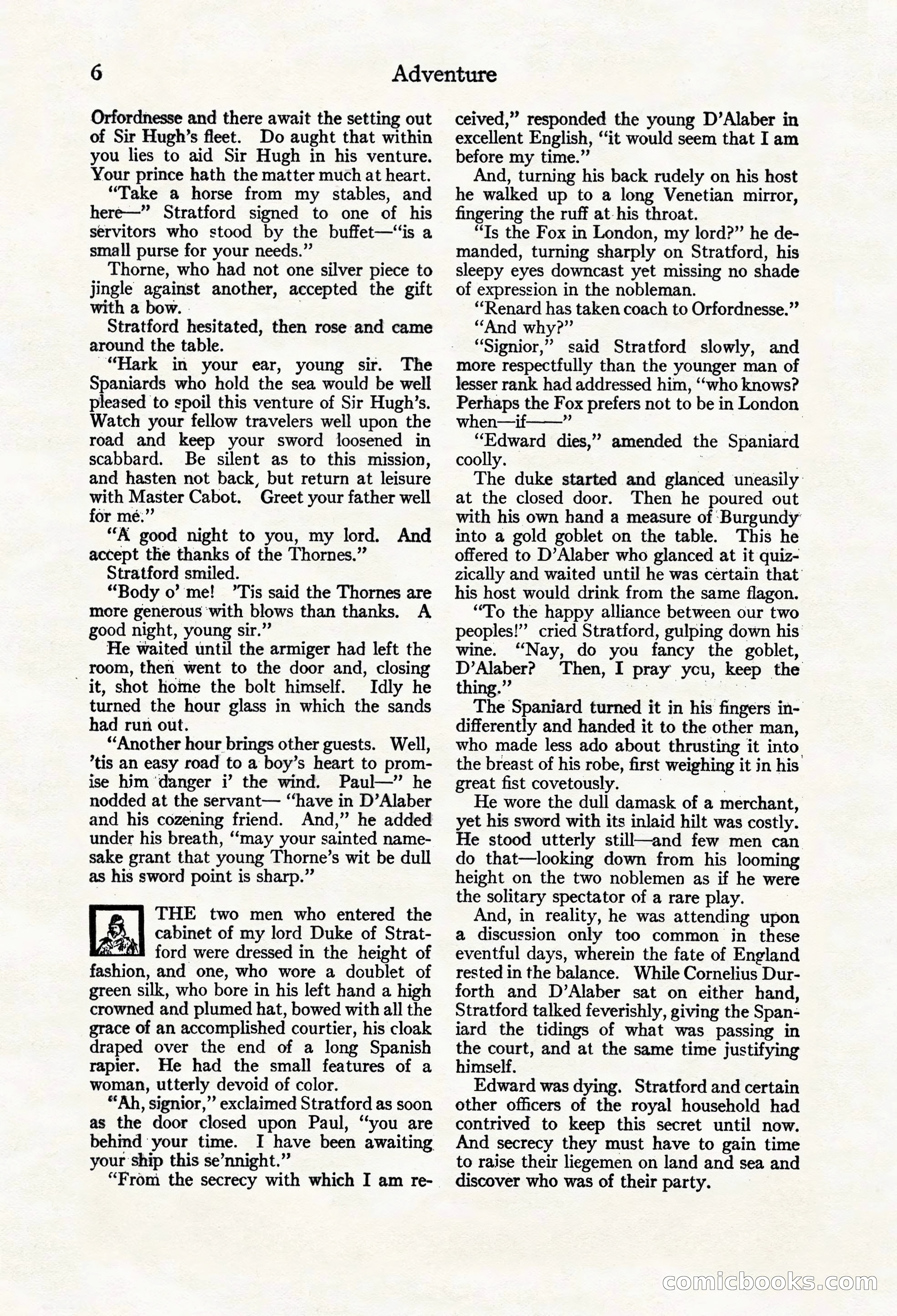
6 Adventure Orfordnesse and there await the setting out of Sir Hugh’s fleet. Do aught that within you lies to aid Sir Hugh in his venture. Your prince hath the matter much at heart. “Take a horse from my stables, and here—” Stratford signed to one of his servitors who stood by the buffet—“‘is a small purse for your needs.” Thorne, who had not one silver piece to jingle against another, accepted the gift with a bow. - Stratford hesitated, then rose and came around the table. “Hark in your ear, young sir. The Spaniards who hold the sea would be well pleased to spoil this venture of Sir Hugh’s. Watch your fellow travelers well upon the road and keep your sword loosened in scabbard. Be silent as to this mission, and hasten not back, but return at leisure with Master Cabot. Greet your father well for mé.” “A good night to you, my lord. And accept the thanks of the Thornes.” Stratford smiled. “Body o’ me! ’Tis said the Thornes are more generous ‘with blows than thanks. A good night, young sir.’ He waited until the armiger had left the room, then went to the door and, closing zit, shot loine the bolt himself. Idly he turned the hour glass in which the sands had run out. ‘‘Another hour brings other guests. Well, ’tis an easy road toa boy’s heart to prom- ise him ‘danger i’ the wind. Paul—” he nodded at the servant— “have in D’Alaber and his cozening friend. And,” he added under his breath, ‘‘may your sainted name- sake grant that young Thorne’s wit be dull as his sword point is sharp.” THE two men who entered the cabinet of my lord Duke of Strat- ford were dressed in the height of fashion and one, who wore a doublet of green silk, who bore in his left hand a high crowned and plumed hat, bowed with all the grace of an accomplished courtier, his cloak draped over the end of a long Spanish rapier. He had the small features of a woman, utterly devoid of color. “Ah, signior,” exclaimed Stratford as soon as the door closed upon Paul, “you are behind your time. your ship this se’nnight.”’ “From the secrecy with which I am re-. I have been awaiting, ceived,” responded the young D’Alaber in excellent English, “it would seem that I am before my time.” And, turning his back rudely on his host he walked up to a long Venetian mirror, fingering the ruff at his throat. “Ts the Fox in London, my lord?” he de- manded, turning sharply on Stratford, his sleepy eyes downcast yet missing no shade of expression in the nobleman. “Renard has taken coach to Orfordnesse.”’ “And why?” “Signior,” said Stratford slowly, and more respectfully than the younger man of lesser rank had addressed him, ‘‘who knows? Perhaps the Fox prefers not to be in London when—if——” “Edward dies,” amended the Spaniard coolly. The duke started and glanced uneasily at the closed door. Then he poured out with his own hand a measure of ‘Burgundy: into a gold goblet on the table. This he offered to D’Alaber who glanced at it quiz- zically and waited until he was certain that his host would drink from the same flagon. “To the happy alliance between our two peoples!” cried Stratford, gulping down his wine. “Nay, do you fancy the goblet, D’Alaber? Then, I pray you, keep the The Spaniard turned it in his fingers in- differently and handed it to the other man, who made less ado about thrusting it into. the breast of his robe, first Weighing it in his great fist covetously. He wore the dull damask of a merchant, yet his sword with its inlaid hilt was costly. He stood utterly stil—and few men can do that—looking down from his looming height on the two noblemen as if he were the solitary spectator of a rare play. And, in reality, he was attending upon a discussion only too common jn these eventful days, wherein the fate of England rested in the balance. While Cornelius Dur- forth and D’Alaber sat on either hand, Stratford talked feverishly, giving the Span- lard the tidings of what was passing in the court, and at the same time justifying himself. Edward was dying. Stratford and certain other officers of the royal household had contrived to keep this secret until now. And secrecy they must have to gain time to raise their liegemen on land and sea and discover who was of their party. CORNICLOO (©