
Pulp Fiction, 1925 · page 29 of 212
Adventure Magazine Cover, March 20, 1925 — page 29: what you’re looking at
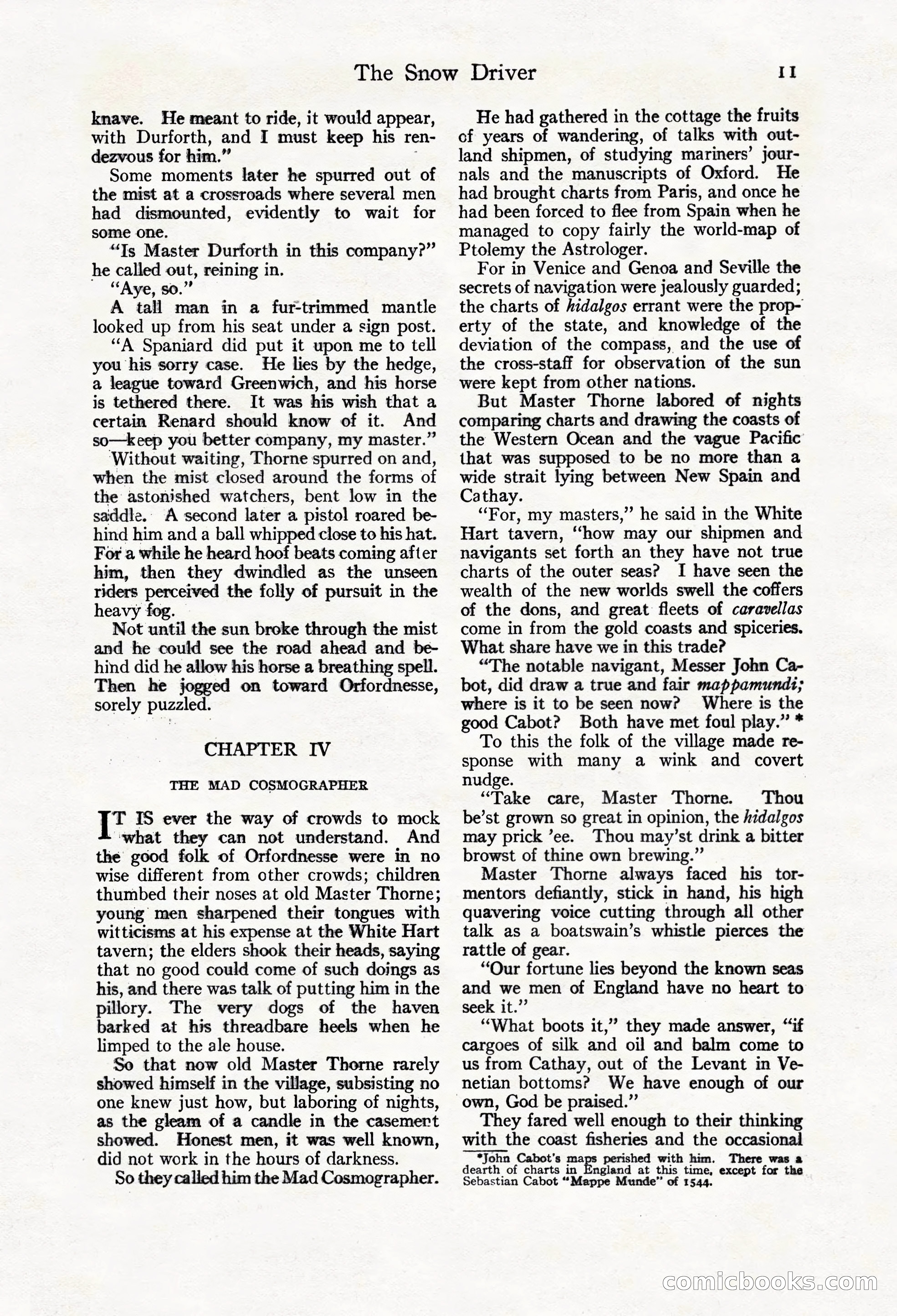
A restored page from Pulp Fiction, 1925. Page through the whole issue in the reader above.
📄 Transcribed text from this page (OCR, searchable)
Machine-transcribed from the original scan — historical spelling and the odd misread are preserved.
The Snow Driver knave. He meant to ride, it would appear, with Durforth, and I must keep his ren- dezvous for him.” Some moments later he spurred out of the mist at a crossroads where several men had dismounted, evidently to wait for some one. “Ts Master Durforth in this company?” he called out, reining in. 66 Aye, so.” A tall man in a fur-trimmed mantle looked up from his seat under a sign post. “A Spaniard did put it upon me to tell you his sorry case. He lies by the hedge, a league toward Greenwich, and his horse is tethered there. It was his wish that a certain Renard should know of it. And so—keep you better company, my master.” Without waiting, Thorne spurred on and, when the mist closed around the forms of the astonished watchers, bent low in the saddle. A second later a pistol roared be- hind him and a ball whipped close to his hat. For a while he heard hoof beats coming after him, then they dwindled as the unseen riders perceived the folly of pursuit in the heavy fog. Not until the sun broke through the mist and he could see the road ahead and be- hind did he allow his horse a breathing spell. Then he jogged on toward Orfordnesse, sorely puzzled. CHAPTER IV THE MAD COSMOGRAPHER iB TS ever the way of crowds to mock ‘what they can not understand. And the good folk of Orfordnesse were in no wise different from other crowds; children thumbed their noses at old Master Thorne; young men sharpened their tongues with witticisms at his expense at the White Hart tavern; the elders shook their heads, saying that no good could come of such doings as his, and there was talk of putting him in the pillory. The very dogs of the haven barked at his threadbare heels when he limped to the ale house. So that now old Master Thorne rarely showed himself in the village, subsisting no one knew just how, but laboring of nights, as the gleam of a candle in the casemert showed. Honest men, it was well known, did not work in the hours of darkness. So they called him the Mad Cosmographer. Il He had gathered in the cottage the fruits of years of wandering, of talks with out- land shipmen, of studying mariners’ jour- nals and the manuscripts of Oxford. He had brought charts from Paris, and once he had been forced to flee from Spain when he managed to copy fairly the world-map of Ptolemy the Astrologer. For in Venice and Genoa and Seville the secrets of navigation were jealously guarded; the charts of hidalgos errant were the prop- erty of the state, and knowledge of the deviation of the compass, and the use of the cross-staff for observation of the sun were kept from other nations. But Master Thorne labored of nights comparing charts and drawing the coasts of the Western Ocean and the vague Pacific that was supposed to be no more than a wide strait lying between New Spain and Cathay. “For, my masters,” he said in the White Hart tavern, ‘how may our shipmen and navigants set forth an they have not true charts of the outer seas? I have seen the wealth of the new worlds swell the coffers of the dons, and great fleets of caravellas come in from the gold coasts and spiceries. What share have we in this trade? “The notable navigant, Messer John Ca- bot, did draw a true and fair mappamundzi; where is it to be seen now? Where is the good Cabot? Both have met foul play.” * To this the folk of the village made re- sponse with many a wink and covert nudge. “Take care, Master Thorne. Thou be’st grown so great in opinion, the hidalgos may prick ’ee. Thou may’st drink a bitter browst of thine own brewing.”’ Master Thorne always faced his tor- mentors defiantly, stick in hand, his high quavering voice cutting through all other talk as a boatswain’s whistle pierces the rattle of gear. “Our fortune lies beyond the known seas and we men of England have no heart to seek it.” “What boots it,” they made answer, “if cargoes of silk and oil and balm come to us from Cathay, out of the Levant in Ve- netian bottoms? We have enough of our own, God be praised.”’ They fared well enough to their thinking with the coast fisheries and the occasional *John Cabot’s maps perished with him. There was a dearth of charts in England at this time, except for the Sebastian Cabot “Mappe Munde” of 1544. CORnNIECLO© (©