
Pulp Fiction, 1925 · page 36 of 212
Adventure Magazine Cover, March 20, 1925 — page 36: what you’re looking at
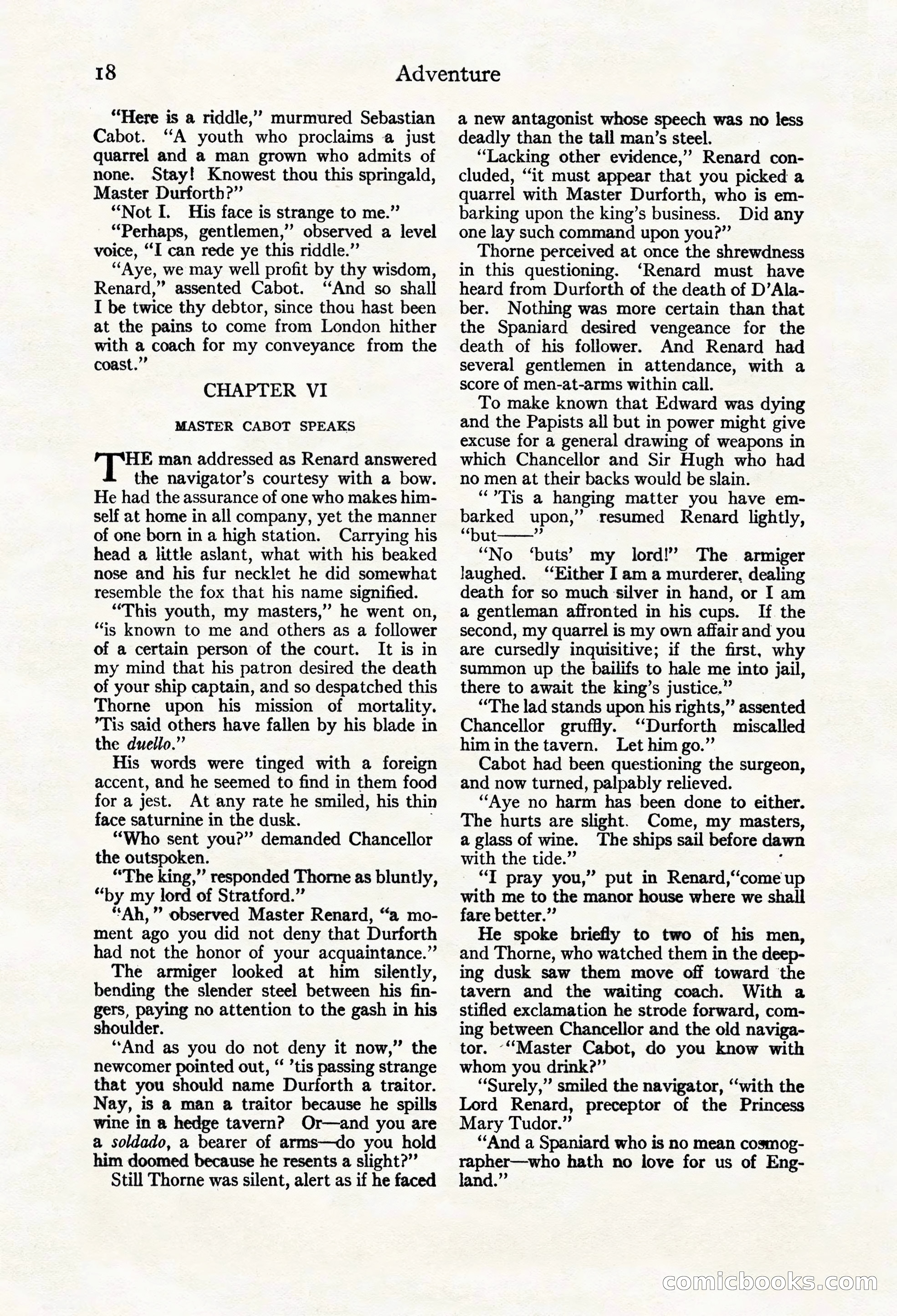
A restored page from Pulp Fiction, 1925. Page through the whole issue in the reader above.
📄 Transcribed text from this page (OCR, searchable)
Machine-transcribed from the original scan — historical spelling and the odd misread are preserved.
18 “Here is a riddle,” murmured Sebastian Cabot. ‘A youth who proclaims a just quarrel and a man grown who admits of none. Stay! Knowest thou this springald, Master Durforth?” “Not I. His face is strange to me.” “Perhaps, gentlemen,” observed a level voice, “I can rede ye this riddle.”’ “Aye, we may well profit by thy wisdom, Renard,” assented Cabot. ‘And so shall I be twice thy debtor, since thou hast been at the pains to come from London hither with a coach for my conveyance from the coast.”’ CHAPTER VI MASTER CABOT SPEAKS HE man addressed as Renard answered the navigator’s courtesy with a bow. He had the assurance of one who makes him- self at home in all company, yet the manner of one born in a high station. Carrying his head a little aslant, what with his beaked nose and his fur necklet he did somewhat resemble the fox that his name signified. “This youth, my masters,” he went on, “is known to me and others as a follower of a certain person of the court. It is in my mind that his patron desired the death of your ship captain, and so despatched this Thorne upon his mission of mortality. Tis said others have fallen by his blade in the duello.”’ His words were tinged with a foreign accent, and he seemed to find in them food for a jest. At any rate he smiled, his thin face saturnine in the dusk. “Who sent you?” demanded Chancellor the outspoken. “The king,” responded Thorne as bluntly, “by my lord of Stratford.” “Ah,” observed Master Renard, “a mo- ment ago you did not deny that Durforth had not the honor of your acquaintance.” The armiger looked at him silently, bending the slender steel between his fin- gers, paying no attention to the gash in his shoulder. ‘And as you do not deny it now,” the newcomer pointed out, “‘ ’tis passing strange that you should name Durforth a traitor. Nay, is a man a traitor because he spills Wine in a hedge tavern? Or—and you are a soldado, a bearer of arms—do you hold him doomed because he resents a slight?”’ Still Thorne was silent, alert as if he faced Adventure a new antagonist whose speech was no less deadly than the tall man’s steel. “‘Lacking other evidence,” Renard con- cluded, “it must appear that you picked a quarrel with Master Durforth, who is em- barking upon the king’s business. Did any one lay such command upon you?” Thorne perceived at once the shrewdness in this questioning. ‘Renard must have heard from Durforth of the death of D’Ala- ber. Nothing was more certain than that the Spaniard desired vengeance for the death of his follower. And Renard had several gentlemen in attendance, with a score of men-at-arms within call. To make known that Edward was dying and the Papists all but in power might give excuse for a general drawing of weapons in which Chancellor and Sir Hugh who had no men at their backs would be slain. “Tis a hanging matter you have em- barked upon,” resumed Renard lightly, “but 9) “No ‘buts’ my lord!” The armiger Jaughed. “Either Iam a murderer, dealing death for so much silver in hand, or I am a gentleman affronted in his cups. If the second, my quarrel is my own affair and you are cursedly inquisitive; if the first, why summon up the bailifs to hale me into jail, there to await the king’s justice.” “‘The lad stands upon his rights,” assented Chancellor gruffy. “Durforth miscalled him in the tavern. Let him go.”’ Cabot had been questioning the surgeon, and now turned, palpably relieved. ‘“‘Aye no harm has been done to either. The hurts are slight. Come, my masters, a glass of wine. The ships sail before dawn with the tide.”’ : “{ pray you,” put in Renard,“come up with me to the manor house where we shall fare better.” He spoke briefly to two of his men, and Thorne, who watched them in the deep- ing dusk saw them move off toward the tavern and the waiting coach. With a stifled exclamation he strode forward, com- ing between Chancellor and the old naviga- tor. “Master Cabot, do you know with whom you drink?” “Surely,” smiled the navigator, “with the Lord Renard, preceptor of the Princess Mary Tudor.” “And a Spaniard who is no mean cosmog- ep erewae hath no love for us of Eng- and.” COnNICLaOe (©