
Pulp Fiction, 1925 · page 39 of 212
Adventure Magazine Cover, March 20, 1925 — page 39: what you’re looking at
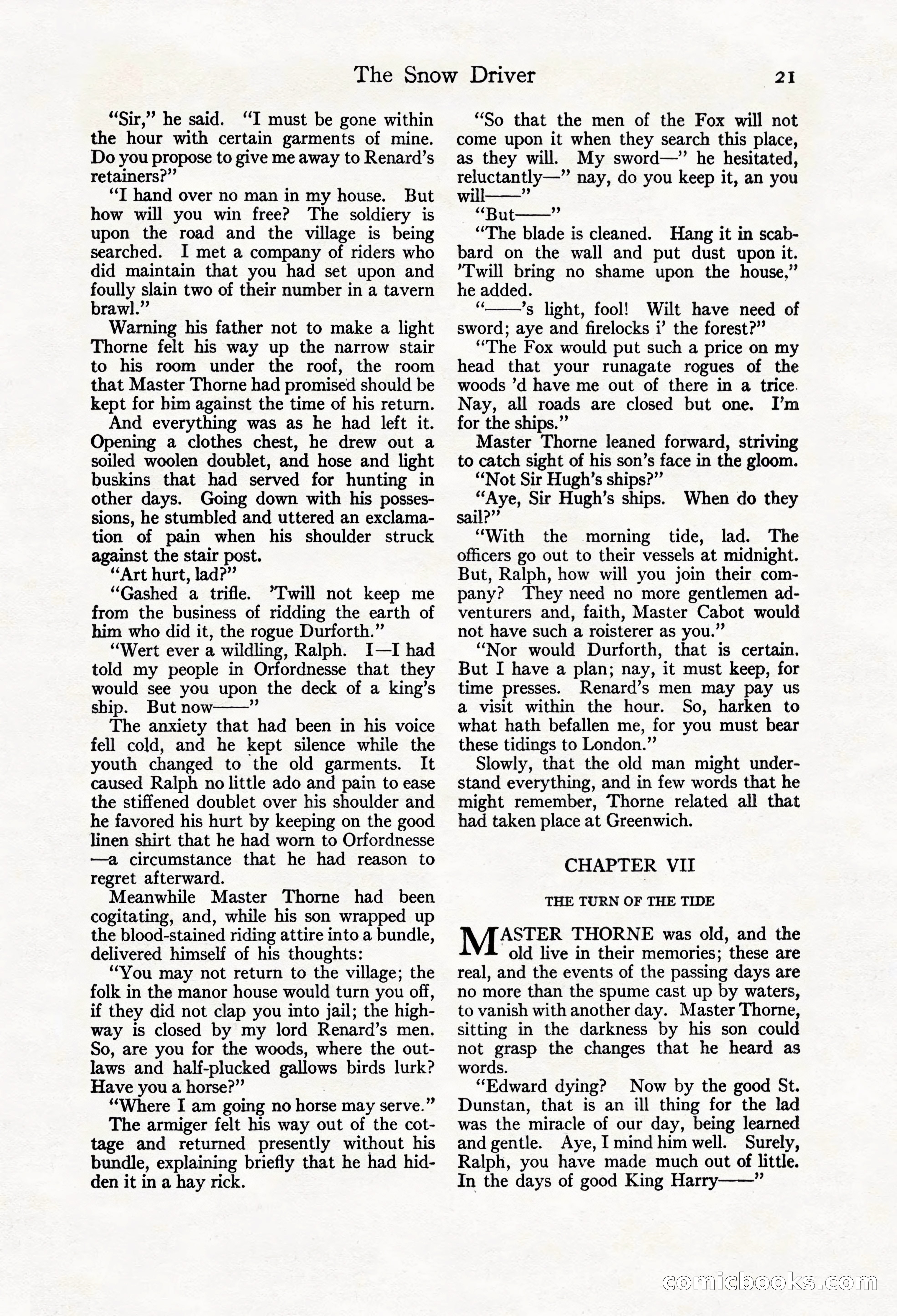
A restored page from Pulp Fiction, 1925. Page through the whole issue in the reader above.
📄 Transcribed text from this page (OCR, searchable)
Machine-transcribed from the original scan — historical spelling and the odd misread are preserved.
The Snow Driver “Sir,” he said. “I must be gone within the hour with certain garments of mine. Do you propose to give me away to Renard’s retainers?” “TI hand over no man in my house. But how will you win free? The soldiery is upon the road and the village is being searched. I met a company of riders who did maintain that you had set upon and foully slain two of their number in a tavern brawl.” Warning his father not to make a light Thorne felt his way up the narrow stair to his room under the roof, the room that Master Thorne had promised should be kept for bim against the time of his return. And everything was as he had left it. Opening a clothes chest, he drew out a soiled woolen doublet, and hose and light buskins that had served for hunting in other days. Going down with his posses- sions, he stumbled and uttered an exclama- tion of pain when his shoulder struck against the stair post. “Art hurt, lad?” “Gashed a trifle. *Twill not keep me from the business of ridding the earth of him who did it, the rogue Durforth.” “Wert ever a wildling, Ralph. I—I had told my people in Orfordnesse that they would see you upon the deck of a king’s ship. But now——’” The anxiety that had been in his voice fell cold, and he kept silence while the youth changed to the old garments. It caused Ralph no little ado and pain to ease the stiffened doublet over his shoulder and he favored his hurt by keeping on the good linen shirt that he had worn to Orfordnesse —a circumstance that he had reason to regret afterward. Meanwhile Master Thorne had been cogitating, and, while his son wrapped up the blood-stained riding attire into a bundle, delivered himself of his thoughts: ‘‘You may not return to the village; the folk in the manor house would turn you off, if they did not clap you into jail; the high- way is closed by my lord Renard’s men. So, are you for the woods, where the out- laws and half-plucked gallows birds lurk? Have you a horse?” “Where I am going no horse may serve.’ The armiger felt his way out of the cot- tage and returned presently without his bundle, explaining briefly that he had hid- den it in a hay rick. 2i “So that the men of the Fox will not come upon it when they search this place, as they will. My sword—” he hesitated, reluctantly—”’ nay, do you keep it, an you will——” “Rut——”’ “The blade is cleaned. Hang it in scab- bard on the wall and put dust upon it. ’Twill bring no shame upon the house,” he added. “slight, fool! Wilt have need of sword; aye and firelocks i’ the forest?” “The Fox would put such a price on my head that your runagate rogues of the woods ’d have me out of there in a trice. Nay, all roads are closed but one. I’m for the ships.” Master Thorne leaned forward, striving to catch sight of his son’s face in the gloom. “Not Sir Hugh’s ships?” ‘Aye, Sir Hugh’s ships. When do they lad. The sail?” “With the morning tide, officers go out to their vessels at midnight. But, Ralph, how will you join their com- pany? They need no more gentlemen ad- venturers and, faith, Master Cabot would not have such a roisterer as you.” “Nor would Durforth, that is certain. But I have a plan; nay, it must keep, for time presses. Renard’s men may pay us a visit within the hour. So, harken to what hath befallen me, for you must bear these tidings to London.” Slowly, that the old man might under- stand everything, and in few words that he might remember, Thorne related all that had taken place at Greenwich. CHAPTER VII THE TURN OF THE TIDE ASTER THORNE was old, and the old live in their memories; these are real, and the events of the passing days are no more than the spume cast up by waters, to vanish with another day. Master Thorne, sitting in the darkness by his son could not grasp the changes that he heard as words. “Edward dying? Now by the good St. Dunstan, that is an ill thing for the lad was the miracle of our day, being learned and gentle. Aye, I mind him well. Surely, Ralph, you have made much out of little. In the days of good King Harry——” COMiicloOoe