
Pulp Fiction, 1925 · page 55 of 212
Adventure Magazine Cover, March 20, 1925 — page 55: what you’re looking at
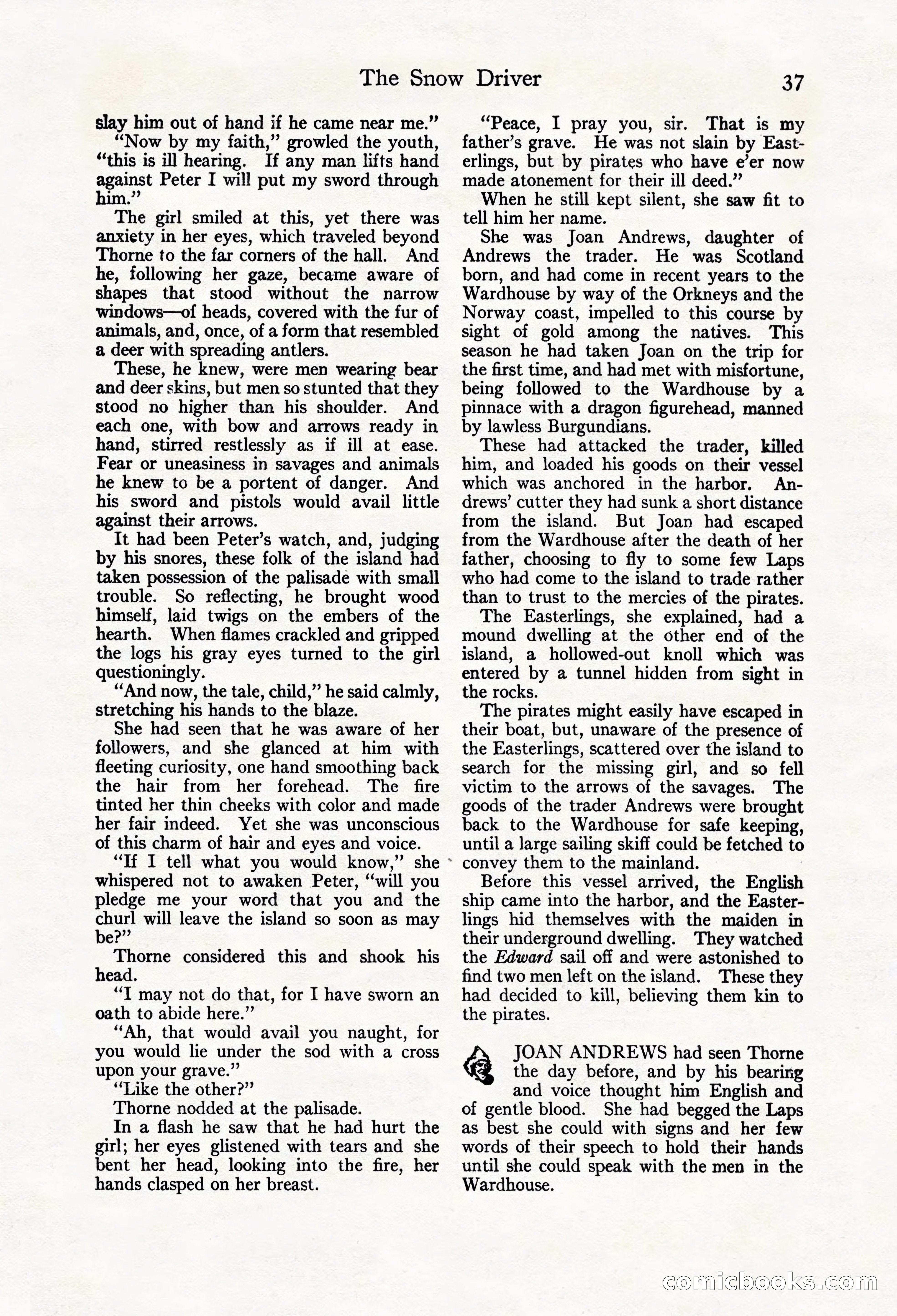
A restored page from Pulp Fiction, 1925. Page through the whole issue in the reader above.
📄 Transcribed text from this page (OCR, searchable)
Machine-transcribed from the original scan — historical spelling and the odd misread are preserved.
The Snow Driver slay him out of hand if he came near me.” “Now by my faith,” growled the youth, “this is ill hearing. If any man lifts hand against Peter I will put my sword through him.?”’ The girl smiled at this, yet there was anxiety in her eyes, which traveled beyond Thorne to the far corners of the hall. And he, following her gaze, became aware of shapes that stood without the narrow windows—of heads, covered with the fur of animals, and, once, of a form that resembled a deer with spreading antlers. These, he knew, were men wearing bear and deer skins, but men so stunted that they stood no higher than his shoulder. And each one, with bow and arrows ready in hand, stirred restlessly as if ill at ease. Fear or uneasiness in savages and animals he knew to be a portent of danger. And his sword and pistols would avail little against their arrows. It had been Peter’s watch, and, judging by his snores, these folk of the island had taken possession of the palisade with small trouble. So reflecting, he brought wood himself, laid twigs on the embers of the hearth. When flames crackled and gripped the logs his gray eyes turned to the girl questioningly. “And now, the tale, child,” he said calmly, stretching his hands to the blaze. She had seen that he was aware of her followers, and she glanced at him with fleeting curiosity, one hand smoothing back the hair from her forehead. The fire tinted her thin cheeks with color and made her fair indeed. Yet she was unconscious of this charm of hair and eyes and voice. “Tf I tell what you would know,” whispered not to awaken Peter, “‘will you pledge me your word that you and the churl will leave the island so soon as may be?” Thorne considered this and shook his head. “TI may not do that, for I have sworn an oath to abide here.” “Ah, that would avail you naught, for you would lie under the sod with a cross upon your grave.” “Like the other?” Thorne nodded at the palisade. In a flash he saw that he had hurt the girl; her eyes glistened with tears and she bent her head, looking into the fire, her hands clasped on her breast. she ° 37 “Peace, I pray you, sir. That is my father’s grave. He was not slain by East- erlings, but by pirates who have e’er now made atonement for their ill deed.” When he still kept silent, she saw fit to tell him her name. She was Joan Andrews, daughter of Andrews the trader. He was Scotland born, and had come in recent years to the Wardhouse by way of the Orkneys and the Norway coast, impelled to this course by sight of gold among the natives. This season he had taken Joan on the trip for the first time, and had met with misfortune, being followed to the Wardhouse by a pinnace with a dragon figurehead, manned by lawless Burgundians. These had attacked the trader, killed him, and loaded his goods on their vessel which was anchored in the harbor. An- drews’ cutter they had sunk a short distance from the island. But Joan had escaped from the Wardhouse after the death of her father, choosing to fly to some few Laps who had come to the island to trade rather than to trust to the mercies of the pirates. The Easterlings, she explained, had a mound dwelling at the other end of the island, a hollowed-out knoll which was entered by a tunnel hidden from sight in the rocks. The pirates might easily have escaped in their boat, but, unaware of the presence of the Easterlings, scattered over the island to search for the missing girl, and so fell victim to the arrows of the savages. The goods of the trader Andrews were brought back to the Wardhouse for safe keeping, until a large sailing skiff could be fetched to convey them to the mainland. Before this vessel arrived, the English ship came into the harbor, and the Easter- lings hid themselves with the maiden in their underground dwelling. They watched the Edward sail off and were astonished to find two men left on the island. These they had decided to kill, believing them kin to the pirates. JOAN ANDREWS had seen Thorne the day before, and by his bearing and voice thought him English and of gentle blood. She had begged the Laps as best she could with signs and her few words of their speech to hold their hands until she could speak with the men in the Wardhouse. COMmMiicloooe