
Pulp Fiction, 1925 · page 68 of 212
Adventure Magazine Cover, March 20, 1925 — page 68: what you’re looking at
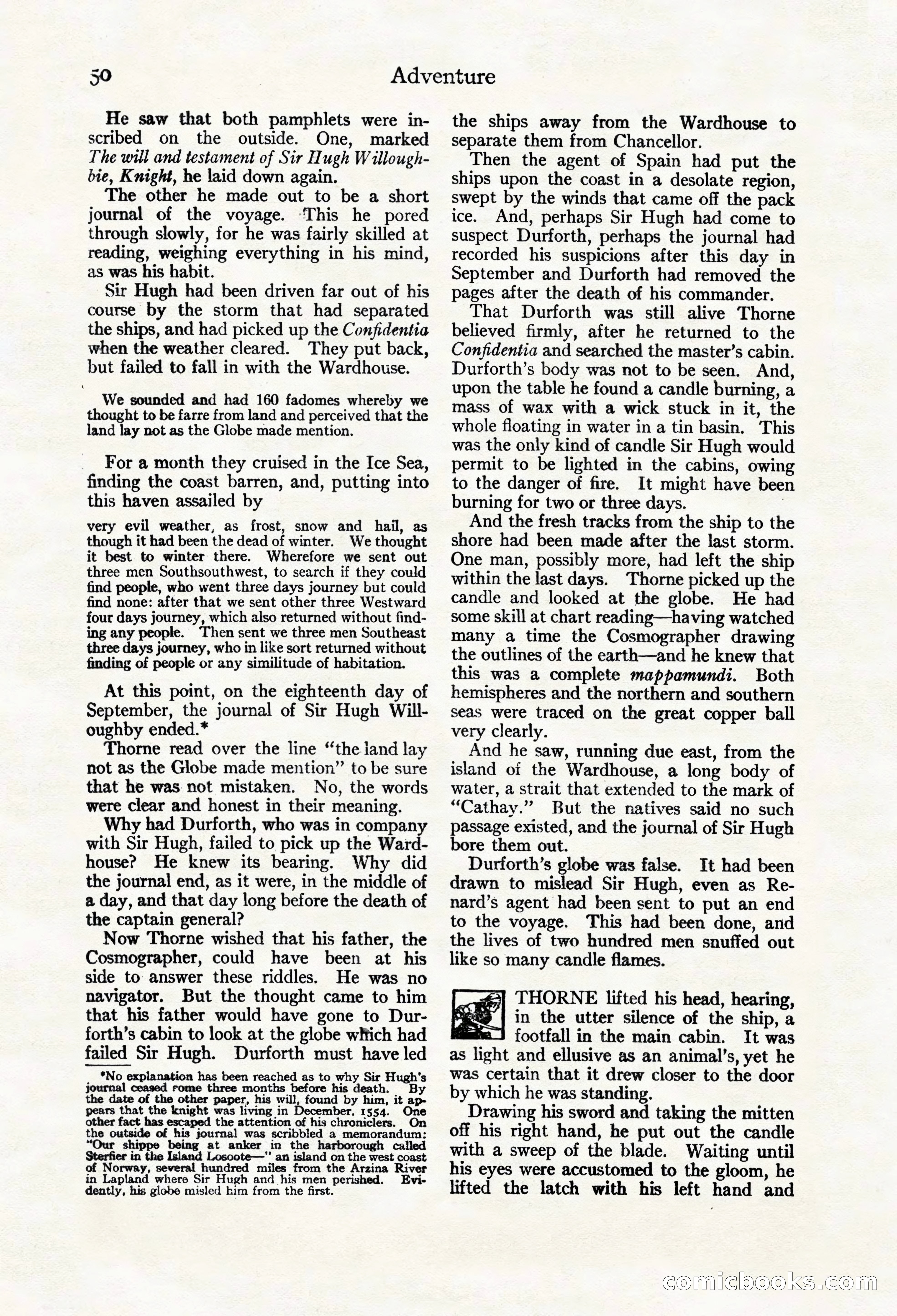
A restored page from Pulp Fiction, 1925. Page through the whole issue in the reader above.
📄 Transcribed text from this page (OCR, searchable)
Machine-transcribed from the original scan — historical spelling and the odd misread are preserved.
50 He saw that both pamphlets were in- scribed on the outside. One, marked The will and testament of Sir Hugh Willough- bie, Knight, he laid down again. The other he made out to be a short journal of the voyage. ‘This he pored through slowly, for he was fairly skilled at reading, weighing everything in his mind, as was his habit. Sir Hugh had been driven far out of his course by the storm that had separated the ships, and had picked up the Confidentia when the weather cleared. They put back, but failed to fall in with the Wardhouse. We sounded and had 160 fadomes whereby we thought to be farre from land and perceived that the land lay not as the Globe made mention. For a month they cruised in the Ice Sea, finding the coast barren, and, putting into this haven assailed by very evil weather, as frost, snow and hail, as though it had been the dead of winter. We thought it best to winter there. Wherefore we sent out three men Southsouthwest, to search if they could find people, who went three days journey but could find none: after that we sent other three Westward four days journey, which also returned without find- ing any people. Then sent we three men Southeast three days journey, who in like sort returned without finding of people or any similitude of habitation. At this point, on the eighteenth day of September, the journal of Sir Hugh Will- oughby ended.* Thorne read over the line “the land lay not as the Globe made mention” to be sure that he was. not mistaken. No, the words were clear and honest in their meaning. Why had Durforth, who was in company with Sir Hugh, failed to pick up the Ward- house? He knew its bearing. Why did the journal end, as it were, in the middle of a day, and that day long before the death of the captain general? Now Thorne wished that his father, the Cosmographer, could have been at his side to answer these riddles. He was no navigator. But the thought came to him that his father would have gone to Dur- forth’s cabin to look at the globe wHich had failed Sir Hugh. Durforth must have led *No explanation has been reached as to why Sir Hugh’s journal ceased rome three months before his death. By the date of the other paper, his will, found by him, it ap- pears that the knight was living in December, 1554. One other fact has escaped the attention of his chroniclers. On the outside of his journal was scribbled a memorandum: “Our shippe being at anker in the harborough called Sterfier in the Island Losoote—"' an island on the west coast of Norway, several hundred miles from the Arzina River in Lapland where Sir Hugh and his men pe Evi- dently, his globe misled kim from the first. Adventure the ships away from the Wardhouse to separate them from Chancellor. Then the agent of Spain had put the ships upon the coast in a desolate region, swept by the winds that came off the pack ice. And, perhaps Sir Hugh had come to suspect Durforth, perhaps the journal had recorded his suspicions after this day in September and Durforth had removed the pages after the death of his commander. That Durforth was still alive Thorne believed firmly, after he returned to the Confidentia and searched the master’s cabin. Durforth’s body was not to be seen. And, upon the table he found a candle burning, a mass of wax with a wick stuck in it, the whole floating in water in a tin basin. This was the only kind of candle Sir Hugh would permit to be lighted in the cabins, owing to the danger of fire. It might have been burning for two or three days. 3 And the fresh tracks from the ship to the shore had been made after the last storm. One man, possibly more, had left the ship within the last days. Thorne picked up the candle and looked at the globe. He had some skill at chart reading—having watched many a time the Cosmographer drawing the outlines of the earth—and he knew that this was a complete mappamundi. Both hemispheres and the northern and southern seas were traced on the great copper ball very clearly. And he saw, running due east, from the island of the Wardhouse, a long body of water, a strait that extended to the mark of “Cathay.” But the natives said no such passage existed, and the journal of Sir Hugh bore them out. Durforth’s globe was false. It had been drawn to mislead Sir Hugh, even as Re- nard’s agent had been sent to put an end to the voyage. This had been done, and the lives of two hundred men snuffed out like so many candle flames. THORNE lifted his head, hearing, in the utter silence of the ship, a footfall in the main cabin. It was as light and ellusive as an animal’s, yet he was certain that it drew closer to the door by which he was standing. Drawing his sword and taking the mitten off his right hand, he put out the candle with a sweep of the blade. Waiting until his eyes were accustomed to the gloom, he lifted the latch with his left hand and Ghook (©