
Pulp Fiction, 1925 · page 81 of 212
Adventure Magazine Cover, March 20, 1925 — page 81: what you’re looking at
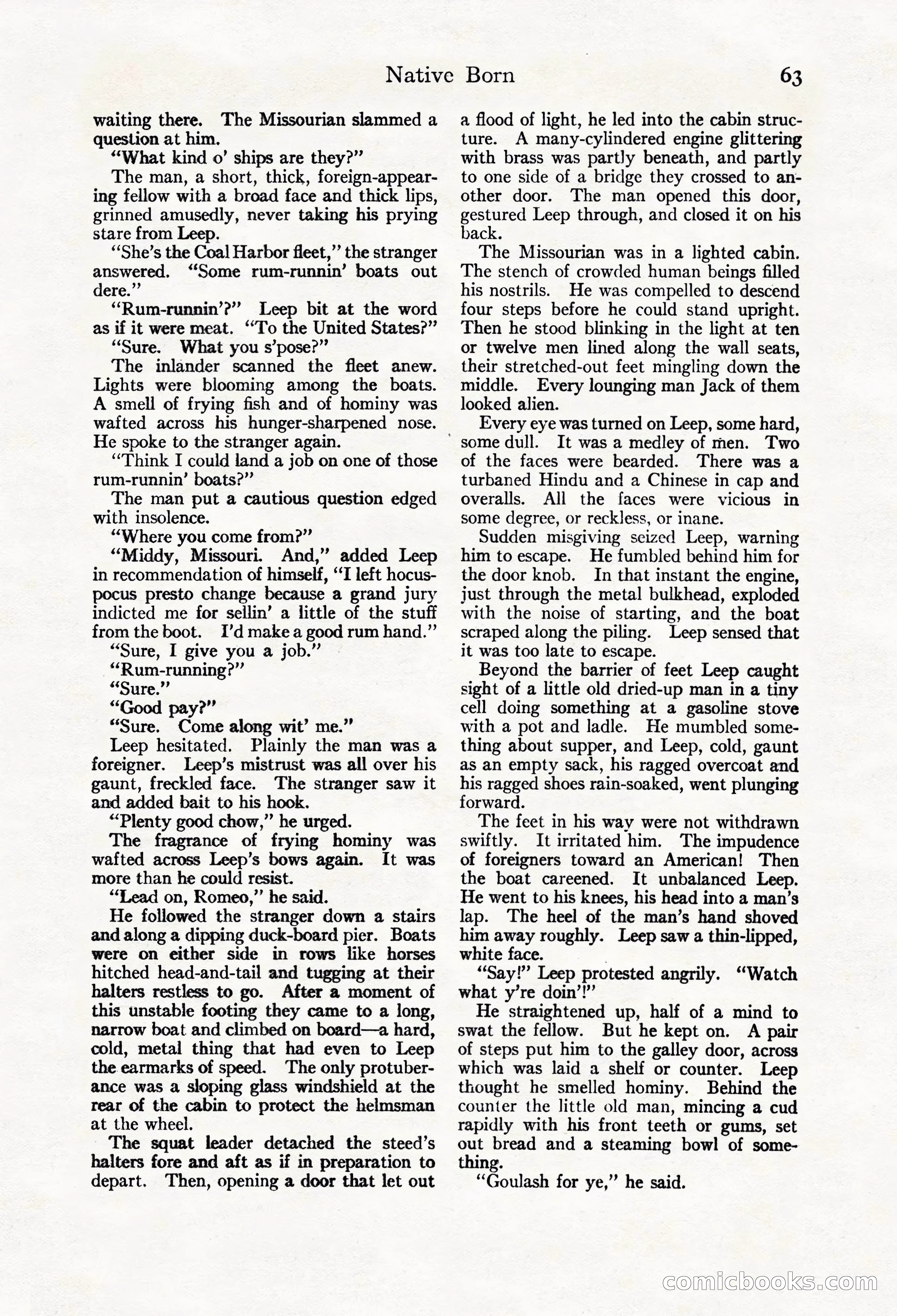
A restored page from Pulp Fiction, 1925. Page through the whole issue in the reader above.
📄 Transcribed text from this page (OCR, searchable)
Machine-transcribed from the original scan — historical spelling and the odd misread are preserved.
Native Born waiting there. The Missourian slammed a question at him. “What kind o’ ships are they?” The man, a short, thick, foreign-appear- ing fellow with a broad face and thick lips, grinned amusedly, never taking his prying stare from Leep. “‘She’s the Coal Harbor fleet,” the stranger answered. “Some rum-runnin’ boats out dere.” ‘‘Rum-runnin’?” Leep bit at the word as if it were meat. ““To the United States?” “Sure. What you s’pose?”’ The inlander scanned the fleet anew. Lights were blooming among the boats. A smell of frying fish and of hominy was wafted across his hunger-sharpened nose. He spoke to the stranger again. “Think I could land a job on one of those rum-runnin’ boats?” The man put a cautious question edged with insolence. “Where you come from?” ““Middy, Missouri. And,” added Leep in recommendation of himself, ‘‘I left hocus- pocus presto change because a grand jury indicted me for sellin’ a little of the stuff from the boot. I’d make a good rum hand.” “Sure, I give you a job.” “Rum-running?” “Sure.” “Sure. Come along wit’ me.” Leep hesitated. Plainly the man was a foreigner. Leep’s mistrust was all over his gaunt, freckled face. The stranger saw it and added bait to his hook. “Plenty good chow,” he urged. The fragrance of frying hominy was wafted across Leep’s bows again. It was more than he could resist. “Lead on, Romeo,”’ he said. He followed the stranger down a stairs and along a dipping duck-board pier. Boats were on either side in rows like horses hitched head-and-tail and tugging at their halters restless to go. After a moment of this unstable footing they came to a long, narrow boat and climbed on board—a hard, cold, metal thing that had even to Leep the earmarks of speed. The only protuber- ance was a sloping glass windshield at the rear of the cabin to protect the helmsman at the wheel. The squat leader detached the steed’s halters fore and aft as if in preparation to depart. Then, opening a door that let out ’ some dull. 63 a flood of light, he led into the cabin struc- ture. A many-cylindered engine glittering with brass was partly beneath, and partly to one side of a bridge they crossed to an- other door. The man opened this door, gestured Leep through, and closed it on his back. The Missourian was in a lighted cabin. The stench of crowded human beings filled his nostrils. He was compelled to descend four steps before he could stand upright. Then he stood blinking in the light at ten or twelve men lined along the wall seats, their stretched-out feet mingling down the middle. Every lounging man Jack of them looked alien. Every eye was turned on Leep, some hard, It was a medley of men. Two of the faces were bearded. There was a turbaned Hindu and a Chinese in cap and overalls. All the faces were vicious in some degree, or reckless, or inane. Sudden misgiving seized Leep, warning him to escape. He fumbled behind him for the door knob. In that instant the engine, just through the metal bulkhead, exploded with the noise of starting, and the boat scraped along the piling. Leep sensed that it was too late to escape. Beyond the barrier of feet Leep caught sight of a little old dried-up man in a tiny cell doing something at a gasoline stove with a pot and ladle. He mumbled some- thing about supper, and Leep, cold, gaunt as an empty sack, his ragged overcoat and his ragged shoes rain-soaked, went plunging forward. The feet in his way were not withdrawn swiftly. It irritated him. The impudence of foreigners toward an American! Then the boat careened. It unbalanced Leep. He went to his knees, his head into a man’s lap. The heel of the man’s hand shoved him away roughly. Leep saw a thin-lipped, white face. | “Say!” Leep protested angrily. “Watch what y’re doin’!”’ He straightened up, half of a mind to swat the fellow. But he kept on. A pair of steps put him to the galley door, across which was laid a shelf or counter. Leep thought he smelled hominy. Behind the counter the little old man, mincing a cud rapidly with his front teeth or gums, set out bread and a steaming bowl of some- thing. “Goulash for ye,” he said. GOmiGcdoo ©