
Pulp Fiction, 1925 · page 91 of 212
Adventure Magazine Cover, March 20, 1925 — page 91: what you’re looking at
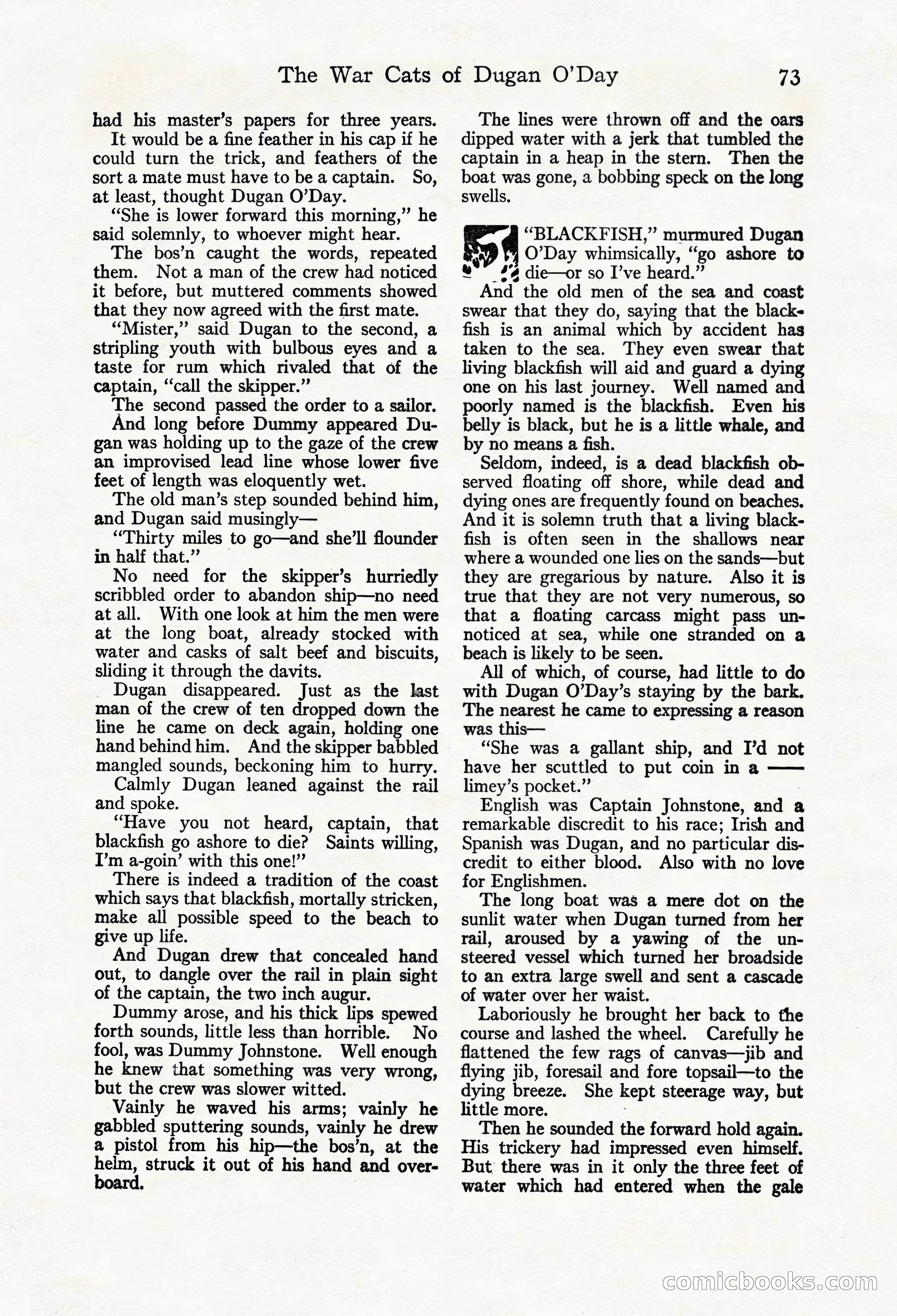
A restored page from Pulp Fiction, 1925. Page through the whole issue in the reader above.
📄 Transcribed text from this page (OCR, searchable)
Machine-transcribed from the original scan — historical spelling and the odd misread are preserved.
The War Cats of Dugan O’Day had his master’s papers for three years. It would be a fine feather in his cap if he could turn the trick, and feathers of the sort a mate must have to bea captain. So, at least, thought Dugan O’Day. “She is lower forward this morning,” he said solemnly, to whoever might hear. The bos’n caught the words, repeated them. Not a man of the crew had noticed it before, but muttered comments showed that they now agreed with the first mate. “Mister,” said Dugan to the second, a stripling youth with bulbous eyes and a taste for rum which rivaled that of the captain, “‘call the skipper.” The second passed the order to a sailor. And long before Dummy appeared Du- gan was holding up to the gaze of the crew an improvised lead line whose lower five feet of length was eloquently wet. The old man’s step sounded behind him, and Dugan said musingly— “Thirty miles to go—and she’ll flounder in half that.” No need for the skipper’s hurriedly scribbled order to abandon ship—no need at all. With one look at him the men were at the long boat, already stocked with water and casks of salt beef and biscuits, sliding it through the davits. Dugan disappeared. Just as the last man of the crew of ten dropped down the line he came on deck again, holding one hand behindhim. And the skipper babbled mangled sounds, beckoning him to hurry. Calmly Dugan leaned against the rail and spoke. “Have you not heard, captain, that blackfish go ashore to die? Saints willing, I’m a-goin’ with this one!” There is indeed a tradition of the coast which says that blackfish, mortally stricken, make all possible speed to the beach to give up life. And Dugan drew that concealed hand out, to dangle over the rail in plain sight of the captain, the two inch augur. Dummy arose, and his thick lips spewed forth sounds, little less than horrible. No fool, was Dummy Johnstone. Well enough he knew that something was very wrong, but the crew was slower witted. Vainly he waved his arms; vainly he gabbled sputtering sounds, vainly he drew a pistol from his hip—the bos’n, at the ee struck it out of his hand and over- 73 The lines were thrown off and the oars dipped water with a jerk that tumbled the captain in a heap in the stern. Then the boat was gone, a bobbing speck on the long swells. “BLACKFISH,” murmured Dugan vy v4 O'Day whimsically, “go ashore to &"" 44 die—or so I’ve heard.” And the old men of the sea and coast swear that they do, saying that the black- fish is an animal which by accident has taken to the sea. They even swear that living blackfish will aid and guard a dying one on his last journey. Well named and poorly named is the blackfish. Even his belly is black, but he is a little whale, and by no means a fish. Seldom, indeed, is a dead blackfish ob- served floating off shore, while dead and dying ones are frequently found on beaches. And it is solemn truth that a living black- fish is often seen in the shallows near where a wounded one lies on the sands—but they are gregarious by nature. Also it is true that they are not very numerous, so that a floating carcass might pass un- noticed at sea, while one stranded on a beach is likely to be seen. All of which, of course, had little to do with Dugan O’Day’s staying by the bark. The nearest he came to expressing a reason was this— “She was a gallant ship, and I’d not have her scuttled to put coin in a —— limey’s pocket.” : English was Captain Johnstone, and a remarkable discredit to his race; Irish and Spanish was Dugan, and no particular dis- credit to either blood. Also with no love for Englishmen. The long boat was a mere dot on the sunlit water when Dugan turned from her rail, aroused by a yawing of the un- steered vessel which turned her broadside to an extra large swell and sent a cascade of water over her waist. Laboriously he brought her back to the course and lashed the wheel. Carefully he flattened the few rags of canvas—jib and flying jib, foresail and fore topsail—to the dying breeze. She kept steerage way, but little more. ; Then he sounded the forward hold again. His trickery had impressed even himself. But there was in it only the three feet of water which had entered when the gale GoOmiiGooo S (©