
Pulp Fiction, 1925 · page 11 of 196
Adventure Magazine Cover — page 11: what you’re looking at
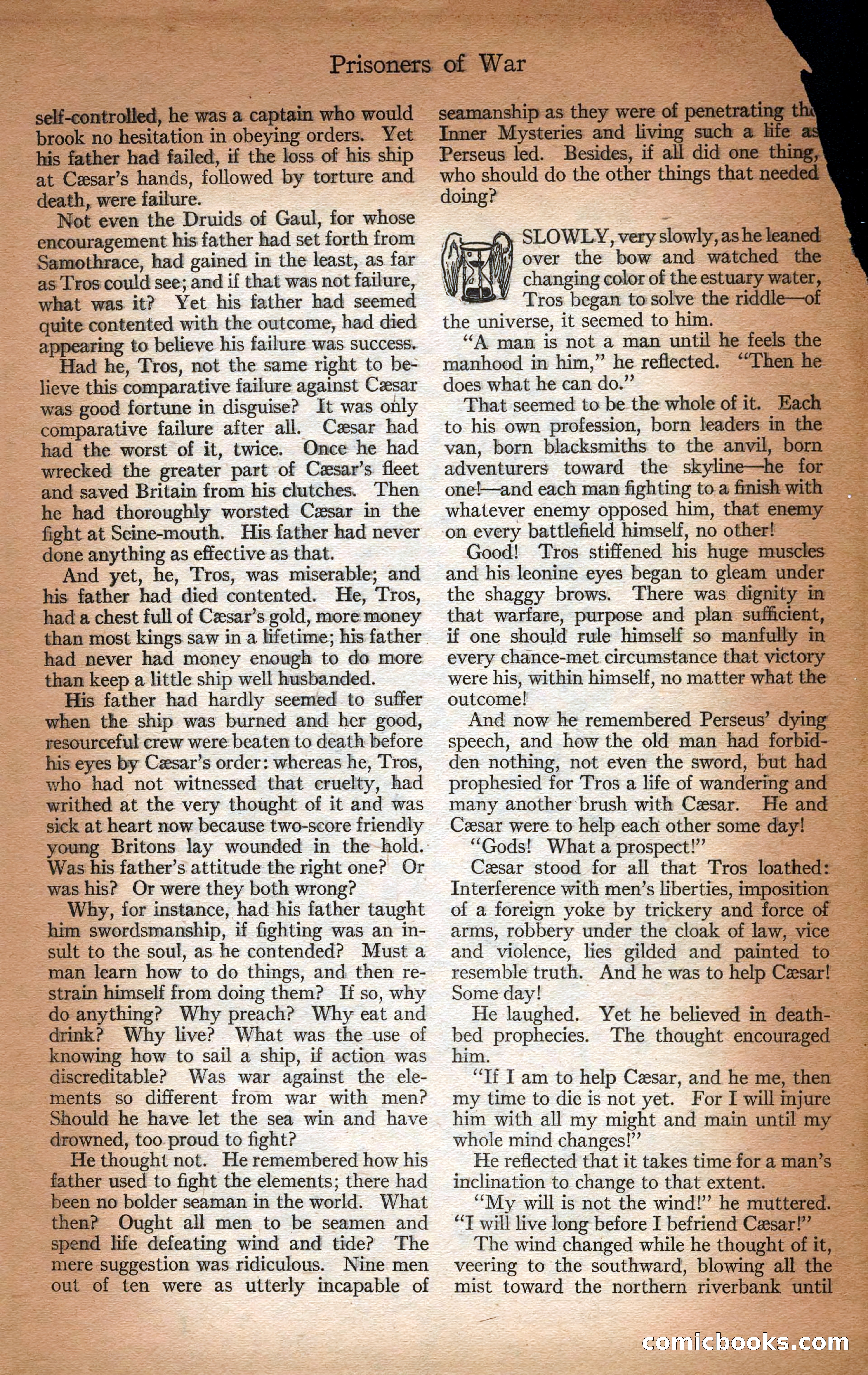
A restored page from Pulp Fiction, 1925. Page through the whole issue in the reader above.
📄 Transcribed text from this page (OCR, searchable)
Machine-transcribed from the original scan — historical spelling and the odd misread are preserved.
Prisoners of War self-controlled, he was a captain who would brook no hesitation in obeying orders. Yet his father had failed, if the loss of his ship at Ceesar’s hands, followed by torture and death, were failure. Not even the Druids of Gaul, for whose encouragement his father had set forth from Samothrace, had gained in the least, as far as Tros could see; and if that was not failure, what was it? Yet his father had seemed quite contented with the outcome, had died appearing to believe his failure was success. Had he, Tros, not the same right to be- lieve this comparative failure against Cesar was good fortune in disguise? It was only comparative failure after all. Cesar had had the worst of it, twice. Once he had wrecked the greater part of Czsar’s fleet and saved Britain from his clutches. Then he had thoroughly worsted Czsar in the fight at Seine-mouth. His father had never done anything as effective as that. And yet, he, Tros, was miserable; and his father had died contented. He, Tros, had a chest full of Ceesar’s gold, more money than most kings saw in a lifetime; his father. had never had money enough to do more than keep a little ship well husbanded. His father had hardly seemed to suffer when the ship was burned and her good, resourceful crew were beaten to death before his eyes by Ceesar’s order: whereas he, Tros, who had not witnessed that cruelty, had writhed at the very thought of it and was sick at heart now because two-score friendly young Britons lay wounded in the-hold. Was his father’s attitude the right one? Or was his? Or were they both wrong? Why, for instance, had his father taught him swordsmanship, if fighting was an in- sult to the soul, as he contended? Must a man learn how to do things, and then re- strain himself from doing them? If so, why do anything? Why preach? Why eat and drink? Why live? What was the use of knowing how to sail a ship, if action was discreditable? Was war against the ele- ments so different from war with men? Should he have let the sea win and have drowned, too-proud to fight? He thought not. He remembered how his father used to fight the elements; there had been no bolder seaman in the world. What thenP Ought all men to be seamen and spend life defeating wind and tide? The mere suggestion was ridiculous. Nine men out of ten were as utterly incapable of seamanship as they were of penetrating | Inner Mysteries and living such a lite Perseus led. Besides, if all did one thing, who should do the other things that needed doing? ~__¢) SLOWLY, very slowly, as he leaned ‘eet iit over the bow and watched the 'i@iNW changing color of the estuary water, =~ Tros began to solve the riddle—of the universe, it seemed to him. “A man is not a man until he feels the manhood in him,” he reflected. “Then he does what he can do.” That seemed to be the whole of it. Each to his own profession, born leaders in the van, born blacksmiths to the anvil, born adventurers toward the skyline—he for one!—and each man fighting to a finish with whatever enemy opposed him, that enemy on every battlefield himself, no other! Good! ‘Tros stiffened his huge muscles and his leonine eyes began to gleam under the shaggy brows. There was dignity in that warfare, purpose and plan. sufficient, if one should rule himself so manfully in every chance-met circumstance that victory were his, within himself, no matter what the outcome! And now he remembered Perseus’ dying speech, and how the old man had forbid- den nothing, not even the sword, but had prophesied for Tros a life of wandering and many another brush with Cesar. He and Cesar were to help each other some day! “Gods! What a prospect!” Cesar stood for all that Tros loathed: Interference with men’s liberties, imposition of a foreign yoke by trickery and force of arms, robbery under the cloak of law, vice and violence, lies gilded and paimted to resemble truth. And he was to help Cassar! Some day! He laughed. Yet he believed in death- = prophecies. The thought encouraged im. “Tf I am to help Cesar, and he me, then my time to die is not yet. For I will mjure him with all my might and main until my whole mind changes!”’ He reflected that it takes time for 4 man’s inclination to change to that extent. “My will is not the wind!” he muttered. “T will live long before I befriend Cesar!” The wind changed while he thought of it, veering to the southward, blowing all the mist toward the northern riverbank until ~~ Eomicbooks.com